

Part of President-elect Donald Trump’s plan to make America great again appears to involve making America bigger, too. Citing security and economic need, Trump has proposed a vast new expansion of U.S. territory, with the Panama Canal, Greenland and Canada in his sights.
Is this Trump’s second go at America’s 19th-century Manifest Destiny movement?
While critics quickly called Trump’s comments crazy, many national security experts, including me, totally disagree. All three of Trump’s targets have plausible reasons to justify them or explain his thinking and strategic goals.
These statements could signal a U.S. shift under Trump, away from a neoliberal international order into a more robustly assertive foreign policy akin to America’s vast expansion in the late 1800s and early 20th century.
Among his remarks, Trump has raised the prospect of acquiring Greenland—essential for U.S. security in the Arctic—from Denmark, which has dismissed the idea but is facing a growing independence movement on the autonomous Danish dependent territory with self-government and its own parliament.
Trump even said he wouldn’t rule out using military force to annex Greenland.
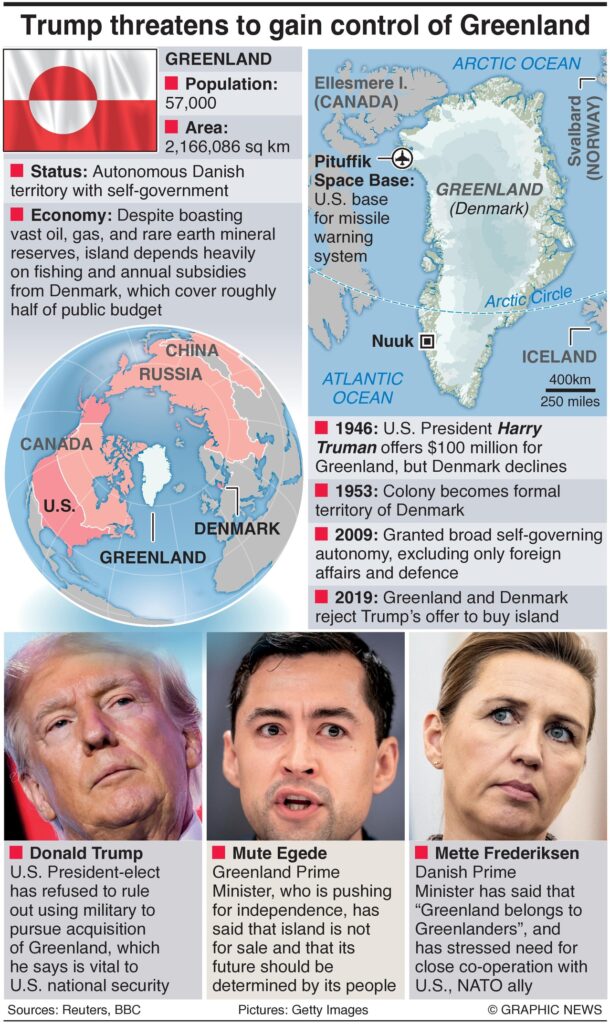
That last comment raised hackles but was pretty silly. The massive, mostly snow and ice-covered, island mass (the largest island in the world) is sparsely populated with only about 57,000 Greenlanders. And the U.S. already has troops and military bases there.
Not to mention that Denmark is a close U.S. ally and a member of NATO.
Because it straddles the Arctic circle between the U.S., Russia and Europe, Greenland is a geopolitical prize that the U.S. and others have eyed for more than 150 years. It’s even more valuable as the Arctic melts and opens up more to shipping and trade.
China has made the Arctic a top priority, calling itself a near Arctic power.
Despite boasting vast oil, gas and rare earth mineral reserves, the island depends heavily on fishing and annual subsidies from Denmark, which cover roughly half of its public budget.
While many Greenlanders may not want to be officially part of the United States, they have openly stated their willingness and desire to become more closely associated with America.
That would include allowing a much larger U.S. military presence and increased mineral and mining rights. By simply making his interest in Greenland known, Trump has already sparked moves in that direction and has prodded Denmark to invest more in Greenland’s defense.
Expect even closer military and economic ties between the U.S. and Greenland under Trump’s second term.
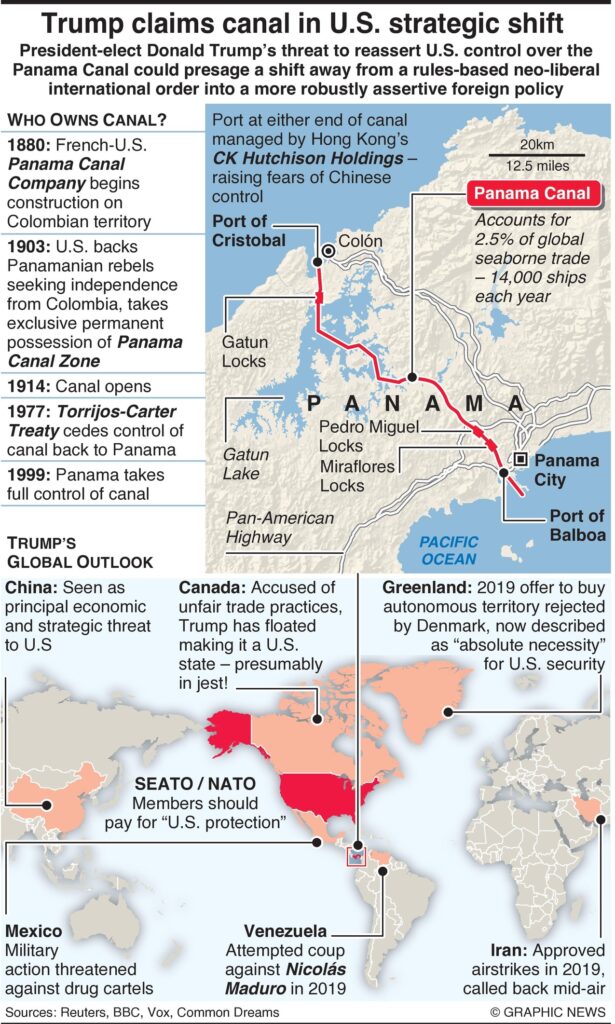
Trump has also threatened to retake the Panama Canal Zone—a critical route for American businesses—which was a part of Colombia until a U.S.-backed movement won independence for what is now Panama in 1904.
The U.S.-built canal opened in 1914 and is critical to U.S. imports and exports, handling about 2.5% of global maritime trade. The canal and the surrounding canal zone was considered American territory and the canal was run by the U.S. for much of the 20th century.
Panama only gained control 25 years ago, in 1999, 20 years after being “given away” by former President Jimmy Carter via a 1979 treaty with the country’s tin-pot strongman at the time, Omar Trujillo.
The giveaway was something Carter’s successor Ronald Reagan had criticized strenuously, famously saying earlier: “We built it. We bought it. It’s ours.” Reagan ultimately accepted the deal.
Fast forward to now, and Trump has accused Panama of charging exorbitant rates to use the passage and warned against Chinese control over the canal, saying he would not let it fall into “the wrong hands.”
Ports at both ends of the canal are managed by a subsidiary of Hong-Kong-based CK Hutchison Holdings and fears have been raised that in the event of a conflict with Beijing, access to U.S. military and civilian shipping could be restricted.
Let’s see what happens next, and what concessions, benefits or changes Trump gets in this strategic waterway in America’s backyard.
And then there’s Canada, our soft and weak northern neighbor with a population the size of California that can barely defend itself, much less the Arctic. Canada’s entire national identity is based on “not being the U.S.,” which isn’t much to base itself on.
Trump has also suggested resource-rich Canada should become the 51st state of the U.S., referring to the prime minister as governor. This is likely not serious, and I wouldn’t want to necessarily absorb 41 million mostly welfare-loving socialists.
Still, there might be some concessions or discussions to be had here as well. Canada is too critical to American national security to ignore.
But what exactly was the original Manifest Destiny that Trump seems to want revived?
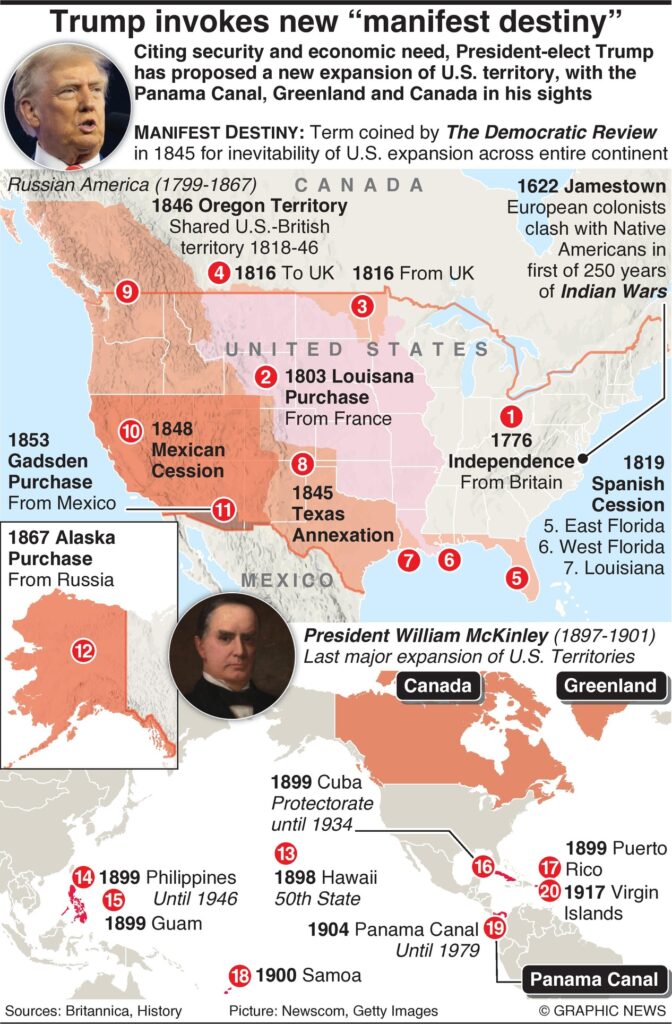
From the first clashes with Native Americans at the British settlement in Jamestown—and 250 further years of Indian Wars—the growth of the U.S. has had an inevitability, expressed in The Democratic Review in 1845 as “Manifest Destiny”—sometimes taken to mean a divine right to the entire continent.
Just 27 years after the Declaration of Independence in 1776, the United States almost doubled in size with the Louisiana Purchase from France, in which Napoleon Bonaparte, keen to raise funds for his European wars, sold 827,000 square miles of land west of the Mississippi River for $15 million.
A deal with the British, and war with Mexico saw U.S. territory reach to the Pacific coast.
Alaska was purchased from the Russian Empire in 1867. The last major expansion of U.S. territories, from Puerto Rico in the Caribbean to the Philippines, was overseen by President William McKinley—a favorite of Trump—following the Spanish-American War of 1898.
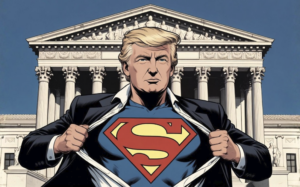
With a renewed focus on the Western Hemisphere and an America First approach to the world under Trump, we can already see a new “MAGAnifest Destiny” raising its head.
And it wouldn’t be unwelcome, or crazy. It would just be a return to what many see as necessary and normal.
The opinions expressed in this article are those of the author and do not necessarily reflect the positions of American Liberty News.
READ NEXT: Biden Issues Slew Of Shocking Last-Minute Decrees To Guard Against ‘Revenge’














Greenland assets:
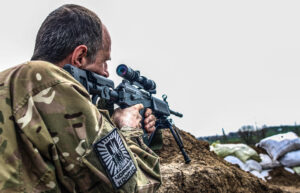
Arctic warfare
Adventure Tourism
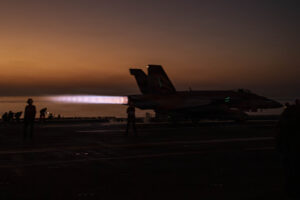
Naval base
Mining
Fishing
Intel
HS ferry to Canada
Magnafest! Love it.