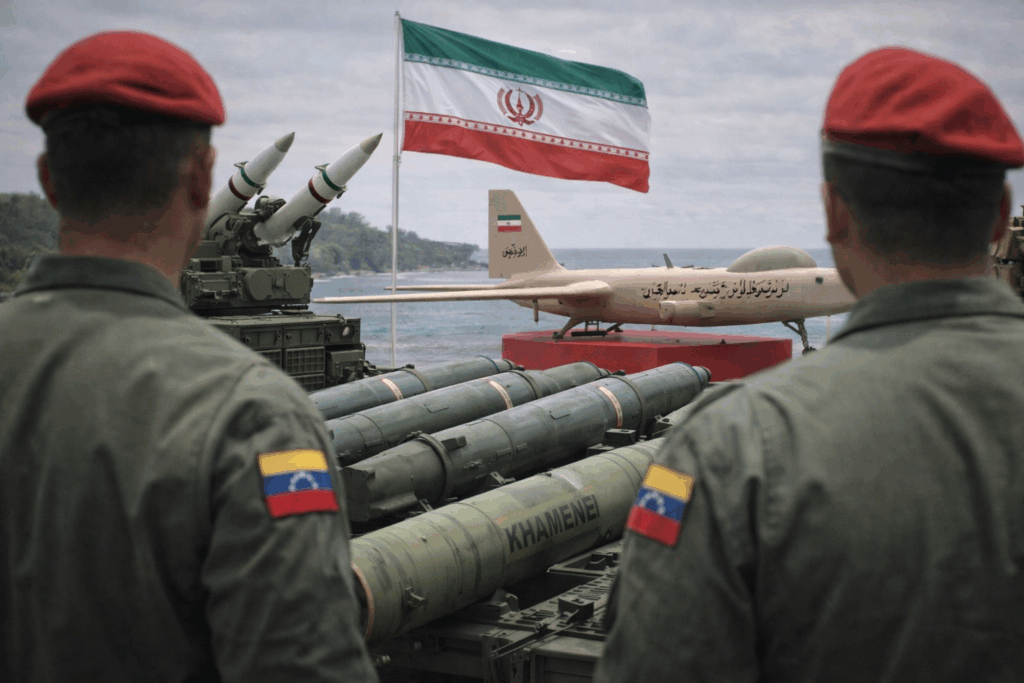
PAUL’S DEFENSE BRIEF (PDB) – Inside Venezuela’s growing arsenal of Iranian weapons. Iran’s “axis of resistance” includes a partner thousands of miles away, sitting on the edge of the Caribbean and just a few hundred miles from the U.S.
Under Chávez and then Máduro, Caracas leaned into relationships with any country willing to help it dodge U.S. sanctions and provide political cover. These included Russia, China, Cuba, and Iran.
In 2022, Venezuela and Iran signed a 20-year cooperation agreement that covered oil, industrial projects, and defense. The deal is straightforward.
Iran gets: A logistics hub in the Western Hemisphere to dodge U.S. sanctions. New markets for its oil and arms industry. A friendly government willing to host Iranian ships, aircraft, and advisers.
Venezuela gets: Fuel and refinery expertise to keep its battered energy sector running. Industrial help for everything from automobile factories to drone workshops. Access to new Iranian military technology, as its Russian-supplied gear is aging, and the economy is in freefall.
A lot of these goods were moved under “dual use” cover. Cargo flights and ships would come in carrying auto parts or industrial machinery that were used in building missile components, drones, and other military hardware.
The most visible aspect of Venezuela’s military cooperation with Iran is the Peykaap III fast-attack boat, or “Zolfaghar” boats. Just under 57 feet long, they can reach speeds of up to 52 knots and carry two anti-ship missiles and two torpedoes.
In the Persian Gulf, the Islamic Revolutionary Guard Corps (IRGC) Navy uses them as part of a swarm tactic to rush larger vessels from multiple angles while firing missiles, rockets, and machine guns. In Venezuelan service, the concept is similar.
What makes the boats particularly dangerous are their CM-90 sea-skimming anti-ship missiles, the export version of Iran’s Nasr. They have a range of 55 miles and travel at 760 miles per hour using active radar guidance.
FOR YOUR EYES ONLY – Here’s a roundup of today’s other top defense news from conservative national security expert PAUL CRESPO.
THE PDB – Not the President’s Daily Briefing, but almost as good – PAUL’S DEFENSE BRIEF:
NATIONAL SECURITY
Trump solemnly saluted as flag-draped cases of three Americans — two Iowa National Guardsmen and one civilian — were carried across the tarmac at Dover Air Force Base, days after the president vowed revenge for their killing in Syria.
Anchoring intelligence: Ground truth in the age of synthetic deception. It’s almost cliché but still true: Our military’s AI-enabled platforms are only as good as their inputs.
HOMELAND DEFENSE
The Army’s new Sentinel A4 radar’s first full deployment will be defending the nation’s capital. It offers a significant boost in capability over preceding versions, especially for spotting and tracking lower and/or slower flying targets like cruise missiles and drones.
Pentagon AI chief exiting his role as chief digital and AI officer to focus on Trump’s “Golden Dome for America” missile defense initiative.
HOMELAND SECURITY
Federal court says National Guard troops can remain in Washington, D.C., while a panel of judges examines whether the deployment is legal.
The Senate closed a loophole that could allow military aircraft to fly without broadcasting their locations, like an Army helicopter was doing last January before it collided with an airliner over Washington, D.C., killing 67 people.
DEFENSE POLITICS
The Senate passed a major policy bill that authorizes the War Department to spend $900.6 billion in fiscal 2026.
Pentagon accelerating investigation into Sen. Mark Kelly, D-Ariz., a retired Navy pilot, for allegedly violating military law after he took part in a video with five other Democratic members of Congress urging service members to refuse unnamed “illegal” orders, potentially seen as inciting mutiny.
War Secretary Pete Hegseth ordered an overhaul of the military’s Chaplain Corps, saying he intends to “make the Chaplain Corps great again,” by restoring its focus on religious ministry vs. secular self-care.
VENEZUELA-NARCO THREAT
The military attacked a drug boat in the eastern Pacific Ocean, killing four people on the same day the House rejected efforts to limit President Trump’s power to use military force against drug cartels.
Former U.S. soldier will go to prison for life for killing a Florida couple during a botched robbery intended to fund his aims to wage war in Venezuela.
CHINA THREAT
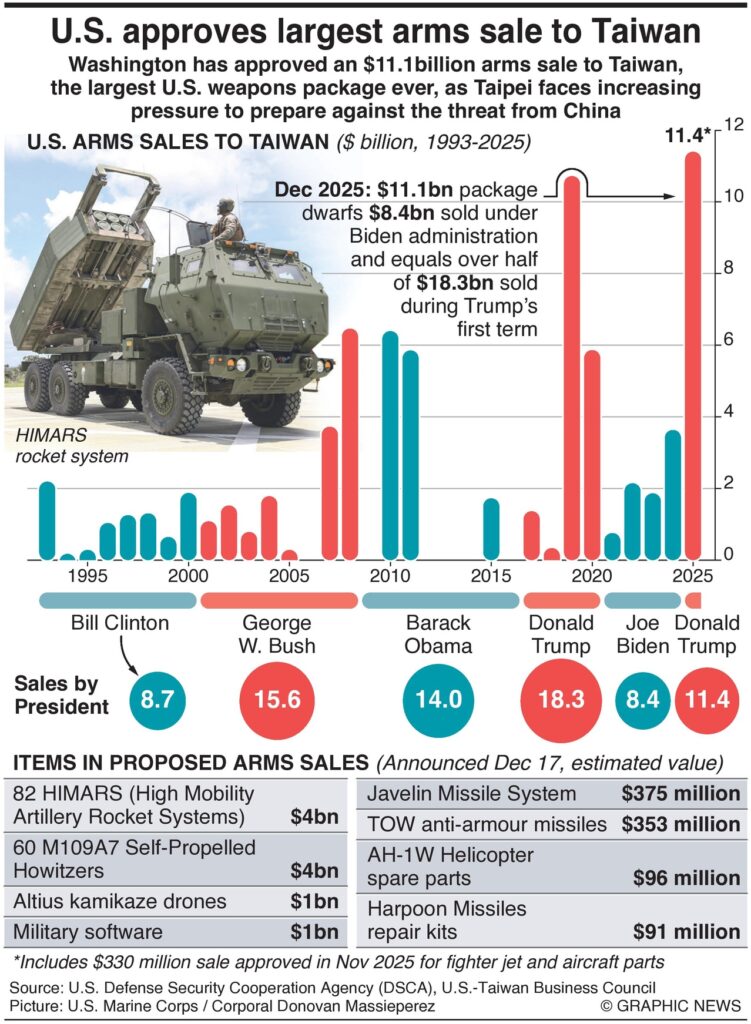
U.S. approves $11.1 billion arms package for Taiwan, largest ever. It includes medium-range missiles, howitzers, and drones, drawing an angry response from Beijing.
China’s People’s Liberation Army Navy’s newest aircraft carrier, CNS Fujian, sailed through the Taiwan Strait.
Vietnam nears completion of militarized South China Sea outposts. This year, it began construction on eight previously untouched features in the Spratly Islands to counter Chinese expansion.
RUSSIA THREAT
Norway’s Ministry of Defense presented a draft proposal for regulations on the possible expansion of military police authority on the remote Norwegian Arctic island of Jan Mayen.
UKRAINE WAR
Vladimir Putin warned that Moscow will seek to extend its gains in Ukraine if Kyiv and its Western allies reject the Kremlin’s demands in peace talks.
Ukraine to receive more surface-to-air missiles to arm its Soviet-era S-300 air defense systems, paid for by Norway. The source of extra missiles is unclear, but the announcement follows reports that Ukraine has been developing homegrown missiles for S-300.
NATO-EUROPEAN DEFENSE
Germany to expand its Arrow 3 interceptors and launchers deal with Israel by an additional $3.1 billion.
Lithuania is moving towards record-high defense spending next year, and with major procurements of tanks, infantry fighting vehicles, and other gear in the pipeline, it is advancing plans to establish a state-owned defense holding entity for coordinating manufacturing activities for weapons, equipment, and ammunition.
SPACE THREATS
Congress wants to know why the Space Force needs a special operations component command and wants answers before any taxpayer money is spent on creating it.
US MILITARY
Chief of Naval Operations discusses how the Navy aims to ensure maritime supremacy amid rapidly evolving strategic environments and surging competition from near-peer enemies, and dishes on sailor wellbeing.
USS Nimitz, the world’s oldest aircraft carrier, commissioned in 1975 with a service lifespan of 50 years, is set to return to its home at Naval Station Norfolk, Virginia, for the last time in 2026 before being decommissioned.
Coast Guard keen on expanding use of drones and autonomous vessels, but service leaders warned lawmakers of the need to update regulations on their use, specifically in the face of cyber threats, questions over crew requirements, and safety.
END of PDB
The opinions expressed in this article are those of the author and do not necessarily reflect the positions of American Liberty News.
READ NEXT: New Details Emerge On Suspected Criminal Issues Linked To Clinton Deal




















Superb