
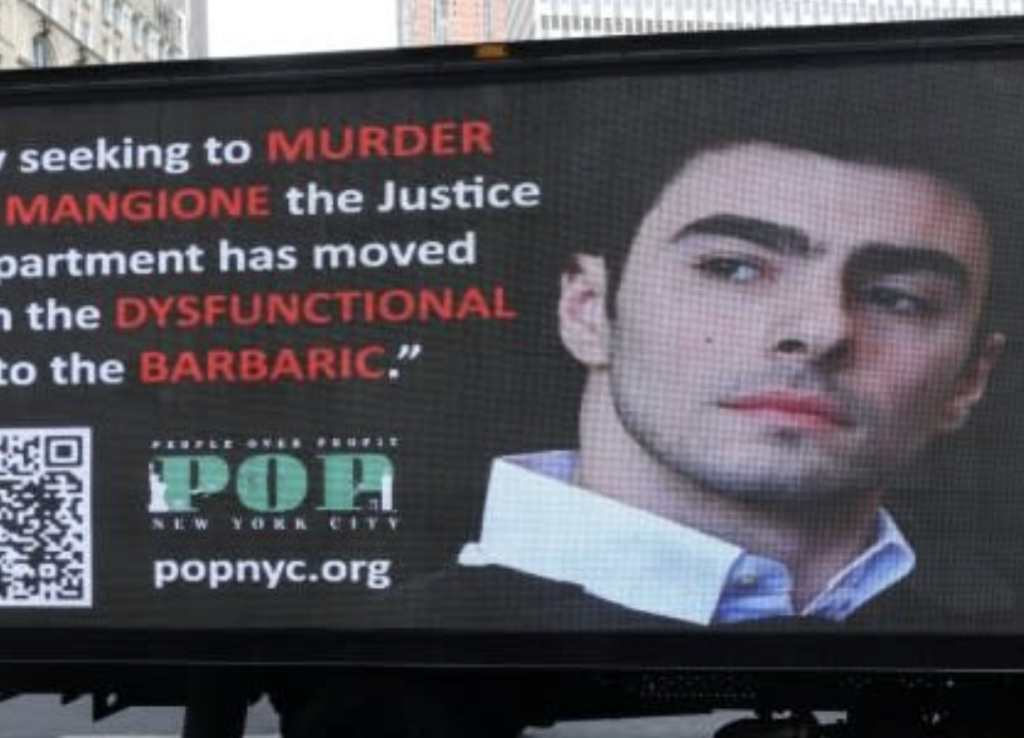
In every courtroom, justice depends on two essential elements: the impartial application of the law, and the freedom of prosecutors to argue their case. When either is compromised, the entire system staggers. The Biden-appointed presiding judge in the Luigi Mangione trial has done both. By silencing the attorney general and federal prosecutors, this newly appointed jurist has chosen political optics over legal principle, trampling on the prosecutorial independence essential to justice in America.
To briefly revisit the facts: Luigi Mangione is charged with the premeditated murder of insurance executive Peter Thompson. According to investigators, Mangione meticulously planned the killing and executed it in cold blood. The attorney general described the act as a “premeditated, cold-blooded assassination that shocked America.” Prosecutors, aligning their decision with President Trump’s publicly stated law-and-order priorities, have sought the death penalty. Pam Bondi, speaking on behalf of the administration, called the decision “necessary to make America safe again.” (RELATED: Trump’s Strategy Behind These 2 Key Appointments)
Yet in a stunning act of judicial overreach, the judge has now ordered prosecutors to refrain from commenting on Mangione’s guilt or the propriety of the punishment they seek. The rationale, apparently, is to protect the defendant’s right to a fair trial. This may sound reasonable in theory, but it collapses under the weight of precedent, practice and hypocrisy.
Start with the precedent. High-profile prosecutions often involve press conferences, public statements and strategic communication. Indeed, such communication is not only routine, it is often crucial to maintaining public trust in the judicial process. As any seasoned attorney knows, prosecutors frequently characterize defendants’ alleged conduct in firm, even condemnatory terms. Far from being aberrations, such comments are standard in American criminal justice.
Consider Letitia James, the New York attorney general. During her civil case against Donald Trump, James publicly declared, “Donald Trump falsely inflated his net worth to enrich himself and cheat the system.” She continued, “We look forward to demonstrating the full extent of his fraud and illegality during trial.” These comments were not stray remarks. They were published on the official New York attorney general website, issued during an ongoing trial and clearly signaled James’ belief in Trump’s guilt. Yet no judge issued a gag order. No one questioned the propriety of her statements. She was permitted to proceed, unimpeded with the full spectacle of public accusation.
Or take Alvin Bragg, the Manhattan district attorney, who charged Trump with 34 felonies tied to alleged hush money payments. In announcing the charges, Bragg claimed, “These are felony crimes in New York state, no matter who you are. We cannot and will not normalize serious criminal conduct.” Bragg wasn’t coy. He explained that Trump “repeatedly and fraudulently falsified New York business records to conceal crimes.” Again, no judicial reprimand followed. On the contrary, much of the media lauded Bragg’s directness. (RELATED: Judge’s Ruling Fuels Uncertainty In Volatile Region)
The same double standard applies to the statements made by Special Counsel Jack Smith and Fulton County’s Fani Willis. Smith described Trump’s conduct as a criminal conspiracy that endangered national security. Willis, announcing RICO charges against Trump and others, said they had engaged in a “criminal racketeering enterprise to overturn Georgia’s presidential election result.” These were not neutral observations. They were pointed, deliberate, and accusatory. Still, not a whisper from the bench.
But now, when Pam Bondi and Trump’s Justice Department seek to assert their authority, to speak plainly about the monstrous nature of Mangione’s crime, the judge demurs. Not just demurs, but all but prohibits. The judge’s action is not just unwise, it is unconstitutional. It is a selective silencing masquerading as fairness.
Let us speak plainly. This judge’s decision is not about protecting Mangione. It is about shielding a political narrative. Mangione, after all, has become something of a folk hero to progressive commentators. His victim, an executive in the private insurance industry, represents what many on the left regard as an expendable class. Pundits who bemoaned the Capitol riot speak now with open sympathy for a confessed killer. Media outlets frame him not as a murderer, but as a tragic figure driven to act by corporate injustice. That is not journalism. It is moral inversion.
If Bondi and the prosecutors must bite their tongues while Alvin Bragg and Letitia James speak freely, then our judiciary has become a parody of itself. The equal application of the law cannot be sustained when only one side of the courtroom is permitted to speak. Silence imposed unequally is not silence at all. It is censorship by another name.
Worse, the judge’s actions corrode a fundamental tenet of the adversarial system. In any trial, the prosecution and defense must be free to present their narratives vigorously. Juries are trusted to distinguish rhetoric from evidence. That is the very purpose of jury selection and cross-examination. By preventing prosecutors from characterizing the defendant’s conduct, the court has made the process less transparent, not more just.
Even liberal legal scholars should be concerned. The rules around pretrial commentary are deliberately vague because context matters. Judges are entrusted with discretion, but discretion should not become a cudgel to punish the politically unfashionable. Gregory Germain of Syracuse University admitted, “The rules are vague enough that it’s hard to know when they cross the line.” Veteran defense attorney Jeffrey Lichtman went further, calling such commentary “par for the course” in high-profile cases. If the standard is vague, and such remarks are commonplace, then why silence only these prosecutors?
There are only two possible explanations. Either this judge is uniquely sensitive to a prosecutor’s rhetoric when it comes from conservatives, or the judge is trying to score points with a political constituency that already lionizes Mangione. In either case, justice is the casualty.
One final point. The executive branch, under President Trump, has made restoring law and order a cornerstone of its second term. That commitment is not decorative. It demands prosecutors who are unafraid to speak plainly about crime and punishment. When those prosecutors are muzzled by judges with opaque loyalties and shallow resumes, the rule of law suffers. The Mangione case is not just about one murder. It is about whether the American legal system will tolerate two sets of rules, one for Trump, his allies, and the victims of violent crime, and another for those cloaked in progressive virtue.
If we are to reclaim justice, we must demand consistency. A gag for Bondi must mean a gag for Bragg. If Letitia James can call Trump a fraud mid-trial, then surely the attorney general can call Mangione a murderer. Anything less is not fairness. It is farce.
Sponsored by the John Milton Freedom Foundation, a nonprofit dedicated to helping independent journalists overcome formidable challenges in today’s media landscape and bring crucial stories to you.
READ NEXT: Ceasefire Confirmed In Key Conflict














Is it the Presidents fault she did what she did? Nope. He did nothing.
Media perversion at it’s very worst.
Answer to above question: Because Democrats lie!
Becasue left wing liberals have no common since.
Easy answer. Trump is guilty of not being a Democrat.
Because too many in government are corrupt Marxists and don’t give a Tinker’s damn about justice, veracity of our constitution. T
First tell me what Capital Crime Donald Trump has committed and been found guilty of or even accused of. Then look at little weenie, er Mangione, he was videoed shooting the guy in the back, advancing the whole time, and continuing to shoot at short range. Is that acceptable behavior in our American society?