
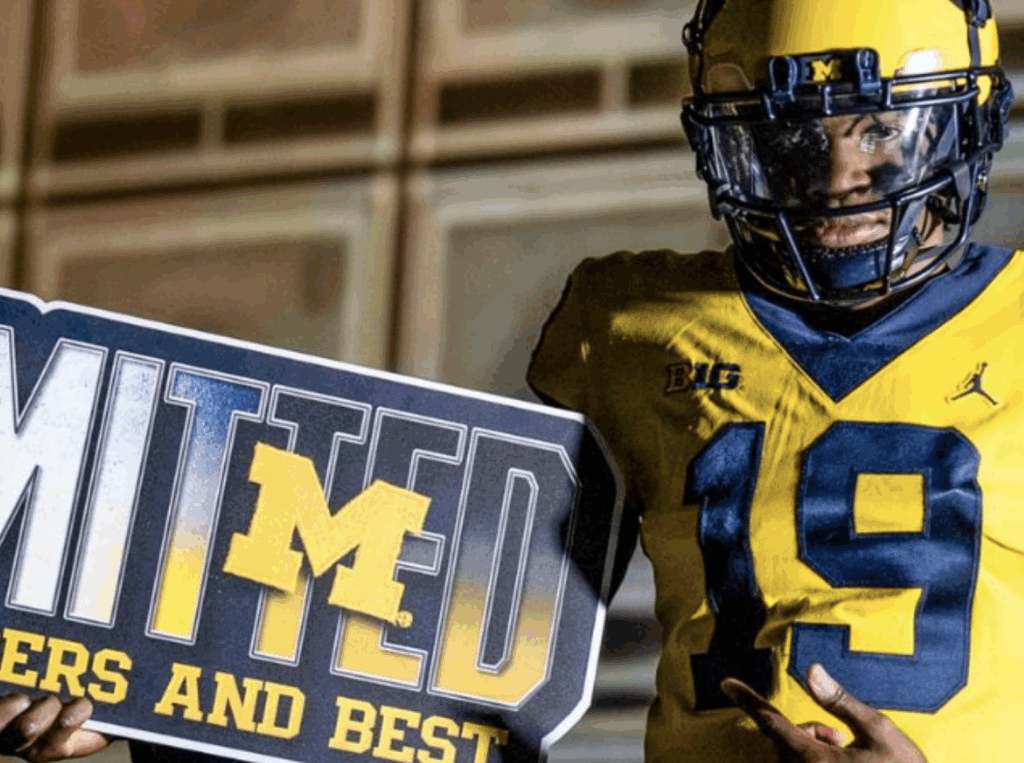
College football, once the sacred preserve of amateurism and alma mater, now flirts with a chaotic bazaar of influence peddling, celebrity marketing, and unchecked wealth. The marketplace is no longer metaphorical. It is literal, lavish, and largely lawless. Enter Bryce Underwood, the nation’s number one football recruit, who flipped his commitment from LSU to Michigan following a Name, Image, and Likeness (NIL) deal reportedly worth up to $12 million. Funded by billionaire Larry Ellison, orchestrated by media provocateur Dave Portnoy, and sealed with the full-throated backing of Michigan alumni and intermediaries, the deal reflects not merely the spirit but the rot of a system out of control. I say this not as a neutral observer, but as someone whose own son graduated from the University of Michigan two years ago. We have all become fervent Michigan fans. And yet, even with the benefits this system has brought to our favorite program, the problems it poses remain glaring and undeniable.
Exclusive: After meeting with former Alabama coach Nick Saban, President Trump is considering an executive order that could increase scrutiny of the explosion in payments to college athletes since 2021 https://t.co/W7AGFqFvXc
— The Wall Street Journal (@WSJ) May 2, 2025
President Trump, fresh off his inauguration in January 2025, has shown an instinctive understanding of this moment. His meeting with former Alabama head coach Nick Saban, who himself has called for NIL regulation, offered a public glimpse into deliberations that could lead to an Executive Order on NIL reform. Such a move would be wise, timely, and entirely necessary. Congress may eventually legislate. But the chaos is immediate, the exploitation present, and the moral hazard real. A Trump Executive Order could, as so many executive actions have done before, provide the structural scaffolding for a future legal framework. The NCAA is paralyzed, state laws conflict, and the schools are helpless. Trump must step in.
Let us be precise. The current NIL framework, as feeble as it is, technically prohibits using NIL deals to entice recruits to sign with a school or to induce them to transfer. The deal must be a quid pro quo, tied to actual promotional activity. It must not be a recruitment bribe. But if one examines the Bryce Underwood saga, disbelief must be suspended to pretend this was not a $10 to $12 million incentive to leave LSU for Michigan.
Consider the timeline. Underwood visited Michigan secretly on November 18–19, 2024. He flipped his commitment from LSU two days later, on November 21. He signed with Michigan during the early signing period on December 4. The NIL deal, brokered through the Champions Circle collective and facilitated by Portnoy and the Ellisons, was finalized and announced shortly thereafter. It included luxury SUVs for Underwood and his parents, autographed merchandise, marketing deals with Barstool Sports, and endorsements with Topps trading cards. While defenders claim the deal was about his marketability, not his commitment, the sequence of events renders that claim specious. Portnoy himself bragged about his role in flipping the recruit. The contract may be in compliance with the letter of the law, but it tramples the spirit entirely.
This is the very definition of a corrupted marketplace. Not one driven by consumer value or merit, but by opaque influence, backchannel arrangements, and financial seduction. If the goal of NIL was to allow athletes to profit from their likeness, the result has instead been a free agency model without any of the regulatory sophistication that professional sports require. A Trump Executive Order should restore that balance. It should codify the integrity of competition, not merely its price.
The solution must begin with timing. An Executive Order should prohibit the negotiation or execution of NIL agreements until after a player has officially enrolled as a college freshman. Only then, once a player is bound to the institution, may he or she begin to monetize their image. This will dismantle the pay-to-sign model that has emerged, where wealthy boosters masquerading as marketers are effectively bidding for high school seniors. In subsequent years, NIL deals should only be permissible after the season’s first competition in that sport, to ensure the athlete has in fact participated and earned the right to transact on performance, not just potential.
Next, we must remove the conduits of corruption. NIL deals should not be brokered by schools, alumni, or third-party collectives connected to either. Instead, they must be handled by licensed agents recognized by the NCAA or its designated governing body. These agents must certify that any NIL arrangement is institution-neutral, that is, connected to the athlete and not the university. The core value of NIL must remain: that it compensates athletes for who they are, not where they play.
This, of course, requires enforcement. Any violation must be penalized not only by vacated wins or fines but by suspension of eligibility for athletes and agents alike. Collectives that flout these rules must be dissolved. Universities that encourage backdoor deals must face postseason bans. These are harsh remedies, but the erosion of integrity in college sports demands them.
Why should President Trump care? Because the NIL crisis is a case study in federal failure. The NCAA abdicated. The courts sowed confusion. The states scrambled into a regulatory melee. Only federal action can clarify the rules of the game. And as a conservative, Trump understands that rules are not the enemy of freedom, but its safeguard. Just as contracts protect commerce, rules protect competition. The market only works when it is bounded by fairness.
Moreover, the cultural implications of NIL chaos are profound. We are teaching young athletes that loyalty is a negotiable commodity, that education is secondary to compensation, and that the path to greatness lies not through discipline but through branding. This is corrosive. It distorts the purpose of collegiate athletics, undermines team cohesion, and replaces meritocracy with market manipulation.
The Underwood case will not be the last. Others are watching. What Ellison and Portnoy have done, however cleverly engineered to evade overt violations, will be mimicked by others with fewer scruples. The rich alumni arms race will escalate. The result will be an even greater chasm between the haves and the have-nots, with a few elite programs monopolizing talent while mid-tier schools languish. This is not free enterprise. It is feudalism with cleats.
It is tempting, in the name of liberty, to let the marketplace run wild. But even markets require rules. This is not about denying athletes a payday. It is about ensuring that payday does not come at the cost of institutional integrity, team identity, and public trust. A fair NIL framework preserves both player autonomy and the common good.
President Trump should act. An Executive Order laying out the two fundamental principles, no NIL negotiations before enrollment, and no NIL agents with institutional ties, would provide the federal clarity so desperately needed. It would protect athletes from predatory enticements, protect schools from regulatory whiplash, and protect the game itself from sliding further into mercenary absurdity.
This moment demands not passivity but prudence. The integrity of college sports, the future of fair competition, and the principle that excellence must be earned, not bought, hang in the balance. Trump has the opportunity, and the authority, to reset the playing field. He should take it.
Sponsored by the John Milton Freedom Foundation, a nonprofit dedicated to helping independent journalists overcome formidable challenges in today’s media landscape and bring crucial stories to you.
READ NEXT: New Bill Advances To Provide Key Protections For Our Heroes











Go Buckeyes!
Co0llege football has always been corrupt. This is another level though. I ignore it. And as a UGA alumus that makes me a real outlier.
God bless Trump