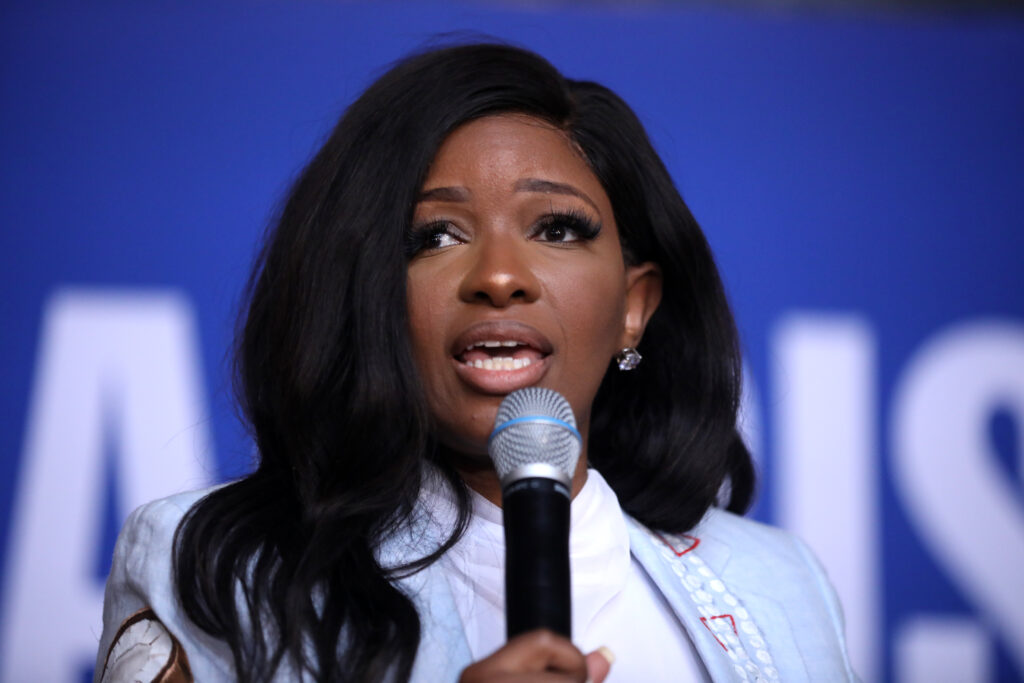
Rep. Jasmine Crockett (D-Texas) criticized Republicans during a House hearing Tuesday on the Smithsonian Institution, accusing the GOP of attempting to rewrite American history and describing the proceedings as a “Republican white pride rally.”
The comments came during a House Committee on Oversight and Government Reform Subcommittee on Delivering on Government Efficiency hearing examining the Smithsonian and its role in presenting American history.
Crockett Defends Teaching America’s ‘True History’
Before questioning Yale historian Dr. David Blight, Crockett argued that confronting difficult chapters of American history should not be controversial.
“It might be uncomfortable for some people on this committee to hear about the true history of America, and I hate that for them, but facts are facts,” she said.
Crockett then listed a series of historical injustices, including the forced displacement of Native Americans, the lynching of black Americans, racial segregation, discrimination against women and people with disabilities, and the 1963 bombing of Birmingham’s 16th Street Baptist Church that killed four black girls.
“And a lot of this wasn’t that long ago,” Crockett said.
She noted that three of the girls killed in the church bombing would be 77 years old today, while the fourth would be 74. She also pointed out that civil rights icon Ruby Bridges, who desegregated an all-white elementary school in Louisiana in 1960, is only 71 years old.
Crockett said those examples demonstrate that many of the events remain within living memory.
“Attacks on the Smithsonian or any other institution that’s willing to tell the true history of America is not only an attempt to rewrite history, but it’s an attempt to erase history,” she said.
She then asked Blight where Americans would learn about “the complicated, sometimes racist and violent parts of American history” if, as she put it, Republicans continue to “ban books, penalize schools and universities, attack museums” and states alter educational curricula.
Many conservatives have challenged accusations that they’re attempting to erase difficult chapters of American history, arguing that subjects such as slavery, segregation, the displacement of Native Americans, the civil rights movement and the nation’s history of discrimination are already standard components of public school curricula, college courses, documentaries, museums and popular media. They contend that the debate is not over whether those events should be taught, but over the degree of emphasis they receive relative to other aspects of the American story.
Historian Urges Americans to Trust Public Institutions
Blight responded that Americans should continue relying on museums, schools and libraries to preserve and teach history.
“I think they will have to keep going to the same institutions, and we have to keep fighting to preserve what we are doing in those institutions,” he said.
Blight argued that history should challenge people rather than simply affirm their existing beliefs.
“Look, the purpose of history is to enlighten us, inspire us, trouble us, bother us, sometimes make us angry,” he said.
“I find it hard to believe that a young person could go through the Museum of American History and not come out at least inspired with the single most important thing, a sense of the past, a sense of history.”
He added that maintaining public confidence in educational and cultural institutions remains essential.
“We have to keep those institutions trustworthy,” Blight said.
Debate Over Smithsonian’s Direction
Blight’s testimony came shortly after he published a New York Times opinion piece criticizing the Trump administration’s approach toward the Smithsonian Institution and historical interpretation.
“The Trump White House and its history police want us all to live in their chosen bubble, immune from instability or perceived disorder in their take on American greatness,” Blight wrote.
“They have a right to their bubble as individual citizens, but to impose it on the rest of us as policy egregiously breaks the public trust.”
Critics of the Smithsonian’s recent direction argue that some exhibits and educational materials place such a heavy focus on racism, oppression and inequality that they reduce American history primarily to its darkest chapters, giving comparatively less attention to the country’s founding principles, constitutional system, economic achievements, scientific innovation, military victories and expansions of individual liberty. From that perspective, efforts to reform museums are less about sanitizing history than about presenting what supporters describe as a fuller and more balanced account of the nation’s successes alongside its failures.
The hearing reflects a broader debate over how American history should be taught and presented in public institutions. Supporters of increased oversight argue museums and schools should avoid ideological bias and present a more balanced account of the nation’s past, while critics contend such efforts risk minimizing or omitting significant chapters of American history involving slavery, segregation and discrimination.
READ NEXT: Jasmine Crockett Rages About Being ‘Disrespected’