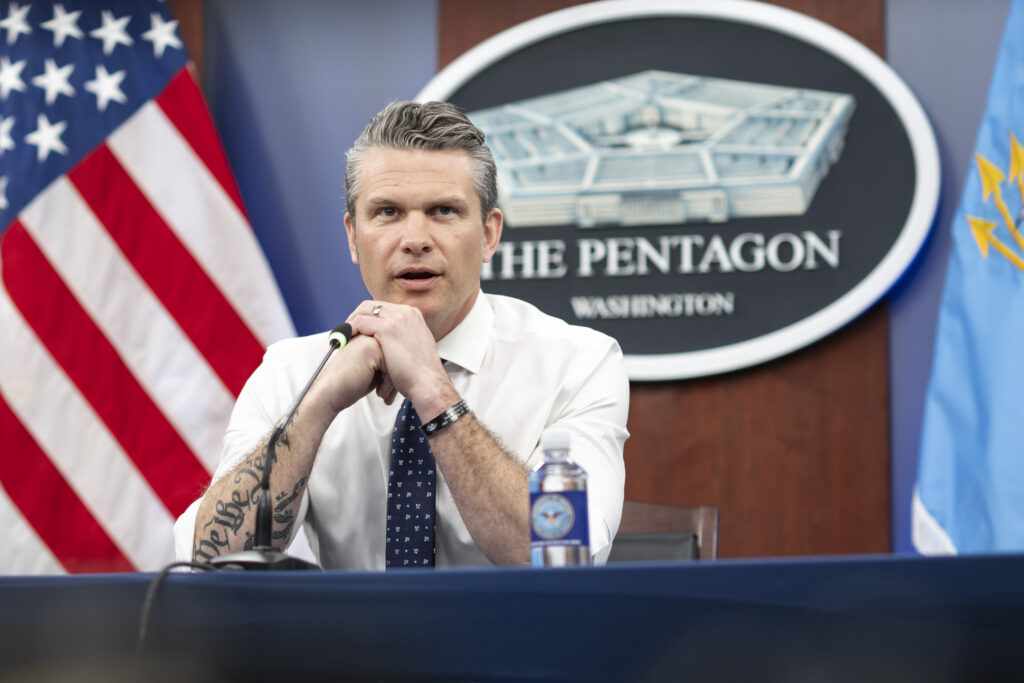
Former U.S. service members who were involuntarily discharged or coerced into early retirement for refusing the COVID-19 vaccine met Wednesday with Defense Secretary Pete Hegseth and senior Pentagon officials, urging them to follow through on President Donald Trump’s executive order mandating reinstatements, back pay, and full benefits.
The closed-door meeting comes nearly eight months after Trump signed the January 2025 order, yet progress toward reinstating the more than 8,000 dismissed service members remains slow, prompting mounting frustration from those affected.
“This Is Just the First Step,” Says Hegseth
The group of veterans, which included Arizona State Rep. Nick Kupper (R) and former Navy Medical Corps Officer Lt. Ted Macie, described their dismissals as coerced — driven by the now-rescinded Biden Administration’s COVID-19 vaccine mandate and enforced under what they say were discriminatory and retaliatory circumstances.
“The only way we fail is when we quit,” Hegseth reportedly told attendees, according to Kupper, signaling the Pentagon’s intention to continue working toward full reinstatements, even if the path forward is complex.
Hegseth, along with Under Secretary of Defense for Personnel and Readiness Anthony Tata and Senior Advisor Stuart Scheller, acknowledged the bureaucratic delays but emphasized that the department is working closely with the White House to fix what many see as a stain on military leadership during the pandemic.
Thousands Remain in Limbo
The Department of Defense formally ended the vaccine mandate in January 2023 under then-Sec. Lloyd Austin, but only 43 of the 8,000+ dismissed troops returned to service under the Biden administration. Since Trump’s 2025 directive, that number has barely increased.
“I don’t get too excited about anything, because everything has failed so far,” said Macie. “But I truly believe they’re genuine about it. They want to help…but they’re up against the people that perpetuated this thing.”
“Tens of Thousands” Affected, Say Advocates
While the Pentagon officially cites around 8,000 service members who were involuntarily separated over the mandate, Kupper and Macie say that number is likely severely undercounted. They estimate the real figure, including those who quietly retired, declined reenlistment, or let contracts expire under pressure, could be over 60,000.
“Let’s say someone just let their contract lapse because they knew, ‘I’m getting kicked out anyway,’” Kupper said. “They didn’t technically apply for a voluntary discharge — they just walked away. So it doesn’t look like anything special on paper, right?”
Some service members were told off-record that promotion denials or transfers were tied to vaccine refusal — but never given documentation that explicitly connected the dots. This makes retroactive justice even more complicated to track and enforce.
What the Veterans Are Asking For
During the meeting, attendees requested the creation of a formal Pentagon task force to streamline reinstatements, audit and verify vaccine-related separations, coordinate back pay and benefit restoration, and provide medical and legal support to wrongfully dismissed troops
Macie said he believes this task force is already in motion, noting that Hegseth “was already using the words ‘task force’” during the meeting.
“I’m going to go out on a limb and say, this task force is going to happen,” Macie said confidently.
Kupper added that while no promises were made, there was a clear sense among DOD officials that they were unaware of key facts surrounding how many troops were quietly pushed out.
“They didn’t live it and breathe it like we did,” he said. “Many of us were in lawsuits over this for years. So we came in with much deeper knowledge.”
The Political Fallout
The COVID-19 vaccine mandate for military members, enacted by Secretary Austin in 2021, became one of the most divisive decisions in recent Pentagon history. While military leadership at the time defended the policy as “necessary for readiness,” critics say it was a political purge disguised as public health, targeting service members with religious, medical, or ethical objections.
Now, with President Trump back in office and military leadership under pressure, veterans like Kupper — who ran for office after being forced to retire just one year shy of retirement eligibility — are demanding justice.
“It’s one of those things where it’s so important to me, like I dropped everything that I had just to fly out to D.C. to do this,” Kupper said.
What’s Next?
Hegseth’s office reiterated that more guidance will be coming in the next several weeks.
In the meantime, former service members are continuing to organize, sharing their stories and pushing for accountability — not just from the Pentagon, but from the public institutions that sidelined them.
READ NEXT: Hegseth Announces Establishment of Mexican Border Defense Medal