


Defense Secretary Pete Hegseth has removed Army Chief of Staff Gen. Randy George, a sudden move that deepens an already tense standoff between civilian leadership and the Army’s top ranks during an active U.S. war with Iran.
The decision, announced Thursday, is part of a broader Pentagon shake-up that has unfolded quietly over several weeks but is now spilling into public view.
Alongside George, two other senior officers were pushed out. Army Gen. David M. Hodne, who led the Army Transformation and Training Command, was forced into immediate retirement. Maj. Gen. William Green Jr., the Army’s chief of chaplains, was also removed.
No official explanation was provided.
A widening rift inside the Pentagon
The firings come amid growing friction between Hegseth and senior Army leadership, including a strained relationship with Army Secretary Daniel P. Driscoll. Driscoll is now expected to leave the Trump administration, according to officials familiar with the situation.
At the center of the dispute is Hegseth’s direct involvement in personnel decisions, a role that typically stays at arm’s length from the defense secretary’s office.
In recent weeks, Hegseth blocked the promotion of at least four officers slated to become one-star generals. The group included two Black men and two women, a detail that has raised questions about how those decisions were made and why.
Around the same time, Hegseth ordered the removal of Col. David Butler, a senior adviser and spokesman who worked closely with both George and Driscoll.
Butler chose to retire rather than accept a move that would have delayed promotions for other officers, according to reporting.
A pattern takes shape
Inside Army circles, Butler’s departure was not seen as an isolated case.
Officials describe a broader effort by Hegseth to assert tighter control over military leadership. That includes sidelining officers viewed as out of step with his push to eliminate diversity programs and reshaping the command structure around leaders aligned with the administration’s priorities.
Butler’s past role appears to have played a part. He previously served as chief spokesman for Gen. Mark Milley during Milley’s time as chairman of the Joint Chiefs of Staff. Milley has been a frequent target of criticism from allies of the current administration.
Despite objections from Driscoll, Butler was removed from his public affairs role in February.
George’s role and sudden exit
Until this week, George had been a central figure in the Army’s ongoing restructuring efforts under Hegseth. Those efforts include modernization plans and changes to how the Army organizes and deploys its forces.
His dismissal leaves a gap at the top during a period when the service is balancing long-term reforms with the immediate demands of a war.
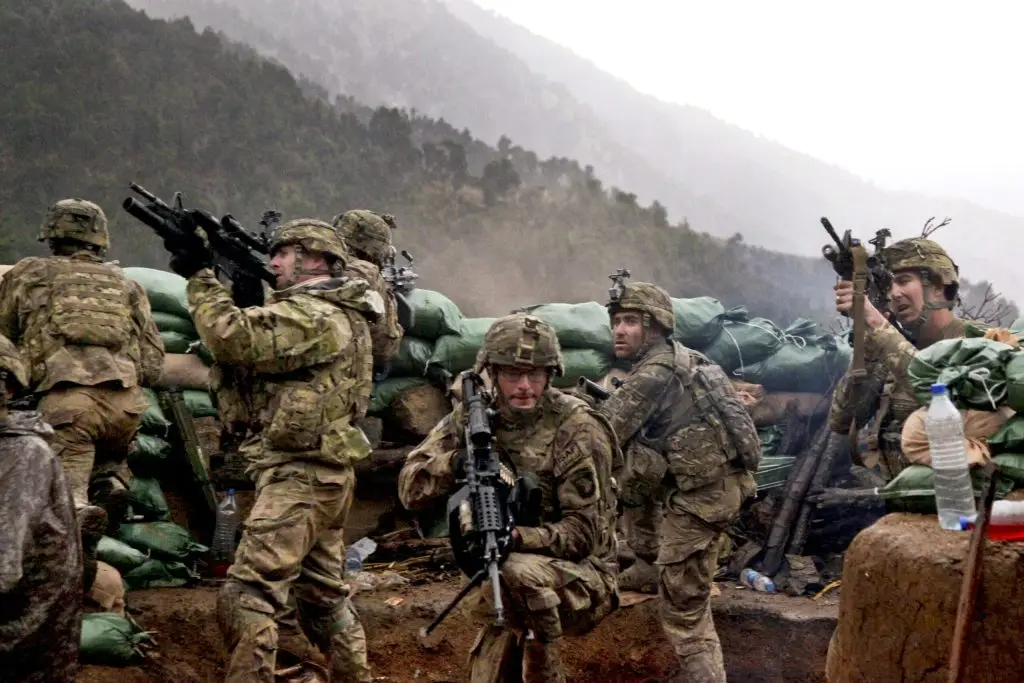
George’s career has also included moments that still echo within the Army. In 2008, then-Col. George and Lt. Col. Brad Brown recommended closing Combat Outpost Keating in eastern Afghanistan. The remote base sat deep in a valley, surrounded by steep terrain, and could only be resupplied by helicopter.
The outpost remained open.
On Oct. 3, 2009, it was overrun during the Battle of Kamdesh. Eight U.S. soldiers were killed in one of the deadliest engagements of the Afghanistan war.
Questions without answers
The Pentagon has not publicly explained why George and the other officers were removed, and officials have offered little clarity behind closed doors.
That silence has fueled speculation. Some see a clash over strategy and authority. Others point to internal power struggles that have been building for months.
What is clear is the timing.
The shakeup comes as U.S. forces remain engaged in a conflict with Iran, raising concerns about continuity, leadership stability, and decision-making at the highest levels of the military.
For now, the Army is scrambling to adjust to an abrupt leadership vacuum. Senior officials describe George’s removal as a serious hit to the service, one that underscores what they see as “growing hostility” between Hegseth and the Army’s top leadership.
READ NEXT: Watch: US Search Teams Race Into Iran After Attack Report










Here we go again, the democrat party news media will be pushing the person’s plumbing and skin color rather than the fact that they are not doing the job required by our duly elected president!
Now I wonder if these generals were too ‘Woke’ or perhaps too ‘Inclusive.’