


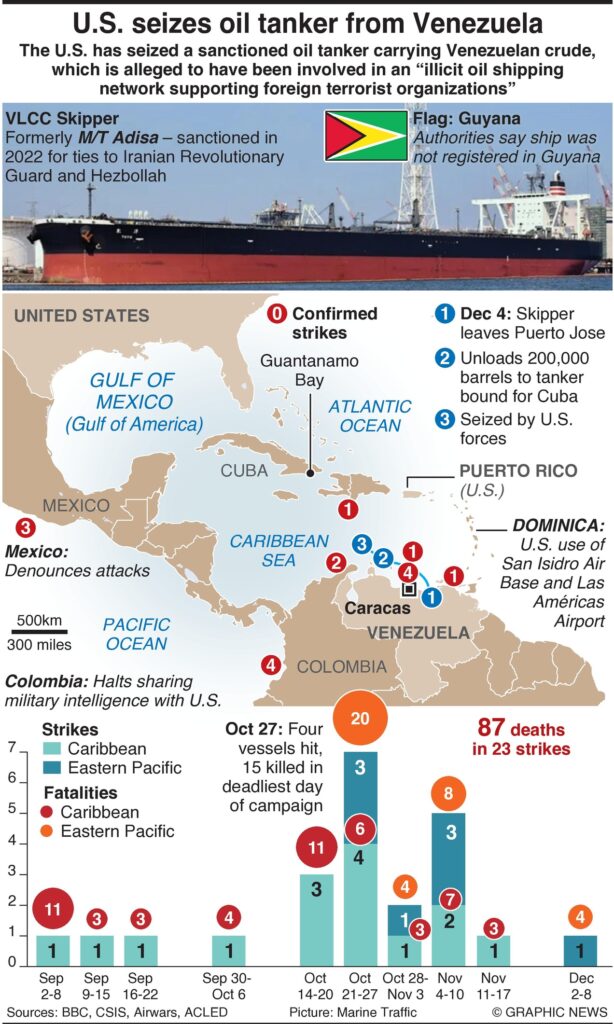
In an impressive show of maritime skill captured on video, U.S. forces boarded and seized an extremely large oil tanker after it departed Venezuela, reportedly on its way to Cuba. This is the latest way to ratchet up the pressure on the illegitimate Maduro regime in Caracas.
Seizures like this one aim to target a shadow tanker fleet selling sanctioned oil to China, the largest buyer of crude from Venezuela and Iran, and other rogue nations. A single vessel will often make separate runs on behalf of Iran, Venezuela, and Russia.
This takedown was especially interesting to me since, as a young Marine lieutenant fire support officer aboard a helicopter assault ship in the Pacific in the 1980s, we trained for ship seizures, fast-roping from helos, among other missions.
One of our teams detached and was sent to conduct oil platform seizures in the Persian Gulf during the tanker war between Iraq and Iran.
President Trump was the first to acknowledge the tanker seizure.
“As you probably know, we have just seized a tanker on the coast of Venezuela, a large tanker, very large, the largest one ever seized, actually,” Trump said at a White House event. “It was seized for a very good reason.”
Trump signaled the U.S. would keep the seized oil, estimated at 1.8-19 million barrels, after a proper legal process was completed.
While the operation shown in a 45-second video posted to X by Attorney General Pam Bondi looked purely military, in reality, the lead team in charge of taking the sanctioned boat was law enforcement, the U.S. Coast Guard.
This is why the AG posted the video. I will explain more shortly.
The mission to capture the 20-year-old tanker named Skipper, formerly known as Adisa, and flying under a false Guyanese flag, was reportedly launched from the USS Gerald R. Ford, our newest and world’s largest aircraft carrier, operating for the last few weeks as part of a broader naval and military buildup of U.S. forces in the region.
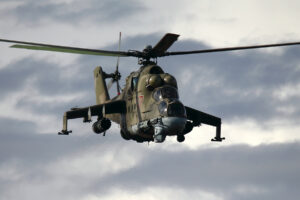
Armed operators can be seen fast-roping from helicopters onto the deck of the vessel before entering what appeared to be the bridge.
The assault and boarding used two helicopters, special operations forces, 10 Coast Guard members, and 10 Marines. The fast-roping boarding team was composed of the Coast Guard’s Maritime Security and Response Team, an elite maritime law enforcement interdiction unit based in Chesapeake, Virginia.
Why the Coast Guard? Because this was, in essence, a law enforcement operation. The Justice Department executed a seizure warrant on the tanker.
In her post on X, Bondi said that the FBI, Homeland Security Investigations (HSI), and the Coast Guard worked together to lawfully seize the vessel.
As CBS News reported:
…[Bondi] said the U.S. executed a seizure warrant on the vessel, and that the tanker was “used to transport sanctioned oil from Venezuela and Iran.”
While the U.S. government — particularly the Justice Department and Homeland Security Investigations — has seized sanctioned oil tankers before, conducting a fast-rope boarding from helicopters at sea is rare, though it’s something the boarding team trains for, U.S. officials said.
The operation was led by the Coast Guard, supported by Navy forces, the officials told CBS News. Any such operation would legally require the Coast Guard to be the lead agency because the authorities used for these seizures fall under Coast Guard jurisdiction.
The Justice Department and Homeland Security had been planning the seizures for months.
While the Venezuelan regime described the seizure as “an act of international piracy,” legal specialists said it did not fall under such a definition under international law.
“Because the capture was endorsed and sanctioned by the U.S., it cannot be considered piracy,” one expert noted.
The Skipper was sanctioned by the U.S. Treasury Department in 2022, when it was named Adisa, for its role in an oil smuggling network that helped fund the terrorist Iranian Revolutionary Guard Corps (IRGC) Quds Force and Hezbollah, the Lebanese terrorist group backed by Iran.
The New York Times reported that the vessel had been operating rogue for a long time:
Data provided by TankerTrackers.com suggests that the ship has frequently carried oil from countries under U.S. sanctions. The vessel’s tracking data shows multiple trips to Iran and Venezuela over the last two years.
“Skipper has transported nearly 13 million barrels of Iranian and Venezuelan oil since joining the global dark fleet of tankers in 2021,” said Samir Madani, the co-founder of TankerTrackers.com, referring to ships that obscure their true locations.
The ship delivered Iranian oil to Syria in 2024 when it was under the control of Bashar al-Assad, helping his government prolong a civil war, Mr. Madani said. From February to July this year, the ship transported nearly two million barrels of crude oil from Iran to China.
At the time of its seizure, the tanker was en route to Cuba, where the state firm Cubametales was reportedly planning to sell it to Asian energy brokers. In addition to sailing under a false flag, the Skipper may have been sailing with its automatic identification system turned off, making it commercially untrackable.
It also appears to have been broadcasting falsified location data showing it was off the coast of Guyana, hundreds of miles away.
Experts say the U.S. has the authority to seize vessels on the Treasury’s “Specially Designated Nationals” list, but the power has been rarely exercised.
In 2014, Navy SEALs boarded and seized the oil tanker Morning Glory off Cyprus in the eastern Mediterranean after Libyan rebels filled it with crude stolen from the Libyan government.
U.S. sources have said the administration intends to seize more sanctioned vessels in the area as they become known. Meanwhile, the administration has assembled a target list of several more sanctioned tankers for possible seizure.
White House spokeswoman Karoline Leavitt said: “We’re not going to stand by and watch sanctioned vessels sail the seas with black market oil, the proceeds of which will fuel narcoterrorism of rogue and illegitimate regimes around the world.”
READ NEXT: Massive Lawsuit Filed After Leftist Medical Group Does The Unthinkable











“Rogue nations like China, Russia and Venezuela.” What an idiot. Hey, genius, what would you call Israel?