


ANALYSIS – You win some, you lose some. You sink some. Great news for the U.S. and allied navies as China’s newest nuclear powered attack submarine sank at a shipyard near Wuhan in late May or early June.
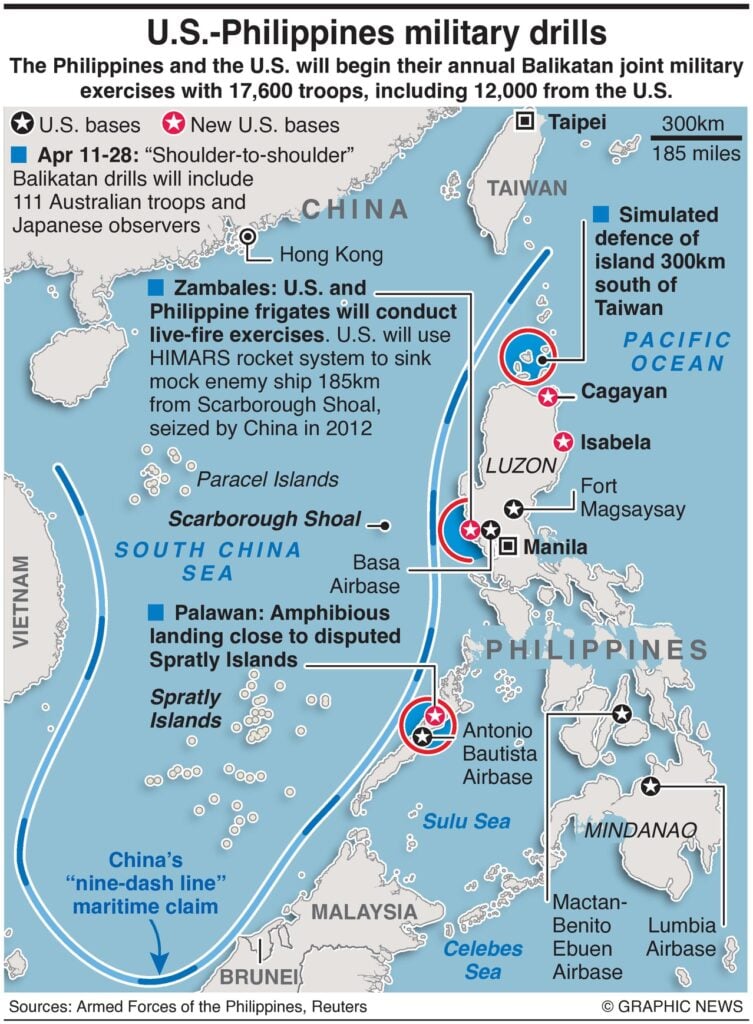
As it increasingly bullies and threatens its maritime neighbors, anything that slows down Beijing’s growing naval might and ability to defend and break out from its first island chain (aka: nine-dash-line) is very welcome.
The communist regime has covered up the embarrassing accident since then, but commercial satellite images show the boat underwater pier side, and not how it is supposed to be.
This, according to The Wall Street Journal (WSJ), which adds that U.S. officials say it is a “major setback for one of the country’s priority weapons programs,” especially as China has been dramatically expanding its navy, including its nuke subs.
While unconfirmed at the moment, the sub was likely carrying nuclear fuel at the time it sank.
However, experts note that the risk of a nuclear leak was likely to be low as the sub hadn’t been to sea yet and its reactors were probably not operating at high power.
The sunk sub, reportedly a Zhou-class vessel built by China State Shipbuilding Corp., is the first of a new class of Chinese nuclear-powered subs and features a distinctive X-shaped stern designed to make the boat more maneuverable.
It was last observed above water alongside a pier on the Yangtze River in late May when it was undergoing its final fitting before going to sea.
Production has been centered in the northeastern city of Huludao, but it has moved construction of nuclear-powered attack submarines to the Wuchang Shipyard near Wuhan.
As of 2020, Beijing had 48 diesel-powered attack subs and six nuclear-powered attack subs.
The WSJ adds:
“The sinking of a new nuclear sub that was produced at a new yard will slow China’s plans to grow its nuclear submarine fleet,” said Brent Sadler, a senior research fellow at the Heritage Foundation, a Washington think tank, and a retired U.S. Navy nuclear submarine officer. “This is significant.”
Neither the People’s Liberation Army, as the Chinese military is known, nor local authorities, have acknowledged the episode.
“It’s not surprising that the PLA Navy would try to conceal the fact that their new first-in-class nuclear-powered attack submarine sank pierside,” said a senior U.S. defense official. “In addition to the obvious questions about training standards and equipment quality, the incident raises deeper questions about the PLA’s internal accountability and oversight of China’s defense industry, which has long been plagued by corruption.”
The first public indication that something was amiss at the shipyard near Wuhan came in the summer when Thomas Shugart, a former U.S. submarine officer and an adjunct senior fellow at the Center for a New American Security, wrote a series of social-media posts noting the unusual activity of the floating cranes, which was captured by commercial satellite imagery.
Why is this incident significant?
These new nuke attack subs are a key part of China’s naval strategy.
As the Pentagon’ recent report last year on China’s military power noted, China’s aim in developing new attack submarines, surface ships and naval aircraft is to counter efforts by the U.S. and its allies to help Taiwan during a conflict.
China also hopes to achieve “maritime superiority” within the first island chain, a string of territory from the Japanese archipelago through Taiwan and the Philippines to the South China Sea. This part of the chain is also known as the “nine-dash-line.”
The opinions expressed in this article are those of the author and do not necessarily reflect the positions of American Liberty News.
READ NEXT: Huge Election Case Comes To Particularly Quiet Conclusion

















Poor Naval engineering?? R&D
Did the Captain go down with the ship (inquiring minds want to know)?