

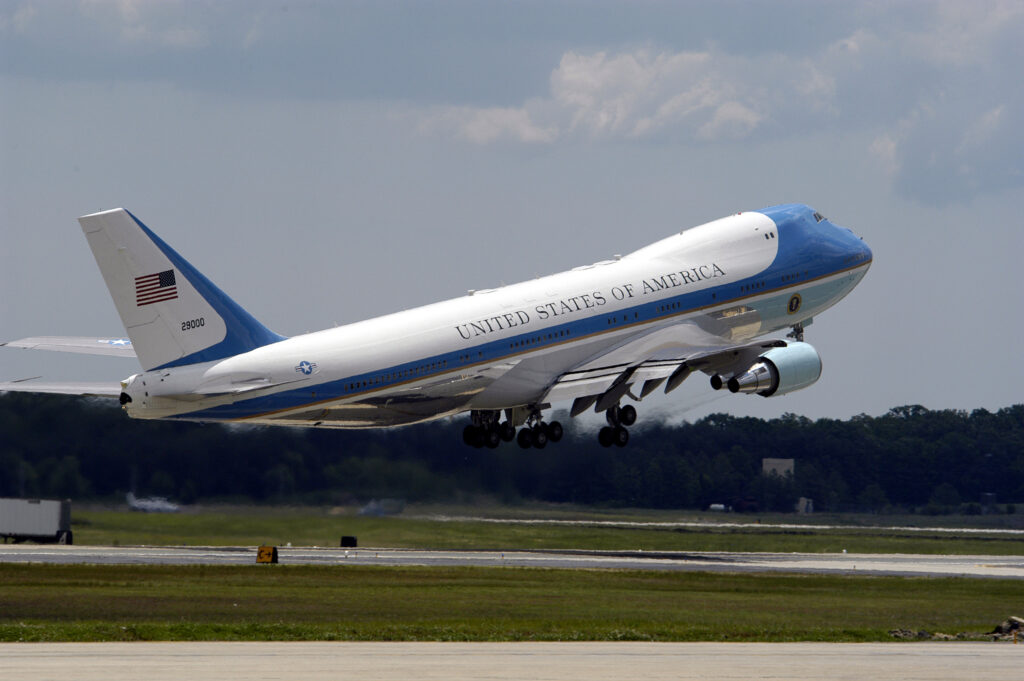
JOINT BASE ANDREWS, Md. — President Donald Trump on Friday unveiled a new presidential aircraft that will serve as an interim Air Force One, showcasing a modified former Qatari Boeing 747-8 that has been converted for executive transport while Boeing’s long-delayed replacement program remains years behind schedule.
Trump emerged from the aircraft during a ceremony with Air Force personnel at Joint Base Andrews, formally introducing what the Air Force refers to as the VC-25B Bridge aircraft.
“The workmanship of this plane is, when you see it, you won’t believe it,” Trump told attendees.
The aircraft is expected to enter service as a temporary presidential transport while Boeing continues work on the permanent next-generation Air Force One fleet, which is now not expected to arrive until approximately 2028.
Former Qatari Royal Aircraft
The aircraft began its life as a luxury Boeing 747-8 operated by Qatar’s ruling family before being transferred to the United States and extensively modified for government use.
The plane was accepted by the U.S. government as a donation and subsequently underwent significant upgrades by defense contractor L3Harris, including secure communications systems, defensive capabilities, and other modifications required for presidential travel.
Administration officials have described the aircraft as a practical solution to ongoing delays affecting Boeing’s VC-25B replacement program.
The Air Force has estimated that modification and conversion work cost substantially less than building an entirely new presidential aircraft, with some reports placing the total upgrade effort below $400 million.
Filling the Gap Until 2028
The new aircraft is intended to bridge a growing capability gap within the presidential fleet.
The current Air Force One aircraft — two specially modified Boeing 747-200s designated VC-25A — have been in service since the early 1990s.
After more than three decades of service, the aging aircraft have become increasingly expensive to maintain.
One of those aircraft recently completed its final mission following Trump’s return from the G7 summit and is now being retired after roughly 35 years of service.
The remaining VC-25A will continue operating alongside the new bridge aircraft until Boeing delivers the permanent VC-25B fleet.
Boeing’s replacement program has faced years of setbacks, technical challenges, and cost overruns that have repeatedly pushed back delivery dates.
Trump’s Preferred Design Returns
Perhaps the most visible change is the aircraft’s exterior.
The jet features a patriotic red, white, and dark blue color scheme that closely resembles the design Trump first proposed during his first term in office.
The livery replaces the iconic light-blue-and-white paint scheme introduced during the Kennedy administration and used by presidents for more than six decades.
The aircraft includes a large American flag on the tail, the presidential seal near the boarding door, and gold accent details incorporated into portions of the design.
Trump has long argued that the updated appearance better reflects American strength and national pride.
The redesign was originally approved during his first administration but later abandoned under President Joe Biden after Air Force officials raised concerns that implementing the changes could increase costs and delay production schedules.
Following his return to office, Trump revived the design and directed the Air Force to adopt similar styling for other executive transport aircraft.
Political and Ethical Debate
The aircraft’s origins have also generated significant controversy.
Critics questioned whether accepting a valuable aircraft from a foreign government raises constitutional and ethical concerns, particularly regarding the Constitution’s Foreign Emoluments Clause.
Security experts additionally raised questions about the extensive modifications necessary to ensure the aircraft met presidential security standards.
The administration has dismissed those concerns, arguing that the aircraft underwent comprehensive inspection and modification before entering service and that accepting the plane provided taxpayers with a cost-effective interim solution.
Trump has also stated that the aircraft will not become his personal property after leaving office.
Symbol of a Delayed Modernization Effort
Friday’s unveiling highlighted both the modernization of the presidential fleet and the continuing difficulties surrounding Boeing’s replacement program.
The permanent VC-25B aircraft, also based on the Boeing 747-8 platform, were originally expected years ago but have become one of the most troubled procurement programs within the federal government.
As a result, the newly unveiled bridge aircraft is expected to play a prominent role in presidential travel throughout much of Trump’s second term.
While intended as a temporary solution, the aircraft will likely become one of the most recognizable symbols of the administration — combining Trump’s preferred Air Force One design, a controversial foreign donation, and an effort to modernize presidential transportation while the United States waits for Boeing to finally deliver the next generation of Air Force One.
This is a breaking news story. Please check back for updates.
READ NEXT: James Talarico Wanted To Hurt Ken Paxton. A Child Became The Vehicle.















It’s just an aircraft!
TDS is going wild!
Would like to know the OVERALL cost to us taxpayers of this ‘new’ AF1. Have heard a brand new hangar was built just for this plane – cost of that? Have heard that other like planes were bought by the government so as to allow for training of the air crews – cost of that? What will happen to those recently bought planes? From what government funding source did all the dollars come from to do all this? Can Mr. Houck get us this information?