It won’t be a cakewalk, but it shouldn’t be Iwo Jima either. Despite all the naysayers and doom and gloom commentary about a potential U.S. military operation to seize Iran’s Kharg Island, which I proposed here a full week before it became topical, our Marines were deployed, or President Trump mentioned it, the mission is absolutely achievable by U.S. forces.
Our Marines, SEALs and 82nd Airborne troops are uniquely suited for this mission. We also have complete aerial naval supremacy over the Gulf and western Iran. And Kharg is geographically vulnerable.
The Pentagon has also war-gamed this scenario for years.
Seizing Kharg would involve neutralizing Iranian air defenses, using special operations forces, and establishing a layered defense to protect occupying troops against drone and missile attacks. “It’s not a cakewalk, but if I was the Iranian military, I would be afraid that the Marines are coming,” said retired Marine Col. William Dunn.
Strategic Significance
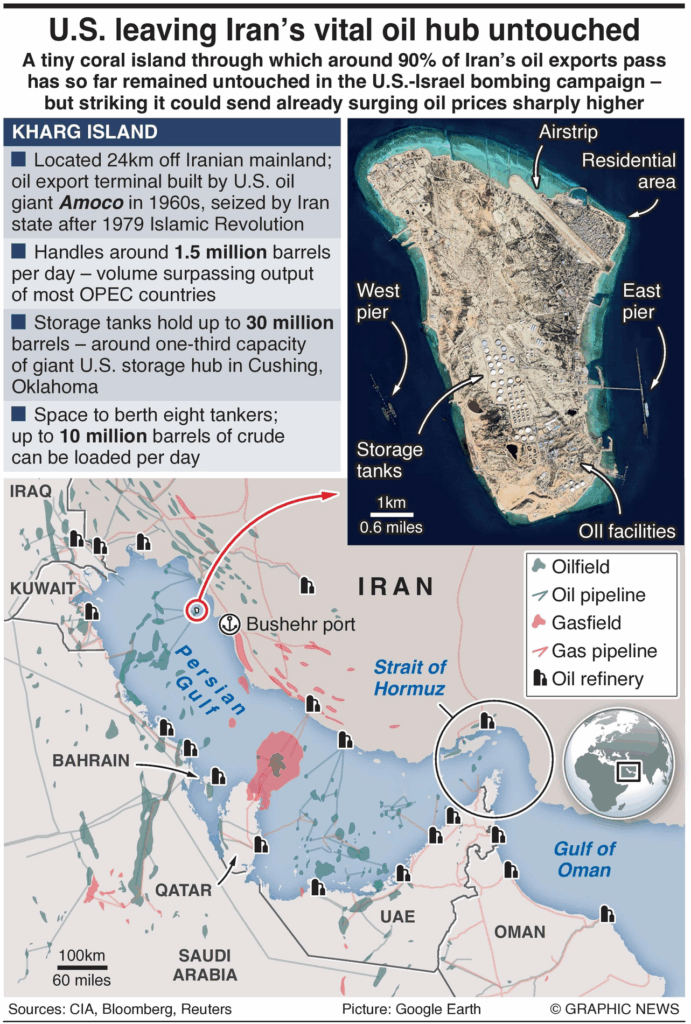
Iran’s Center of Gravity: From the beginning I argued that seizing the island, Iran’s ‘Crown Jewel,’ would give us a massive economic “chokehold” over the Iranian regime because as Iran’s “economic jugular vein” it handles roughly 90% of the country’s crude oil exports.
Controlling it would provide the U.S. with ultimate leverage to “bankrupt” the Islamic Revolutionary Guard Corps (IRGC) and force Iran to reopen the Strait of Hormuz.
Factors for Success
While militarily challenging, several factors contribute to the feasibility of such an operation:
1. The U.S. has already deployed specialized units to the region specifically designed for this type of mission:
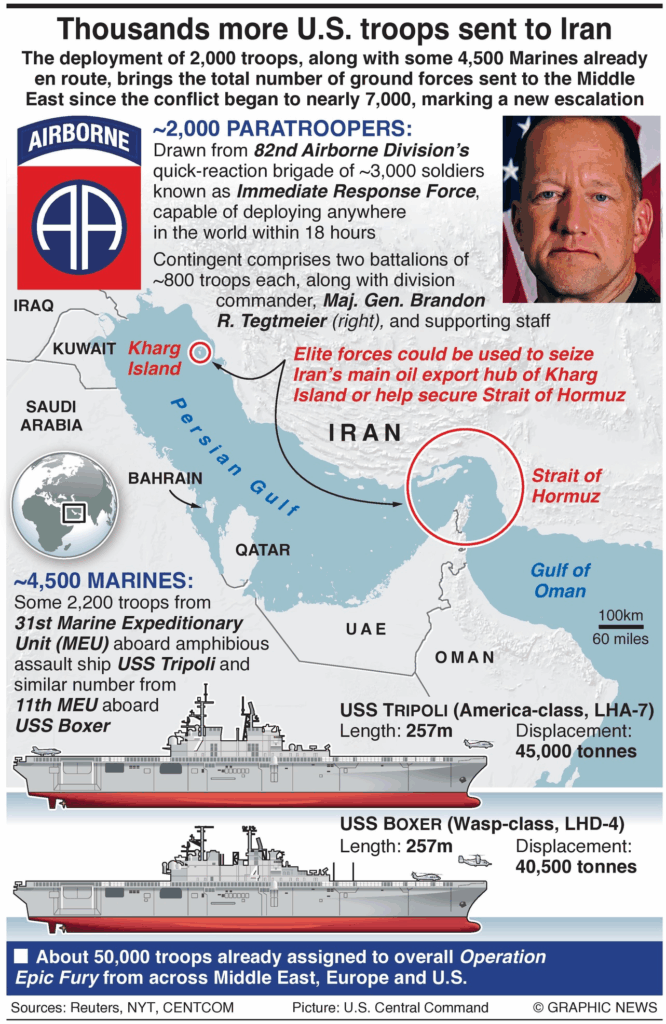
Marine Expeditionary Units (MEUs): These units with 2,500 Marines each, helicopters, F-35 fighters, landing craft, light armored vehicle, and HIMARS rocket launchers, specialize in rapid-response amphibious landings, raids, and assault missions from the sea.
One MEU is already in theater while another is enroute.
82nd Airborne Division: Approximately 1,000 soldiers from the “Immediate Response Force” are in the region; they are optimized for fast, airborne entry to secure key terrain like airfields.
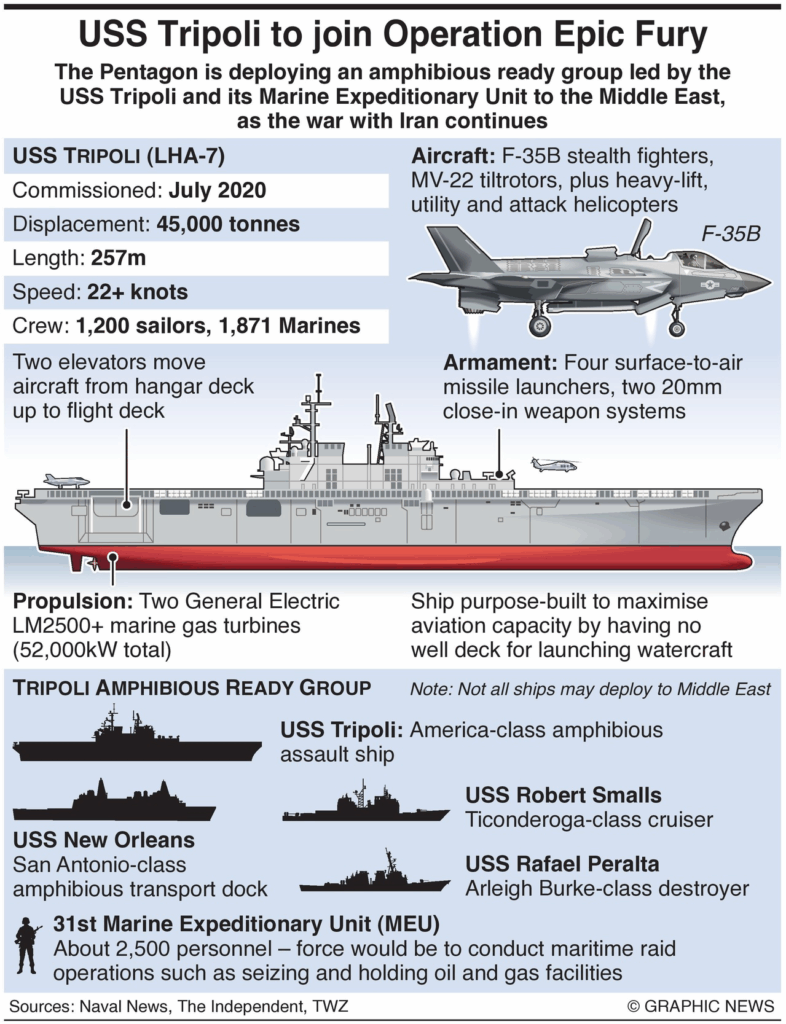
2. Air and Naval Superiority: Military analysts, including retired Admiral James Stavridis, generally seen as a liberal, suggest the U.S. can “hold it indefinitely” as long as it maintains air and sea superiority over the island and surrounding waters.
Targeted Degradation: U.S. Central Command reported that recent and ongoing bombing raids successfully “obliterated” over 90 military targets on the island, including mine storage and missile bunkers, while intentionally sparing oil infrastructure.
Meanwhile, Iran’s coastal forces have been relentlessly hit. Retired Vice Admiral Kevin Donegan stated the mission is “absolutely executable” because much of Iran’s coastal defense capability has been degraded by recent U.S. strikes.
Persistent Surveillance: The U.S. maintains near-constant overhead surveillance, allowing commanders to track Iranian defensive movements and environmental changes in real-time.
3. Although Kharg Island is reportedly still somewhat heavily defended, its physical characteristics make it a viable, and vulnerable, objective.
Isolated Target: As a fairly small 13-square-mile island, it is a defined, isolated, flat rocky outcrop about 15 nautical miles off the Iranian coast. Its location allows for significant naval and air power projection by U.S. forces that does not require the massive troop levels needed for a mainland invasion.
Deep-Water Access: Unlike the shores along Iran’s mainland, the island’s coast is close to deep waters, facilitating the approach of large naval vessels and landing craft.
4. Experts note that the initial seizure might only require a relatively small force of 800 to 1,000 troops. I argued that a single MEU could take the island, if defenses were properly defeated beforehand, and SEALs were used to prepare the battlefield. Still, two MEUs, and paratroopers, would be better.
And threat intelligence will always guide the size and type of the force.
The Marines would go in fast from the sea via helicopters, tiltrotors and amphibious hovercraft, Adding 1,000 paratroopers would make rapid success almost a certainty.
While perhaps a bit optimistic, President Trump has stated that U.S. forces could take the island “any time we want” on “five minutes’ notice” – at least once our forces arrived on station.
Some doom and gloom analysts warn it is a high-risk operation that could become a liability or even consider it a potential ‘Trap.’ And there are of course risks and dangers that must be factored in.
Tactical Challenges
Casualties: Iran has built subterranean, hardened bunkers on the island, making an amphibious assault potentially difficult and costly. Navy SEALs and bunker buster bombs could counter these risks. GBU-72 Advanced 5K Penetrator, as well as high-explosive, laser-guided “bunker-buster” bombs, have already been used to hit these underground facilities.
The IRGC has also fortified the island with anti-personnel and anti-armor mines, portable anti-air MANPADS, and additional military personnel. Continued air and missile attacks, and massive suppressive fire during any assault would help mitigate this risk, as would SEALs.
Offshore attacks: The island is located only 16–20 miles from the Iranian mainland, making any occupying force vulnerable to persistent drone, missile, and artillery fire. As noted earlier, U.S. targeting of these forces has already achieved substantial reduction in Iranian capabilities and we control the air and sea.
Iranian forces may defend the island rigorously, using drones and shoulder-fired missiles, which could potentially lead to high U.S. casualties. All the measures noted above, though, would help reduce this risk considerably. And Iranian forces could also just surrender.
Strategic Risks
Rather than bringing a swift end to conflict, holding the island could drag the U.S. into a longer-term war. Possible, but many argue that this risk is overblown and unrealistic considering Iran’s economic vulnerability. Rapid settlement is much more likely.
Retaliation: Iranian officials have warned of “relentless, unceasing attacks” on regional infrastructure in countries that assist the U.S. operation. But Iran is already doing this and likely running low on munitions.
Escalation: Former NATO Commander James Stavridis warned that such an incursion could prolong the conflict and potentially draw in global powers like China, which relies on Iranian oil. This is unlikely. As we have already seen, few countries are keen to get involved. China also has significant reserves and energy alternatives.
Alternatives
Some, including Stavridis, have suggested an offshore blockade of the island as an alternative to a ground invasion. This would prevent Iranian oil exports without the risk of casualties associated with putting “boots on the ground” in Iranian territory.
This is definitely an option worth considering. And having the forces there to seize the island also gives the president the option to blockade it. Meanwhile, as the forces arrive that make all these scenarios possible, the IRGC high command is clearly becoming very concerned.
FOR MORE DETAILED, UNCENSORED, INTELLIGENCE AND ANALYSIS FROM PAUL CRESPO, subscribe to his SUBSTACK