

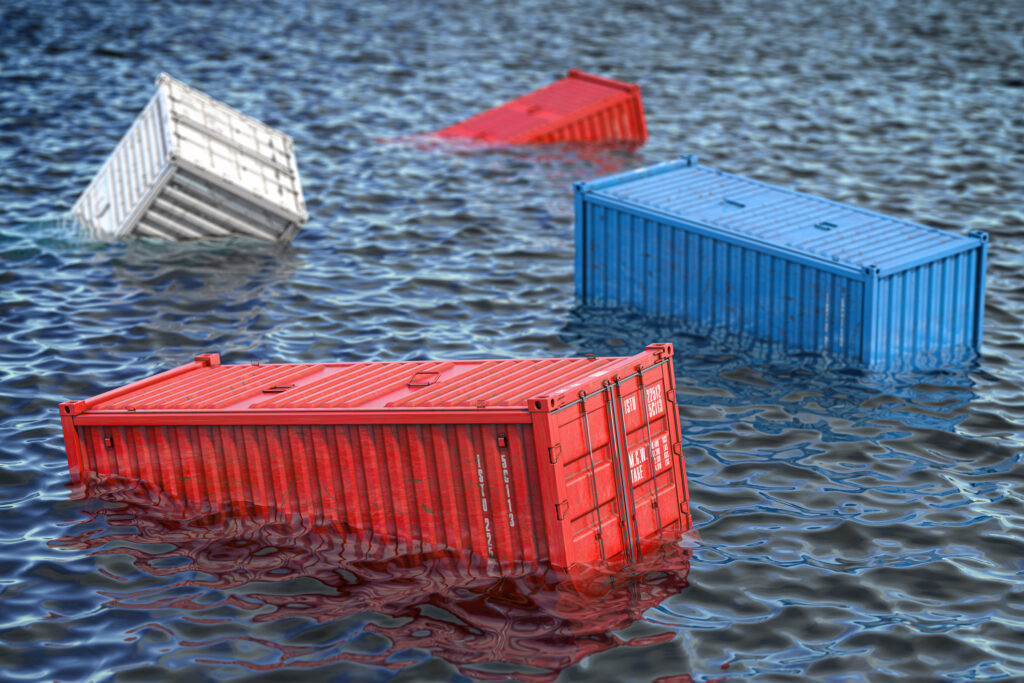
The United Nations’ International Maritime Organization (IMO) has quietly embarked upon a bold initiative cloaked in the virtuous garb of climate responsibility. Ostensibly designed to mitigate greenhouse gas emissions from international shipping, this global carbon levy is, in reality, a veiled taxation mechanism poised to significantly burden American consumers and businesses. What may initially appear as prudent environmental stewardship reveals itself, under scrutiny, as a dramatic expansion of global taxation, circumventing American democratic processes and redistributing wealth under U.N. auspices.
The mechanics of the tax are deceptively simple. Under the proposed framework, shipping companies would be required to pay a fixed fee per metric ton of carbon dioxide emitted during transoceanic voyages. This fee, expected to begin at a baseline of $100 per ton and scale over time, would be calculated based on the fuel used and the vessel’s emissions profile. Crucially, this cost is not absorbed by the shipping conglomerates. It is passed down the chain of commerce—first to importers, then to wholesalers, and ultimately to the end consumers. The result is an invisible tax hike on every imported good that enters American ports, from smartphones assembled in Southeast Asia to agricultural produce from Latin America. The levy, in effect, operates as a consumption tax imposed by a foreign body on the American populace.
According to research by UNCTAD and DNV, this levy could escalate freight costs by between 71% and 85%, potentially doubling the price of shipping goods from overseas by mid-century. Such an increase is not mere statistical abstraction—it translates directly to elevated costs for everyday items, affecting everything from imported electronics to agricultural commodities. Shipping industry executives, from tanker operators to dry bulk carriers, have already begun expressing grave concerns, warning that these cost increments will inevitably cascade through supply chains, burdening American consumers and reducing corporate earnings in an already tenuous economic climate.
GLOBAL WARMING: The UN, through its International Maritime Organization, is quietly advancing a global carbon tax on shipping that could double overseas freight costs for Americans. Framed as a climate initiative, the levy would funnel billions into UN-controlled climate funds… pic.twitter.com/zY2kRBwNmk
— @amuse (@amuse) April 3, 2025
Beyond economic ramifications, the levy raises significant questions of democratic legitimacy. Traditionally, the power of taxation has been strictly the province of elected legislatures—explicitly, in the American context, the U.S. Congress. Yet the IMO’s method of implementing this tax is deftly designed to bypass such legislative oversight. By framing the carbon levy as amendments to MARPOL Annex VI regulations, the U.N. effectively sidesteps the requisite Senate ratification processes for international treaties. Consequently, this global levy could be implemented domestically through executive regulatory changes without meaningful congressional debate or approval. This constitutes nothing less than taxation without representation, a principle that, ironically, once motivated the American colonies’ revolt against Britain.
To understand the long-term danger, one need only glance eastward across the Atlantic. The European Union, originally conceived as a common economic market to facilitate trade and prevent future conflicts, has gradually metastasized into a supranational government. What began as voluntary economic cooperation now resembles an unelected bureaucracy capable of overriding national parliaments. Today, from energy mandates to migration quotas, Brussels dictates terms to sovereign nations in ways unimaginable at the time of the Treaty of Rome. The European Commission—a body of unelected technocrats—wields more influence over member states’ laws than many of their own legislatures. The arc of integration has bent toward centralization, not consensus.
This should serve as a cautionary tale. The IMO’s carbon levy, though seemingly benign in scope, is an embryonic form of the same political dynamic. By establishing the precedent that an international body can impose direct economic obligations on sovereign nations without the consent of their legislatures, the levy lays the groundwork for a future in which financial sovereignty is no longer national, but global. What Brussels is to the Eurozone, the U.N. aspires to become for the world: an unelected arbiter of fiscal and regulatory policy.
Moreover, the levy stands to generate tens of billions of dollars annually, projected to reach between $40 and $60 billion by 2050. Alarmingly, these substantial revenues would flow directly into U.N.-controlled climate funds, notably entities like the Green Climate Fund. Such arrangements inherently dilute national sovereignty by placing substantial financial resources under international bureaucratic oversight, insulated from direct democratic accountability. Conservative institutions such as the Heritage Foundation have astutely identified this as a stealth redistribution of wealth, warning that these mechanisms effectively empower U.N. bureaucrats to direct funds largely sourced from American consumers to favored developing nations and climate projects abroad. This surreptitious fiscal maneuver aligns disturbingly well with broader globalist ambitions to establish international regulatory and fiscal precedents.
It is particularly ironic—and telling—that even the purported beneficiaries of this wealth redistribution, developing nations themselves, have voiced stark opposition. Brazil, among other nations in South America and Africa, recognizes the profound economic toll such levies would impose on economies heavily dependent on maritime trade. A study conducted by Brazil’s University of Sao Paulo underscores the levy’s regressive nature, revealing that GDP in developing regions could shrink by approximately 0.13%, disproportionately harming those least able to bear such economic shocks. The American Economic Association further elucidates this imbalance, noting that nations exporting lower-value goods, such as agricultural products, would experience outsized impacts relative to richer, industrialized nations exporting higher-value goods like electronics.
Critics from within the shipping industry highlight the levy’s impracticality and economic destructiveness. Industry stakeholders note that the tax not only elevates operational costs significantly but also introduces uncertainty that discourages essential investments in maritime infrastructure and innovation. Companies are already discussing the prospect of divesting assets and reducing fleet sizes in anticipation of soaring operational expenses, suggesting a looming contraction in global shipping capacity precisely when economic resilience and expansion are most urgently needed.
Perhaps most troublingly, the broader implications of this initiative extend far beyond immediate economic concerns. The levy represents a clear precedent for establishing an authoritative global taxation regime, undermining national sovereignty and democratic governance. By circumventing traditional legislative approval and empowering an unelected international body to directly impose financial obligations on American consumers and businesses, the IMO’s carbon tax proposal threatens fundamental democratic principles. It symbolizes a decisive step toward a system wherein sovereign governments increasingly cede fiscal autonomy to international bureaucracies, reshaping global governance structures without democratic consent or transparency.
Historically, efforts to impose taxation without representation have sparked fierce resistance, grounded in fundamental ideals of liberty and self-determination. This U.N.-led carbon levy on shipping should thus be seen not merely as an economic misstep but as a profound political and philosophical assault on democratic governance. American policymakers, businesses and citizens alike must recognize the gravity of this issue, challenging not only the specific economic ramifications of this proposed levy but also its broader implications for democratic sovereignty and accountability.
In the end, the debate is not fundamentally about climate policy. Rather, it revolves around who holds the authority to impose taxes and control wealth—the elected representatives of sovereign nations or distant, unelected international bodies insulated from direct accountability. The question confronting Americans is clear: will we acquiesce quietly to this silent erosion of democratic control, or will we assert our foundational principles of self-governance and economic freedom?
The stakes could scarcely be higher. As Benjamin Franklin sagely cautioned, “When the people find that they can vote themselves money, that will herald the end of the republic.” Equally true is the inverse: when a people lose the power to determine their own financial burdens, they relinquish not only their wealth but their liberty itself.
Sponsored by the John Milton Freedom Foundation, a nonprofit dedicated to helping independent journalists overcome formidable challenges in today’s media landscape and bring crucial stories to you.
READ NEXT: Trump’s Latest Extraordinary Move Undoubtedly Puts America First












This should herald the end of the damned UN, or at least our exit, and their exit from our nation. Use the HQ as housing for our homeless and disabled veterans.
Is Congress paying attention? This is just another reason America needs to re-evaluate its membership and conditions of remaining in Global organizations that want to remove our sovereignty.
This is EXACTLY THE REASON, before I purchase ANYTHING OVER $100 or purchase case goods, I check where the item was manufactured. I will pay more happily for items made in the USA and so should everyone else!
Been saying it for a long time — get U.S. out of the U.N. immediately, and get the U.N. off American soil! The U.N. is currently a nefarious global power seeking total control! We need to leave it now!
ACarbonTax per ton of fuel used in International shipping.
It used to called the Dane Geld.
And was just as ileagal
Isn’t it in our Constitution or somewhere written down that taxing or laws made outside of our Congress and Constitution are considered foreign and cannot be enforced on American citizens. Didn’t the United Nations try to enforce their gun wishes or laws upon American citizens by demanding actually that the U.N. could make and enforce U.N. laws upon American citizens. They wanted guns turned over them and names and all information on citizens holding guns on American soil. I believe our Founders made sure no foreign gov’t could enforce their laws upon American citizens in the U.S. And just because the U.N. buildings are parked on American soil doesn’t make them our gov’t. They can’t even stop wars and when the U.N. sends in armies to supposedly protect refugees in U.N. camps, the soldiers in their armies end up raping women and children in the country in a civil war. The U.N. puts Muslims in charge of the refugee camps and the Muslims put their people inside the camps with first grab at the food given by Americans and Christians are parked outside the camps and get the food left over. And American citizens are supposed to be paying sneaky taxes in a round about way to the U.N. to support their crap.
Who cares what the U.N. wants? We need to evict them from their New York headquarters and stop all contributions. Then we can tell them to put their fees where the sun doesn’t shine.
Total control takes place ONE STEP AT A TIME ! Even China knows that. Do something before it’s too late.
Sounds like a great time to get out of the UN and allow them to set up office in another country.
USA should just get out of the UN. NOW!
We must question thye validity of the United Nations today more than ever. In my humble opinion does the UN actually serve a purpose to the US? They can’t bring about peace in the Ukraine because basically Russia can simply veto any action. While understand that US have the same power. The US has always been a step above all other major powers in the world when at war. The Russian soldiers during WW2 were basically animalistic in their treatment of people . Nothing has changed. Does every country pay their fair share of the expense of the UN? What percentage does Russia or China pay in comparison to the US? My understanding is that US pays 26.95%, China pays 18.69% and Russia pays 2.28%. The remaining nations pay 52.09%. I think it is time to re-evakuate the UN! They have no right to tax our ships.