

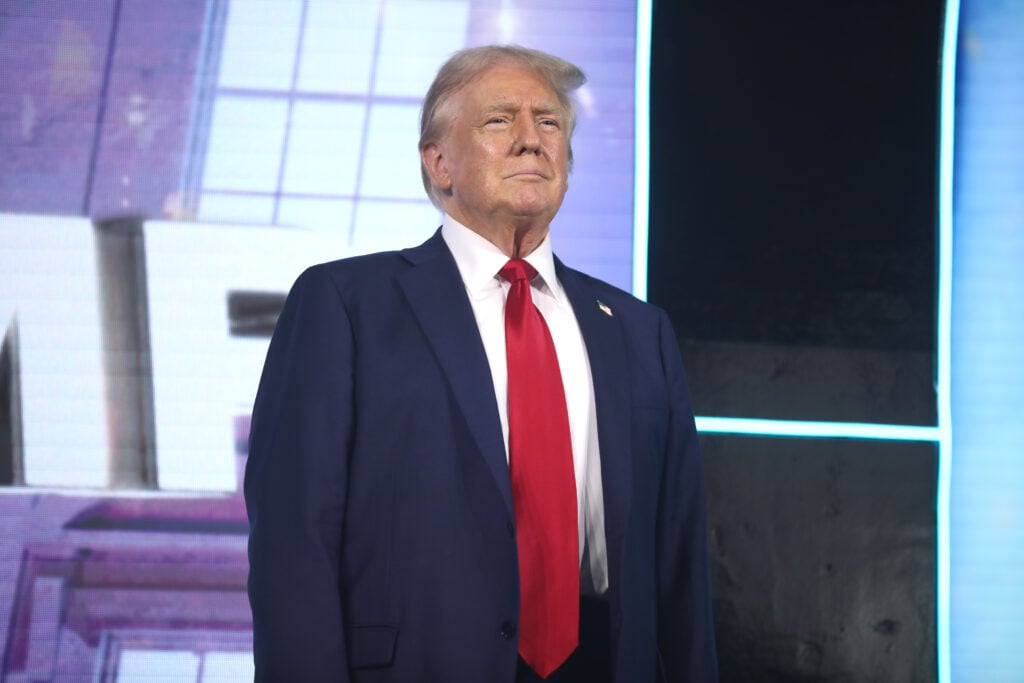
President Donald Trump on Sunday outlined a new vision to strengthen American manufacturing by encouraging foreign companies investing in the United States to temporarily bring in their own experts — not to replace American workers, but to train them in how to build complex products like semiconductors, ships, trains, and computers.
Trump made the announcement via his Truth Social platform, saying this strategy would both attract foreign investment and help American workers master high-skill manufacturing techniques that have long since moved offshore.
“When foreign companies who are building extremely complex products, machines, and various other “things,” come into the United States with massive investments, I want them to bring their people of expertise for a period of time to teach and train our people how to make these very unique and complex products, as they phase out of our country, and back into their land,” Trump wrote.
A Reverse of the H-1B Paradigm?
Trump’s proposal also marks a stark departure from decades of immigration and labor policy, particularly under the H-1B visa program, which critics say often resulted in American workers being forced to train their own lower-paid foreign replacements — only to be laid off once the knowledge transfer was complete.
While the H-1B system was originally designed to bring in highly skilled workers to fill shortages, it has long faced criticism for enabling companies to offshore jobs and suppress wages.
This shift aligns with Trump’s longstanding pledge to prioritize American workers and reclaim industrial capacity lost to globalization.
However, labor unions and immigration skeptics may raise concerns about temporary foreign labor replacing domestic jobs, even if the stated goal is training and technology transfer.
Relearning What Was Lost
The president cited America’s once-thriving shipbuilding industry as an example of what must be recovered.
“We used to build a ship a day. Now we barely build a ship a year,” Trump said. “We have to learn from others how to make these products, or, in many cases, relearn.”
The initiative, Trump stressed, is about strategic cooperation.
“We welcome them, we welcome their employees, and we are willing to proudly say we will learn from them — and do even better than them at their own ‘game,’ sometime into the not-too-distant future,” he added.
Boosting Confidence for Foreign Investment
Trump clarified that his goal is not to “frighten off” or discourage foreign nations from investing in the U.S., but rather to create an environment where global companies see long-term value in building within the United States.
“If we didn’t do this, all of that massive investment will never come in the first place,” Trump warned.
The proposal is part of Trump’s broader industrial policy, which includes aggressive tariffs, reshoring of manufacturing, and increased support for critical industries such as defense, energy, and microelectronics.
Tariffs and Economic Nationalism Still Central to Trump’s Vision
Trump’s latest manufacturing comments come just days after the U.S. Supreme Court announced it would hear a case challenging the legality of Trump’s sweeping tariffs — a cornerstone of his economic policy.
Earlier this month, Trump claimed that more than $15 trillion in new investment had been driven by the tariffs, which were designed to curb Chinese economic influence.
He warned in a recent post that if courts strike them down, the United States would “likely become a Third World Nation.”
READ NEXT: Poll Reveals Majority Of Americans Don’t Want More H1-B Visas















Always some stupid gimmick solution that is practically designed to be exploited.