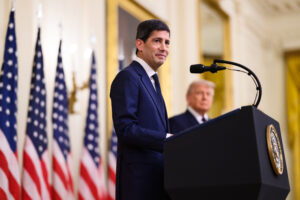
In a promise with huge implications for U.S. energy policy, President-elect Donald Trump has pledged to immediately reverse President Joe Biden’s sweeping ban on new offshore oil and gas drilling permits.
Speaking to radio talk show host Hugh Hewitt on Monday, Trump took aim at Biden’s hours old executive order, which halts drilling across 625 million acres of U.S. coastal waters. “I see it just came over that Biden has banned all oil and gas drilling across 625 million acres of U.S. coastal territory. It’s ridiculous,” Trump declared. “I’ll unban it immediately.”
The Biden administration announced the edict early Monday morning, ending days of speculation. The executive order bans new drilling on large portions of the East and West Coasts, the Eastern Gulf of Mexico and Alaska’s North Bering Sea. (RELATED: Biden And Obama’s Drilling Coup: Undermining Trump’s Mandate)
PRESIDENT TRUMP: "I see it just came over that Biden has banned all oil and gas drilling across 625 million acres of U.S. coastal territory. It's ridiculous. I'll unban it immediately." pic.twitter.com/mGijm5N6v7
— Trump War Room (@TrumpWarRoom) January 6, 2025
“My decision reflects what coastal communities, businesses, and beachgoers have known for a long time: that drilling off these coasts could cause irreversible damage to places we hold dear and is unnecessary to meet our nation’s energy needs. It is not worth the risks,” a statement from Biden read.
Nevertheless, the outgoing president’s ban could have long-term implications for U.S. energy independence, especially as other nations ramp up offshore drilling efforts. Countries such as China, Cuba, India, United Arab Emirates, Mexico, Saudi Arabia, Qatar, Brazil and Norway are actively expanding their energy operations, highlighting the strategic challenges made worse by Biden’s move. Critics argue that restricting domestic production leaves the U.S. increasingly reliant on foreign energy sources, thereby undermining its competitive edge.
Biden’s order utilizes the Outer Continental Shelf Lands Act (OCSLA) of 1953, a decades-old law granting the executive branch broad authority to protect U.S. waters from oil and gas leasing. However, the law’s provisions do not explicitly allow for such protections to be revoked, raising questions about whether Trump—or any future president—could easily overturn the designation. Legal challenges are likely to play a key role in determining the order’s permanence.
The U.S. has historically relied on foreign energy sources, particularly oil, but this reliance has decreased significantly in recent years due to domestic energy production advancements.
Despite progress, increasing reliance on global markets for oil and gas could expose U.S. consumers to price volatility caused by geopolitical disruptions. Meanwhile, the push for renewable energy has created new dependencies, such as importing solar panels and wind turbine components from foreign producers, particularly China.
Ensuring a balanced energy mix, increasing domestic production of critical materials and reducing exposure to volatile foreign markets are key to addressing potential overreliance on foreign energy sources.
With energy security emerging as a critical issue, Trump’s promise to reverse Biden’s ban sparks a broader debate and potential legal challenges in the upcoming months.
READ NEXT: Betrayal Brewing In Trump’s New A-Team? Expert Issues Urgent Warning