
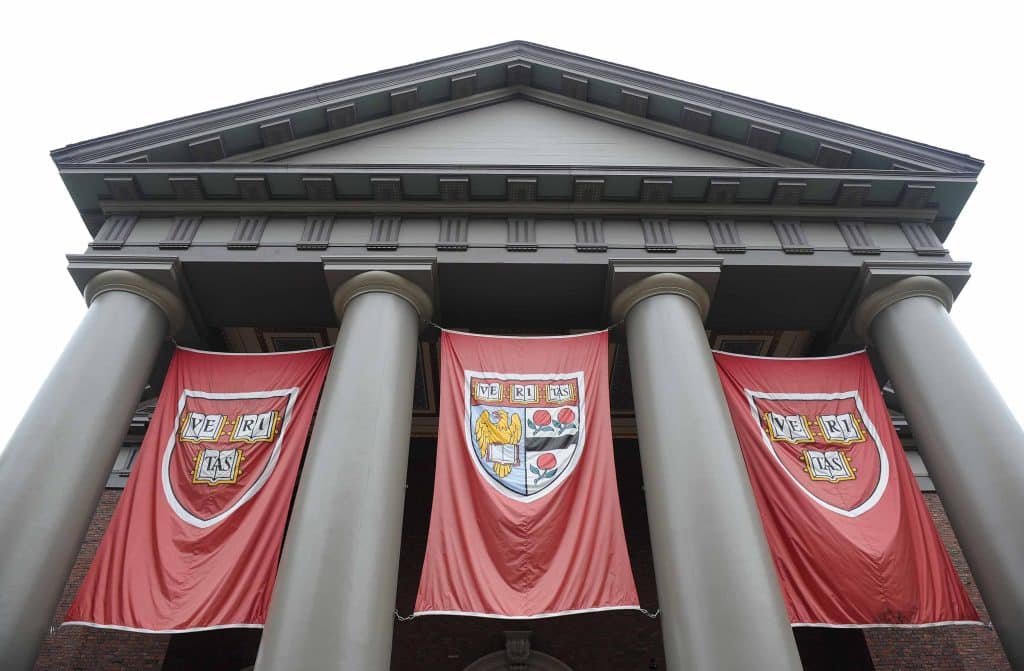
A longtime Harvard University history professor has left the Ivy League after four decades, using his departure to deliver a sweeping and sharply worded critique of what he described as the school’s ideological drift, lowered academic standards, and embrace of progressive orthodoxy.
James Hankins, who taught history at Harvard for 40 years, announced his departure in an essay titled “Why I’m Leaving Harvard,” published in Compact Magazine. Hankins said he decided as early as 2021 that he would leave the university but remained until a four-year retirement agreement expired just weeks ago. He has since taken a position as a visiting professor at the University of Florida.
Hankins cited Harvard’s COVID-era policies as an early breaking point, describing the university’s response as authoritarian and intellectually stifling.
“We had just endured almost two years under the university’s strict Covid regime,” Hankins wrote. “This was a form of emergency governance that mirrored to a fault the whole country’s uncritical acceptance of The Science and its proclivity, when backed by public power, for tyrannous invasions of private life.”
He criticized requirements that professors lecture while masked and conduct seminars over Zoom, saying such measures were incompatible with serious education.
Hankins also pointed to what he described as discriminatory admissions practices following the 2020 riots sparked by the death of George Floyd. While he initially expected what he called “empty virtue-signaling,” he said the university instead adopted informal policies that disadvantaged white male applicants.
“In reviewing graduate student applicants in the fall of 2020 I came across an outstanding prospect who was a perfect fit for our program,” Hankins wrote. “In past years this candidate would have risen immediately to the top of the applicant pool. In 2021, however, I was told informally by a member of the admissions committee that ‘that’ (meaning admitting a white male) was ‘not happening this year.’”
Hankins described a second case involving a former Harvard undergraduate with what he called the highest academic record in his class and whom he described as “certifiably brilliant.” According to Hankins, the student was rejected by every Harvard graduate program to which he applied.
“He too was a white male,” Hankins wrote. “Everywhere it was the same story: Graduate admissions committees around the country had been following the same unspoken protocol as ours.”
“The one exception I found to the general exclusion of white males had begun life as a female,” he added.
A Harvard spokesperson confirmed, as Hankins noted in his essay, that graduate admissions decisions are faculty-led and handled at the departmental level.
Beyond admissions, Hankins argued that Harvard’s history department has been hollowed out academically over decades, pressured by activists to abandon the Western canon and lower standards for hiring and promotion.
He described a former “two-book standard” for senior faculty appointments—requiring two published scholarly books—as a hallmark of academic rigor prior to the 1990s.
“The two-book standard would be shelved in the late 1990s when we were under increasing pressure to hire more women faculty,” Hankins wrote. “Feminist activists…were demanding that half of all new appointments be women.”
Because women comprised less than 10 percent of history PhDs at the time, Hankins argued that achieving numerical equality required lowered standards—an assertion he said was vociferously denied by activists.
“The real problem, they said, was the inability of men properly to value female scholarship,” Hankins wrote, adding that dissenters were labeled “sexists.”
Hankins also criticized the department’s shift away from Western civilization toward “global” and “transnational” history. He described how a two-semester Western civilization requirement he helped establish—followed by the integration of non-Western history—was dismantled by the early 2000s.
“Soon the department was promoting an ever higher percentage of junior faculty,” he wrote, describing tenure expectations that increasingly required only partial manuscripts rather than completed scholarly works.
He characterized many of these newer faculty members as “left-leaning” and said the changes coincided with a broader institutional globalization that deprioritized Western history.
“‘Transnational history’ meant that Europeanists would no longer teach the internal history of European nations—no more courses on the German Reformation, Elizabethan England, or the French Revolution,” Hankins wrote.
He contrasted this with how other civilizations were taught.
“Western global history, by contrast, displays no loyalty to Western societies or traditions; quite the contrary,” he wrote. “In the hands of hyper-progressive (or ‘woke’) practitioners, Western global history is often, indeed, actively anti-Western.”
Hankins concluded that he sees little chance of reform within elite academic institutions.
“For those like myself…a better hope lies in building new institutions unencumbered by the corruption and self-hatred that infect the old,” he wrote.
His departure adds to a growing chorus of criticism from academics who argue that elite universities have sacrificed intellectual rigor and viewpoint diversity in favor of ideological conformity.
READ NEXT: Harvard Protestors Strike Deal To End Encampment
Sponsored

















In other words they now exclusively manufacture good little Communists and Racists and the degree is worthless.