

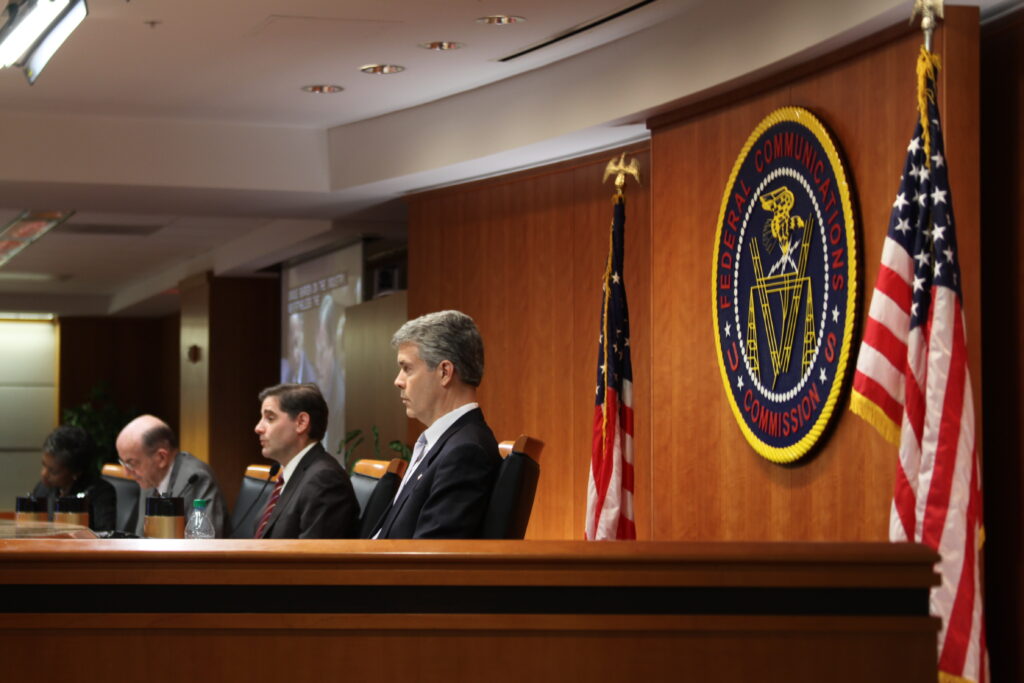
A Republican senator is pushing back against threats by Federal Communications Commission Chair Brendan Carr to revoke broadcast licenses from news outlets over their coverage of the war with Iran.
Sen. Ron Johnson (R-Wis.) criticized the idea during a television interview, warning against government pressure on the media regardless of which party is in power.
The Wisconsin Republican defended press freedoms while criticizing what he described as excessive government involvement in the media.
“I’m a big supporter of the First Amendment,” the senator told Fox News. “I don’t like the heavy hand of government, no matter who’s wielding it. … I would rather the federal government stay out of the private sector as much as possible.”
“The federal government’s role is to protect our freedoms — protect our constitutional rights,” he added.
FCC chair Brendan Carr warned that broadcasters had to "correct course before their license renewals come up." https://t.co/YN2cl5ZFks
— Newsweek (@Newsweek) March 15, 2026
Carr warns broadcasters about “distortions”
The dispute began Saturday after Carr suggested that broadcasters airing what he described as “hoaxes and news distortions” about the war in Iran could face consequences when their licenses come up for renewal.
In a social media post, Carr argued that broadcast stations using public airwaves must operate in the public interest and could lose their licenses if they fail to do so.
The warning followed criticism from President Donald Trump and other administration officials who say media coverage of the Iran conflict has been misleading or hostile to the administration.
Trump publicly supported Carr’s stance, accusing some outlets of spreading false reports about the war.
First Amendment concerns emerge
Carr’s comments quickly drew criticism from lawmakers in both parties and from free speech advocates.
Johnson’s remarks stood out because he is closely aligned with Trump politically but said he opposed using federal power to pressure media outlets.
Democratic lawmakers were more blunt, describing the threats as an authoritarian attempt to intimidate the press.
Constitutional law 101: it’s illegal for the government to censor free speech it just doesn’t like about Trump’s Iran war.
— Elizabeth Warren (@SenWarren) March 14, 2026
This threat is straight out of the authoritarian playbook. https://t.co/7B3inYEV2t
When our nation is at war it is critical that the press is free to report without government interference. It is literally in the Constitution. This is overreach by the FCC because this Administration doesn’t like the microscope and doesn’t want to be held accountable. https://t.co/Y6fxigFERQ
— Captain Mark Kelly (@CaptMarkKelly) March 14, 2026
The is the federal government telling news stations to provide favorable coverage of the war or their licenses will be pulled.
— Chris Murphy 🟧 (@ChrisMurphyCT) March 14, 2026
A truly extraordinary moment.
We aren't on the verge of a totalitarian takeover. WE ARE IN THE MIDDLE OF IT.
Act like it. https://t.co/3w4kpzray7
FCC Commissioner Anna Gomez, the agency’s lone Democrat, also criticized the idea and said such threats conflict with First Amendment protections for independent reporting.
Limits on the FCC’s authority
The FCC regulates television and radio stations that use public airwaves and periodically renews their licenses. But the agency does not directly license national cable networks such as CNN or many digital outlets.
That means enforcement actions typically target individual local broadcast stations rather than the national networks themselves.
Media law experts say revoking broadcast licenses over editorial decisions would face serious constitutional hurdles because the government generally cannot punish news organizations for the content of their reporting.
While the government can regulate certain aspects of broadcasting, it typically cannot penalize news outlets for the viewpoints they express or the specific content of their reporting.
Section 326 of the Communications Act of 1934 explicitly prohibits the FCC from interfering with the right of free speech through broadcast communication.
Although the FCC can investigate claims of “broadcast news distortion,” the legal threshold is extremely high, requiring evidence of deliberate falsification rather than simple inaccuracy or differences of opinion.
A growing fight over war coverage
The clash reflects a broader conflict between the administration and major news organizations over reporting on the Iran war.
Administration officials have accused the media of exaggerating damage from Iranian attacks and spreading misinformation, while journalists and press freedom groups argue the government is attempting to pressure outlets into favorable coverage.
Johnson said the answer to disputed reporting should not be federal intervention.
Even when coverage is controversial or unpopular, he argued, the First Amendment limits how far the government can go in policing the press.
READ NEXT: Judge’s Midterm Ruling Deals Blow To Democrats
















Sen. Ron Johnson (R-Wis.) Obviously has his head where the sun doesn’t shine. Most if not all of the maine news outlets have an agenda, to bambuzal the American public that can’t think for themselves and rely on fake news for their info.