
Good morning.
As Washington weighs the fallout from joint American-Israeli strikes on Iranian leadership, investigators are probing a deadly shooting in Texas for possible terrorist ties. At the same time, Congress is accusing European officials of quietly reshaping what Americans are allowed to say online.
Terror Threat Level Under Scrutiny After Iran Strikes
In the wake of joint strikes by the United States and Israel that allegedly killed Iranian leaders — including Supreme Leader Ali Khamenei — some national security voices are urging the federal government to formally raise the country’s terrorism threat level.
Former DHS adviser Charles Marino said the Department of Homeland Security should elevate the National Terrorism Advisory System (NTAS), arguing that the current threat environment warrants it.
“There’s no doubt that law enforcement and intelligence agencies are operating at an elevated threat level here in the United States,” Marino said, pointing to fears of potential retaliation or sleeper cell activity following the strikes.
Iranian officials have threatened retaliation, raising concerns among American security agencies about domestic vulnerabilities.
Marino also tied what he described as growing internal risks to past border and immigration policies, arguing that weaknesses in asylum and legal immigration systems have made the homeland more susceptible to infiltration and radicalization.
Former ATF Special Agent in Charge Bernard Zapor echoed concerns about domestic preparedness, warning that funding uncertainty for DHS could leave the country exposed.
“Our public safety has to be paramount,” he said, emphasizing that national security should rise above politics.
For now, DHS has not formally raised the NTAS level. But calls to do so are growing louder.
Austin Shooting Investigated as Possible Terrorism
Those warnings took on sharper urgency after a deadly shooting early Sunday in downtown Austin.
Just after midnight, a 53-year-old gunman opened fire at Buford’s Backyard Beer Garden along Sixth Street, killing two people and injuring 14 others. The suspect, later identified as Ndiaga Diagne, was shot and killed by police less than a minute after officers encountered him.
According to authorities, the suspect wore clothing bearing religious language and Iranian imagery. A shirt displaying the Iranian flag was reportedly visible beneath a hoodie reading “Property of Allah.” Investigators also recovered a Quran inside his vehicle and discovered Iranian flags and images of Iranian leaders during a search of his home.
The Federal Bureau of Investigation said evidence suggests a possible nexus to terrorism, though officials cautioned that a definitive motive has not yet been established. Agents are working with the Austin Police Department to process digital and physical evidence.
Texas Gov. Greg Abbott offered condolences to victims’ families and pledged state support. President Donald Trump was briefed on the attack, according to the White House.
Authorities are urging the public to avoid speculation as investigators determine whether the violence was ideologically driven, influenced by foreign actors, or the act of a lone extremist.
For now, the attack underscores what security officials describe as a volatile and uncertain domestic threat landscape.
House Report Alleges European Campaign to Censor Americans
While law enforcement focuses on physical security, lawmakers are sounding alarms over a threat to digital freedom.
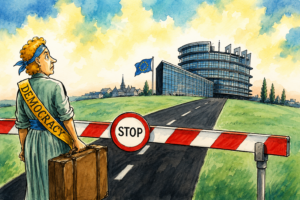
The U.S. House Judiciary Committee released an interim staff report alleging that the European Commission conducted a years-long pressure campaign to influence how major social media platforms moderate content globally — including speech by American citizens.
According to the Committee, nonpublic documents obtained under subpoena show European officials held more than 100 closed-door meetings with tech companies since at least 2020, pushing for stricter content moderation policies.
The report claims that, under this pressure, platforms censored “true information and political speech” related to debates over COVID-19, mass migration, and transgender issues. It further alleges that the Commission disproportionately targeted conservative viewpoints and interfered in elections across Europe.
In December 2025, the Commission fined social media platform X nearly six percent of its global revenue, a decision the Committee characterized as retaliatory for its stance on free speech protections.
The European Commission has not publicly responded to the latest congressional findings. The Committee says it will continue investigating an existential risk to Americans’ First Amendment rights.
READ NEXT: Censorship With A Smile: Europe’s Redefinition Of Press Liberty