
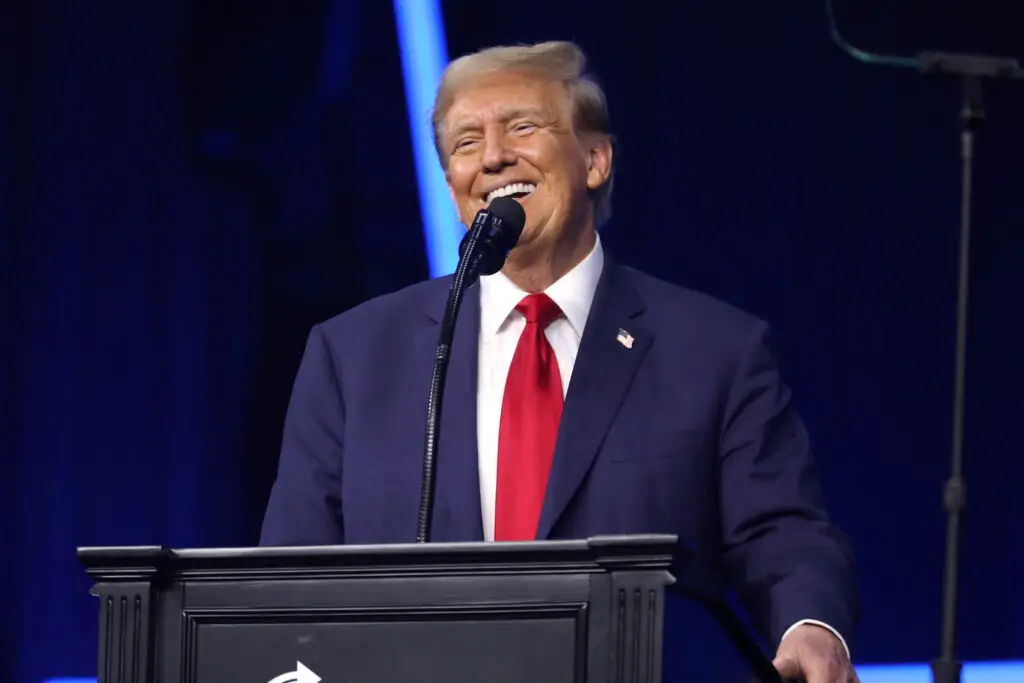
President Donald Trump is expected to sign an executive order on Friday that will designate English as the official language of the United States. This move will have significant implications for government operations and services, particularly those provided to non-English speakers.
The executive order will allow federal agencies and organizations receiving federal funding to decide whether they will continue to offer services and documents in languages other than English. This is a significant shift from previous policies, and will rescind a mandate from former President Bill Clinton, which required government entities to provide language assistance to non-English speakers in order to receive federal funding.
The White House insists that making English the official language will “promote unity, establish efficiency in government operations, and create a pathway for civic engagement.”
The United States has never had an official language at the federal level, unlike more than 30 states, which have adopted laws making English the official language. Groups such as U.S. English, which advocates for the recognition of English as the nation’s official language, have long supported the measure.
Trump has consistently voiced concerns about the growing use of non-English languages in the U.S. and has often pointed to the challenges it presents. “We have languages coming into our country, we don’t have one instructor in our entire nation that can speak that language,” Trump said last year. “These are languages—it’s the craziest thing—they have languages that nobody in this country has ever heard of. It’s a very horrible thing.”
The push for English as the official language is not just about communication, but also about national identity and integration. Trump has previously criticized bilingualism in the U.S., taking issue with former Florida Governor Jeb Bush for speaking Spanish on the campaign trail in 2015. “This is a country where we speak English, not Spanish,” Trump stated during a Republican debate at the time.
The controversy surrounding the use of other languages in the United States not new. In states like Texas, where Spanish-speaking communities are significant due to the state’s history and proximity to Mexico, debates over language have been a recurring issue. In 2011, a Texas state senator demanded that an immigrant rights activist speak in English during a legislative hearing, reigniting a long-standing debate.
While Trump’s order will allow federal agencies to continue providing services in languages other than English at their discretion, it is expected to limit the scope of language assistance that was previously mandated. Supporters of the executive action argue that it’s another example of Trump’s America First agenda, with the goal of unifying the country over shared practices and culture.
Critics of the order argue that it could marginalize non-English speakers and create barriers for immigrants seeking to integrate into American society, though supporters argue that if an immigrant truly wants to integrate into American society, they’d prioritize learning the country’s most commonly spoken language.
READ NEXT: Report: Fox News To Launch Spanish Language News Program
















Should have been done years ago. Look at all the different languages that require interpretation and the printing costs. Multi-lingual society does nothing to create assimilation. When I was a kid it was the children that were telling their parents and grand parents to learn English. My question has always been, how do I know what the translation really says? As I’ve seen in the recent past trusting government to produce the truth is questionable at best.