

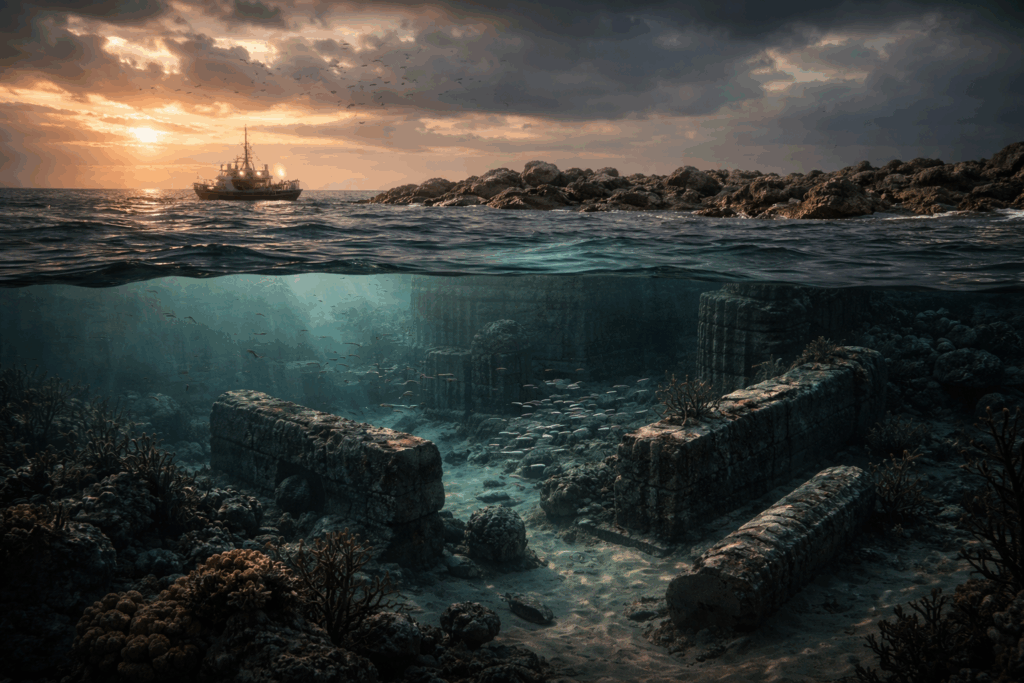
Reports of mysterious underwater formations off the Louisiana coast have reignited speculation about a possible 12,000-year-old “lost city,” though experts remain highly skeptical of the claims.
The theory centers on an area near the Chandeleur Islands, a chain of barrier islands roughly 50 miles east of New Orleans in the Gulf of Mexico.
The Discovery Claims
The idea of ancient “ruins” comes largely from George Gelé, a retired architect and self-described amateur archaeologist who has studied the area for decades.
Gelé claims he has identified:
- Large granite formations on the ocean floor
- Sonar images suggesting building-like structures
- Evidence of a possible pyramid roughly 280 feet tall
He has argued the site — which he calls “Crescentis” — could represent a submerged city predating known civilizations like the Maya and Inca.
Adding to the intrigue, local fishermen have reported:
- Pulling up square-cut stones in their nets
- Experiencing strange compass and electronics disruptions near the site
In a resurfaced 2022 interview with WWLTV, Gelé made a striking claim about the origins of the site. “All I know is that someone built the city 12,000 years ago,” he said, according to the New York Post:
In the clip, Gelé claimed that for 50 years, he has been capturing sonar images of submerged structures off Chandeleur Islands, a chain of uninhabited barrier islands situated in the Gulf of Mexico around 50 miles east of New Orleans.
The mysterious buildings reportedly number in the hundreds and are located 30 feet below the water’s surface and are buried underneath an additional 100 feet of sediment.
The crown jewel of this so-called lost city is a so-called 280-foot pyramid jutting up from the ocean floor, which the architect claims emits a powerful electromagnetic signature that affects passing boats. In fact, he believes that these aquatic remnants are “geographically related to the Great Pyramid of Giza in Egypt.”
All together, these pieces form a former civilization, dubbed Crescentis, which dates back 11,700 years to the end of the last Ice Age when rising seas inundated the coast.
Why Some Think It Could Be Ancient
Supporters of the theory point to geological history:
- Around 12,000 years ago, sea levels were much lower at the end of the last Ice Age
- Parts of what is now the Gulf Coast could have been dry land
This has fueled speculation that a prehistoric settlement may have been submerged as waters rose.
Skepticism From Experts
Despite the viral attention, scientists have not confirmed the existence of any ancient city.
More conventional explanations include:
- The stones may be ballast from old Spanish or French ships
- The formations could be natural geological features or debris from past human activity
Researchers note that no peer-reviewed archaeological evidence has verified the claims.
Speculation and Theories
The mystery has also sparked more fringe ideas, including:
- Links to ancient advanced civilizations
- Comparisons to Atlantis-like lost cities
- Even UFO-related theories tied to reported electromagnetic anomalies
However, none of these claims are supported by scientific consensus.
Bottom Line
While the idea of a 12,000-year-old lost city off Louisiana’s coast has captured public imagination, it remains unproven and widely disputed.
For now, whatever lies beneath the Gulf waters near the Chandeleur Islands remains a mystery — somewhere between science, history, and speculation.
READ NEXT: Once-Rising GOP Star Faces Prison Over Communist Lobbying Scheme



















Gulf of America.
Patrick, it is now the Gulf of America, not Mexico. Thank you for your attention to this matter.
Gulf of America!
I’m going with a ballast dump.
As a South Louisiana native, I can tell you that the picture above does not look like the Louisiana coastline. There are NO rocks or mountainous formations on the coast of Louisiana. It would be nice to see real pictures of the area talked about in the article.
theidea that a 480 ft tal structure could be made from ballasts, is totally ridiculous,so called scientist will always look for some excuse when confronted with non-conventional discoveries.
The quote “All truth passes through three stages: First, it is ridiculed; Second, it is violently opposed; Third, it is accepted as self-evident” is widely attributed to philosopher Arthur Schopenhauer. It describes how radical new ideas or truths initially face harsh rejection before gaining acceptance.