






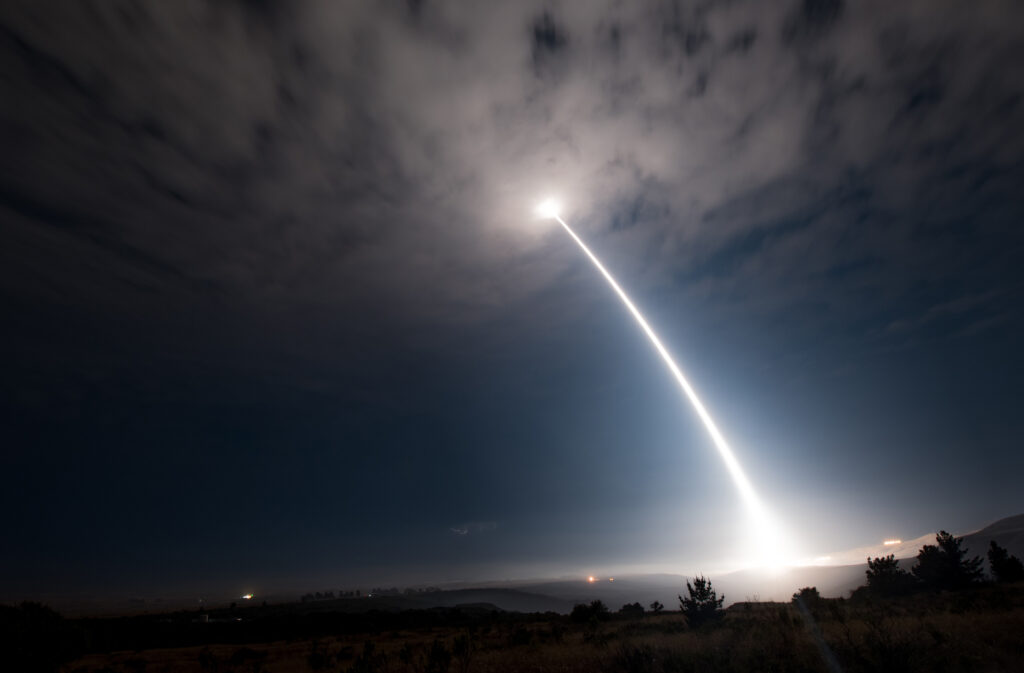
On Thursday, North Korea announced the successful test of its new intercontinental ballistic missile (ICBM), the “Hwasong-19,” which it claims can reach any target within the continental United States. This solid-fuel missile, described by state media as the “world’s strongest strategic missile,” demonstrated unprecedented range for the hermit kingdom, before ultimately landing in the ocean between Russia and Japan.
Observed by senior officials, including North Korean leader Kim Jong Un and his daughter, the missile reportedly traveled over 1,000 kilometers (621 miles) and reached an altitude of 7,000 kilometers (4,350 miles). The flight set a record for the longest ICBM flight by North Korea, lasting one hour and 26 minutes.
The missile launch was conducted using an 11-axle Transporter, Erector, Launcher (TEL), a mobile platform that enhances the difficulty of detecting launch preparations. The missile followed a steep, high-arc trajectory before whizzing into the Sea of Japan.
Kuzey Kore, yeni 'Hwasong-19' kıtalararası balistik füzenin fırlatma videosunu yayınladı. pic.twitter.com/G9hPeX7Lcm
— TRT HABER (@trthaber) November 1, 2024
Key Details on the Hwasong-19 ICBM
–Flight Range: Analysts estimate the Hwasong-19’s range at approximately 15,000 kilometers (9,320 miles), making it theoretically capable of reaching the entire continental United States.
–Launch Observers: North Korean leader Kim Jong Un and his daughter were present for the test, reinforcing the symbolic importance of the event within North Korea’s ongoing weapons development narrative.
–State Justification: According to statements from state media, Kim Jong Un described the test-fire as a defensive measure, intended as a clear “counteraction” against perceived threats to North Korean security from regional rivals.
North Korea successfully tested its longest-ever intercontinental ballistic missile, with a potential range of 15,000 km, that could bring the entire mainland of the United States within range https://t.co/SL1xbwdmcn pic.twitter.com/XzLYDblsdx
— Reuters (@Reuters) October 31, 2024
Regional and Global Concerns
The test has drawn swift condemnation from the U.S., South Korea, Japan, European nations and the U.N., with critics highlighting the timing—just before the U.S. presidential election.
Additionally, the test coincides with North Korea’s deployment of 11,000 troops to support Russia’s invasion of Ukraine.
With the recent shipment of North Korean troops and ongoing military supplies to support Russia’s invasion in Ukraine, speculation has grown among international observers about the potential for Russian technology transfers, including advanced missile or nuclear weapon technology, to North Korea.
The solid-fuel nature of the Hwasong-19 makes it easier and safer to operate while reducing detection risks, highlighting North Korea’s advancing military capabilities.
Regardless of any hypothetical contributions from Moscow, Pyongyang’s most recent launch adds to a year of heightened missile activity, where each new test serves as both a demonstration of North Korea’s expanding military strength and a clear message to its adversaries.
READ NEXT: USPS In Hot Water Over Latest Mailer Debacle




















Can we Counter??
Why in Gods name would anyone build such a weapon? A deterrent to attack or invasion they say, OMG what has the world come to?
I’m sure we have missiles equal to the task if Biden hasn’t lost the launch codes.
Perhaps Putin should sit down with KJU and explain the M.A.D. defense concept to this twit . . .