











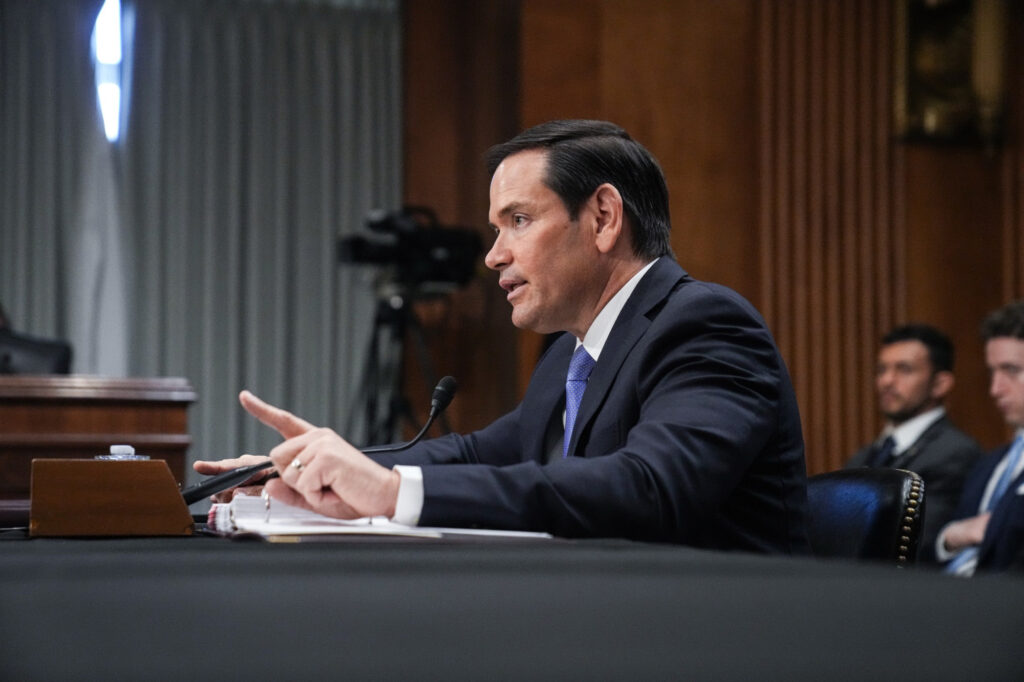
When Secretary of State Marco Rubio announced his plan to reorganize the State Department, he did not merely shuffle furniture or reassign bureaucrats. He threw down the gauntlet. In a message sent to Congress on May 29, Rubio made the stakes plain: “Over the past quarter century, the domestic operations of the State Department have grown exponentially, resulting in more bureaucracy, higher costs, and fewer results for the American people.” He went on to explain, “The reorganization plan will result in a more agile Department, better equipped to promote America’s interests and keep Americans safe across the world.” This is no cosmetic reform. It is an attempt to salvage diplomacy from the clutches of sclerosis.
The plan is nothing short of audacious. As revealed in the initial April announcement, Rubio seeks to reduce the number of bureaus and offices from 734 to 602, an 18 percent cut, and eliminate roughly 700 domestic staff positions, targeting a 15 percent reduction in Washington-based personnel. More recently, State Department officials confirmed that the restructuring will ultimately slash or merge 311 existing domestic offices, cutting or joining more than 40 percent of the Department’s nearly 700 offices overall. Up to 3,400 positions could be eliminated, representing between 15 and 20 percent of the agency’s domestic headcount. These are not symbolic trims. This is institutional liposuction.
While many bureaucracies age into obsolescence, Foggy Bottom has metastasized. The cost is not merely budgetary. A bureaucracy that grows reflexively soon loses clarity of purpose, and a State Department mired in ideological pursuits and overlapping missions loses touch with its constitutional mandate: to represent American interests abroad.
But critics, especially those still loyal to the Obama-era vision of foreign policy as a vehicle for globalist evangelism, have cried foul. They claim the reorganization is a retreat from soft power, a gutting of moral leadership, or, most hysterically, a war on human rights. But these are not reductions in conscience. They are reassertions of relevance. The American taxpayer deserves a foreign policy arm that reflects national interests, not the aspirations of academic NGOs.
Consider the targeted cuts. Offices dedicated to war crimes, global criminal justice, global women’s issues, and diversity and inclusion are to be dissolved or consolidated. The Office of the Coordinator for Foreign Assistance and Humanitarian Affairs will absorb some of their functions, but under a framework that prioritizes measurable outcomes and national interest alignment. Critics interpret this consolidation as regression. But that interpretation rests on a flawed premise: that more offices and more programs ipso facto yield more moral foreign policy. On the contrary, when responsibility is diffused among ideologically driven silos, accountability evaporates. As Reagan once quipped, a government bureau is the nearest thing to eternal life we’ll ever see on this earth. Rubio intends to end a few of those immortals.
The deeper philosophical shift here is from utopian idealism to sober realism. International diplomacy is not a graduate seminar in social justice. It is a theater of realpolitik, shaped by incentives, trade-offs, and interests. Under previous administrations, the State Department had become a staging ground for ideological crusades dressed in the robes of diplomacy. Human rights offices issued stern press releases while authoritarian regimes tightened their grip. Diversity officers generated glossy reports while actual diplomats struggled to coordinate embassy security. Meanwhile, core missions like foreign assistance, treaty enforcement, and intelligence liaison suffered from fragmentation and resource cannibalization.
Rubio’s plan reflects the priorities of a nation awakening from the illusions of empire-building. It consolidates power under bureaus better aligned with America’s strategic objectives. The Bureau of Cyberspace and Digital Policy, for instance, will now be placed under the Office of Economic Growth, recognizing that cybersecurity threats are not abstract specters but tools of economic warfare. Similarly, regional coordination will be centralized to avoid redundancy and encourage strategic unity. The reorganization makes it harder for each corner of the department to pursue its own mini-foreign policy. That is a feature, not a bug.
No doubt the restructuring will face entrenched resistance. Bureaucracies rarely go quietly into that good night. Leaks, op-eds, and resignations will follow. So too will the usual ritual of performative outrage in congressional hearings. Yet the logic of the plan is defensible on conservative, constitutional, and strategic grounds. A leaner State Department is not a diminished one. It is a Department returned to its core mission.
Rubio’s move should also be understood in light of a broader executive philosophy emerging under the Trump administration’s second term. When Elon Musk was at the helm of the Department of Government Efficiency (DOGE), every cabinet office was pushed to justify its programs in terms of cost, deliverables, and alignment with American interests. The State Department cannot be exempt. For decades, it was the sacred cow of Washington: too delicate to touch, too noble to question. That untouchability produced bloat, mission creep, and a professional culture that too often saw itself as a global actor first, and an American agency second.
This reorganization returns the Department to republican accountability. Rubio has made clear that the new structure was not devised in isolation. “We have taken into account feedback from lawmakers, bureaus, and long-serving employees,” he wrote. That engagement is critical, not only for institutional buy-in but because it reflects a return to constitutionalism. Foreign policy, like all aspects of governance, must be responsive to the elected branches. The State Department is not a priesthood. It is a tool of statecraft, accountable to the President and the Congress, and ultimately to the people.
To understand the urgency of this reform, one must appreciate the stakes. American diplomacy today faces the twin threats of geopolitical challenge and internal incoherence. Abroad, rising powers like China and revanchist states like Russia exploit gaps in US strategy and coordination. At home, the apparatus of diplomacy has lost its sense of direction, pulled between competing ideological missions and redundant bureaus. Without reform, the US risks becoming a power that speaks often but says little, that attends every summit but leads none.
Rubio’s reorganization is not a silver bullet. It will not instantly repair decades of drift. But it is a step, and a bold one, toward restoring coherence to American diplomacy. It is a recognition that moral clarity requires institutional clarity, that effectiveness demands focus, and that the best way to champion American values abroad is to first align our institutions at home with American interests.
Critics will continue to accuse Rubio of dismantling “global leadership.” Let them. If “global leadership” means a proliferation of taxpayer-funded social engineering abroad while American embassies crumble and foreign service officers burn out under bureaucratic inertia, then dismantling is exactly what is needed. The point is not to retreat from the world but to engage it with purpose. To quote John Quincy Adams, America “goes not abroad in search of monsters to destroy.” She seeks instead to serve as the well-wisher to the freedom and independence of all, but the champion and vindicator only of her own.
If Rubio’s plan succeeds, and it must, then the State Department will emerge not only leaner but wiser. It will be a department that moves, as Rubio rightly insists, “at the speed of relevancy.” And in an age of shifting alliances, digital disruption, and ideological conflict, that speed may well determine whether American diplomacy remains effective or becomes extinct.
If you enjoy my work, please consider subscribing: https://x.com/amuse.
Sponsored by the John Milton Freedom Foundation, a nonprofit dedicated to helping independent journalists overcome formidable challenges in today’s media landscape and bring crucial stories to you.
READ NEXT: Trump Wins Key Ruling




















Get DOGE help then all the way needed
The entrenched fat cats will fight Rubio tooth and nail on this plan.
Needed Units FT in State Dept
Treaties
Asia Pacific
EU
Defense
Tourism/Trade
for Niche use
then subdivide by Embassies worldwide