

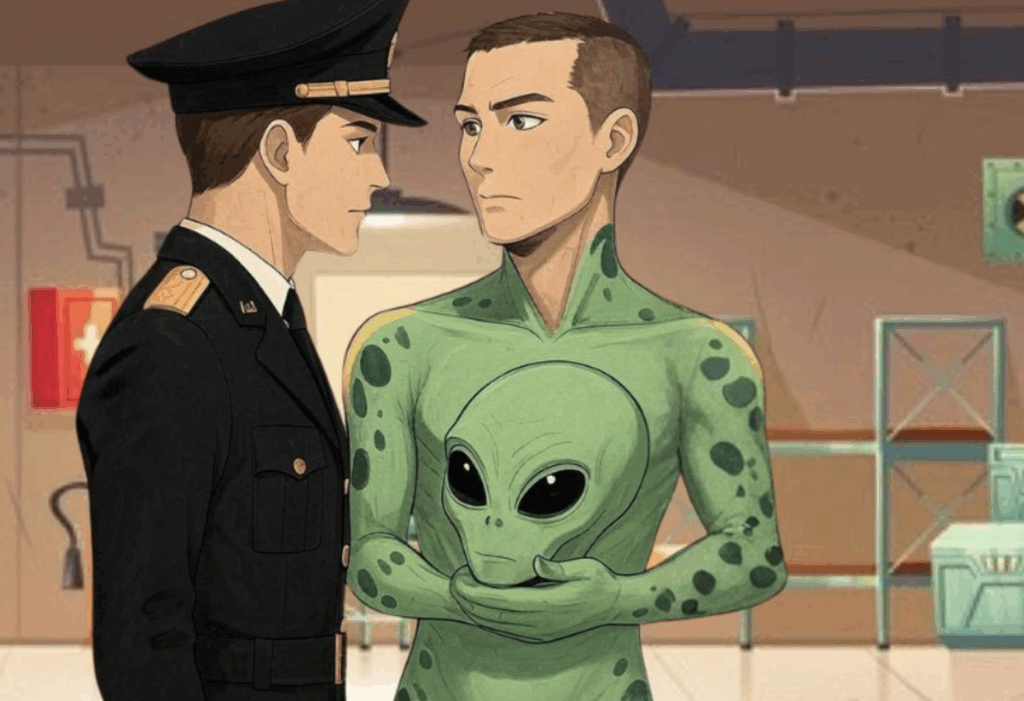
The United States government did conceal something extraordinary about unidentified flying objects, but not the existence of extraterrestrials. What it concealed was its own machinery of deception. The UFO myth, it now appears, was born not from alien visitations but from deliberate misdirection by the Pentagon and intelligence community. The alien cover-up was itself a cover story, hiding the truth that America’s own classified programs and psychological operations created the legend in the first place.
In 2022, the Department of Defense created the All-domain Anomaly Resolution Office (AARO) under physicist Dr. Sean Kirkpatrick. The mandate was simple: resolve the mystery of Unidentified Aerial Phenomena. Its mission included cataloging sightings and probing claims that secret government programs possessed crashed alien craft. After two years of investigation, with full access to decades of records and personnel, AARO found no evidence whatsoever of extraterrestrial vehicles, bodies, or technology. As Pentagon spokeswoman Sue Gough explained, the office “has not discovered any verifiable information to substantiate claims that any programs regarding the possession or reverse-engineering of extraterrestrial materials have existed in the past or exist currently.” Yet what AARO did find was more disturbing: a pattern of deception, secrecy, and psychological operations that had spun a legend out of thin air.
— Joel C. Sercel, PhD (@JoelSercel) June 7, 2025
The truth, AARO concluded, is that the US government itself seeded and spread UFO stories for its own purposes. During the Cold War, the Pentagon learned that mystery could be more powerful than denial. Instead of explaining classified weapons tests, it often let citizens, journalists, and foreign spies believe they had seen flying saucers. A newly declassified Defense Department review confirmed that military officials planted UFO rumors, staged photographs, and held false briefings to mislead curious observers. A retired Air Force colonel admitted that he distributed fake photos of alien spacecraft near the Area 51 test range under direct orders. The goal was to distract the Soviets from the new F‑117 Nighthawk stealth fighter then being tested. The colonel’s phony images, released to the public, helped create one of the most enduring myths of the 20th century. The alien cover story worked better than any camouflage paint.
How The Air Force Used UFOs To Drive a Man Insane. The story of Paul Bennewitz pic.twitter.com/sqT7wXCOWI
— Jesse Michels (@AlchemyAmerican) July 4, 2025
By the 1980s, UFO lore had become a tool of counterintelligence. Advanced aircraft such as the B‑2 Spirit bomber and secret drone prototypes could be tested in plain sight, as long as witnesses thought they were otherworldly. The Pentagon found that rumor itself could be weaponized. Officials viewed alien speculation as a convenient mask for classified research. “The spread of alien rumors was a form of camouflage,” one Defense Department insider later explained. “It let us hide the real in the fantastic.” By feeding the public’s appetite for mystery, the government diverted scrutiny away from its most sensitive projects.
This tactic dated back even earlier. The famous 1947 “Roswell incident,” long cited as proof of alien contact, originated in the crash of a classified balloon array used to monitor Soviet nuclear tests. To preserve secrecy, the Air Force issued a false press release claiming recovery of a “flying disc.” Within twenty-four hours, the story was retracted, but the damage was done. The myth was far more durable than the truth. The alien narrative served to bury the real secret: America’s earliest nuclear surveillance program.
AARO’s investigation uncovered similar patterns in later decades. One extraordinary revelation involved “Yankee Blue,” a clandestine in‑house hoax within the Air Force itself. This peculiar program involved briefing incoming officers that aliens were real and that the Air Force maintained a secret crash retrieval operation. New personnel were shown fake photographs of alien craft and told they were joining an ultra‑classified anti‑gravity research division. They were even made to sign nondisclosure agreements and warned that revealing the secret could be treason. Many took the story seriously for the rest of their careers. In truth, “Yankee Blue” was a loyalty test and psychological experiment, designed to see who could be trusted with genuine classified material. By 2023, AARO had traced hundreds of participants misled by this internal hoax before the practice was formally banned.
Not all UFO legends were born as pranks. Some began as side effects of genuine experiments. In 1967, Air Force officers at a nuclear missile base reported a glowing object hovering above the gates just before several missiles went offline. Conspiracy theorists later cited this as evidence that extraterrestrials had disabled America’s nukes. Decades later, declassified files revealed the truth: the incident was a controlled electromagnetic pulse test, conducted to measure missile resilience against power loss. The Airmen who witnessed the event were never informed of the experiment’s purpose, both to preserve secrecy and to prevent the Soviets from learning about American vulnerabilities. In their silence, myth filled the void. What was intended as a security test became one of the most celebrated UFO stories in history.
Secrecy thrives in ambiguity. During the height of the Cold War, America’s classified programs were expanding rapidly, from reconnaissance satellites to stealth aircraft to experimental propulsion. The government needed plausible deniability for mysterious lights in the sky. Aliens became the perfect alibi. Once the public imagination embraced the idea of extraterrestrial visitors, any unusual radar blip or crash could be explained away as something not of this Earth. The lie was safe because it appealed to wonder. Few realized that the so‑called UFO cover‑up concealed not alien evidence but human ingenuity and paranoia.
Even supposed physical proof of alien technology collapsed under scrutiny. AARO reviewed the saga of “Art’s Parts,” the mysterious metal fragments mailed in the 1990s to radio host Art Bell. UFO believers claimed they were fragments of the Roswell crash. Decades later, former rock star Tom DeLonge’s research group purchased the samples for analysis, claiming they exhibited exotic, layered structures beyond human metallurgy. The Army’s research lab and Oak Ridge National Laboratory tested the material. Their conclusion was unequivocal: the fragments were ordinary aluminum‑magnesium alloy, consistent with mid‑20th‑century industrial waste. What UFO enthusiasts thought was alien metal was almost certainly scrap from World War II manufacturing. The fragments were relics of human history, not extraterrestrial visitation.
From Roswell to Area 51, each supposed revelation about alien craft traces back to human deception, error, or ambition. Yet these stories persist because they satisfy a deep psychological need. The alien narrative flatters us by suggesting that the most advanced beings in the galaxy find us interesting. It also relieves us of responsibility for the strange and unexplained. To believe that alien craft disabled missiles is easier than to accept that our own government ran reckless experiments on its weapons systems. The myth comforts even as it deceives.
The deeper truth is that America’s UFO obsession was a mirror of its own anxieties. The Cold War was an era of secrecy, suspicion, and technological marvel. Ordinary citizens glimpsed lights in the sky and saw cosmic visitors because their own government trained them to expect mystery. The Pentagon discovered that belief could be managed. By cultivating the myth of alien visitation, it built a fog of illusion around its most sensitive projects. The alien cover‑up was never about extraterrestrials; it was about managing perception.
AARO’s findings expose a profound irony. The Pentagon, in trying to protect its secrets, ended up creating a cultural phenomenon that outlived its creators. The myth it built to disguise earthly programs has become one of the most powerful legends in modern history. Even now, despite official debunking, the UFO belief system continues to flourish online and in popular culture. The illusion has become self-sustaining. What began as a smokescreen for stealth bombers now fuels billion-dollar entertainment franchises and congressional hearings. A lie built for national security became an article of faith.
The implications of this are not merely historical. They illuminate the dangerous feedback loop between secrecy and belief. When a government routinely manipulates truth, it teaches its citizens to doubt everything, including the truth itself. The alien myth thus stands as both a monument to human imagination and a warning about the corrosive effects of official deception. Transparency, once lost, breeds superstition.
In the end, America’s great UFO mystery was never about visitors from the stars. It was about us: our secrecy, our fears, and our capacity for self-deception. The Pentagon’s disinformation built the legend. Our culture sustained it. And only now, with the work of investigators like Sean Kirkpatrick, can we begin to see that the so-called alien cover-up was a mirror reflecting our own shadow. The real visitors haunting our skies were never extraterrestrial. They were the ghosts of our own classified past.
If you enjoy my work, please share my work and subscribe: https://x.com/amuse.
Sponsored by the John Milton Freedom Foundation, a nonprofit dedicated to helping independent journalists overcome formidable challenges in today’s media landscape and bring crucial stories to you.
READ NEXT: Democrats Get Their Worst News Since Election Day 2024














In 1967, Air Force officers at a nuclear missile base reported a glowing object hovering above the gates just before several missiles went offline. Decades later, declassified files revealed the truth: the incident was a controlled electromagnetic pulse test, conducted to measure missile resilience against power loss. The Airmen who witnessed the event were never informed of the experiment’s purpose, both to preserve secrecy and to prevent the Soviets from learning about American vulnerabilities. In their silence, myth filled the void. What was intended as a security test became one of the most celebrated UFO stories in history.
That finally explains the incidents at Echo-Flight and Oscar-Flight at Malmstrom AFB. Allegedly, Boeing conducted tests to replicate power spikes on commercial power, and were able to duplicate the guidance system shutdowns about 3% of the time. Wonder how they were able to show the lights over the several sites. A civilian and a sheriff’s deputy also saw some lights in Belt Canyon. I was in the area, restarting one of the missiles, and was asked if we saw anything, but we never did.
Since 1947 to date
Deep State day 1 to date