


Talks aimed at ending the war in Ukraine are picking up speed, according to officials in Kyiv and Washington. Both sides say progress has been made on a U.S.-drafted “28-point plan” that would require sweeping concessions from Ukraine in exchange for security guarantees.
Reporting indicates the proposal asks Ukraine to give up control of Donbas and formally recognize Russian control of Crimea, Luhansk, and Donetsk. It would also require Ukraine to scale down its military. The United States has not publicly confirmed the full details, but Ukrainian President Volodymyr Zelenskiy said he is ready for “honest work” with U.S. officials on the plan after meeting in Kyiv with Army Secretary Daniel Driscoll and other envoys.
As The New York Times reports:
Mr. Trump has set a deadline of Thursday for Ukraine to agree to the 28-point peace plan, an early draft of which many Ukrainians dismissed as capitulation because it acceded to longstanding Kremlin demands.
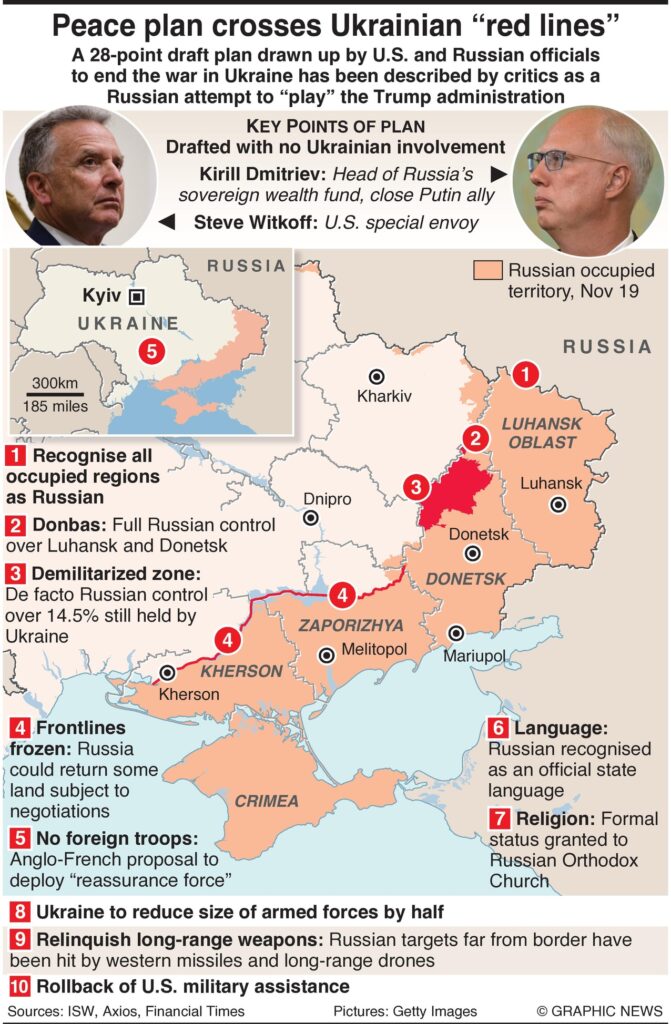
The talks, which began in Geneva on Sunday, were cast as an effort to bridge the gaps, and in a joint statement released after the discussions, Ukraine and the United States both said that much had been accomplished.
“They reaffirmed that any future agreement must fully uphold Ukraine’s sovereignty and deliver a sustainable and just peace,” the statement read. “As a result of the discussions, the parties drafted an updated and refined peace framework.”
Interim Deals Set the Stage
Earlier this year, the United States brokered limited agreements meant to cool the battlefield. One deal sought to halt certain attacks on sea and energy infrastructure through the Black Sea risk zone. Another involved Ukraine’s conditional readiness to accept a 30-day ceasefire. Both moves were seen as early steps toward a broader negotiation framework.
Allies Push Back on Terms Seen as Too Costly
The proposed concessions have caused friction within Europe. Several allies argue the terms lean too far in Russia’s favor and risk locking in gains Moscow seized by force. Ukrainian officials face similar pressure at home, where accepting major territorial losses would be politically explosive and militarily difficult.
There is also uncertainty over what Russia is actually offering in return. Key issues remain unresolved, including sovereignty, territorial withdrawal, and long-term security guarantees. Without clear commitments from Moscow, the talks are advancing on paper but not yet in practice. No full ceasefire or treaty is in place.
Security Guarantees Remain Vague
One of the biggest unknowns is what U.S. and allied security guarantees would look like. Officials have not laid out how these commitments would work, be enforced, or deter future aggression. That gap is shaping much of the debate inside Ukraine, Europe, and Washington.
Why the Stakes Are High
A negotiated end to the war would mark a major shift for the region and for the broader international system. It would shape military balances, energy flows, and diplomatic ties for years. The United States has also taken a more hands-on role, moving from military support to direct involvement in drafting peace terms.
Domestic politics add another layer. Ukrainian public opinion remains firmly against territorial concessions, and lawmakers in the United States may resist any deal viewed as overly generous to Russia.
What Comes Next
Several questions will determine where the talks go from here:
Will Ukraine accept the U.S. plan? Kyiv may seek changes or clarifications before signing on.
How Moscow responds. Russia could agree, push for more concessions, or stall the process.
How Europe reacts. Allies wary of a deal that weakens Ukraine’s long-term security will keep pressing their case.
What the implementation timeline looks like. Any deal would need clear steps for a ceasefire, monitoring, sanctions policy, and territorial control.
How public sentiment shifts. Views in Ukraine, Russia and the United States will influence what is politically possible.
For now, the negotiations are real, the stakes are high, and the outcome is far from certain.
READ NEXT: DOJ Employee Charged After Allegedly Doxxing Federal Agent
















It’s erroneous to view the terms of the agreement in isolation. That’s what the Left wants people to do. What is more accurate is to project possible scenarios for Ukraine and Russia based on the history of this war and other wars the US has been in over the past 70 years. The historical record shows that, starting in Vietnam, the liberal dominated culture and the US Government prefer a stalemate to victory. It is good for business and fulfills the need for liberals to criticize and denounce the US culture and military. It also creates a feast for lawyers to sue on behalf of our adversaries.
Therefore, the prospect for Ukraine was for continued stalemate. It would receive enough aid to survive militarily but not prevail. In the meantime, its destruction, losses, and suffering would continue to accumulate. Even if Trump wanted to help Ukraine prevail the US Left and the Federal Courts would throw enough sand in the wheels to prevent anything conclusive and then blame Trump and Ukraine for not winning the war. Continuing the war in the present context is a lose-lose proposition. The present peace talks are a way for Ukraine to survive and rebuild, and for Russia to avoid becoming a Chinese colony.