

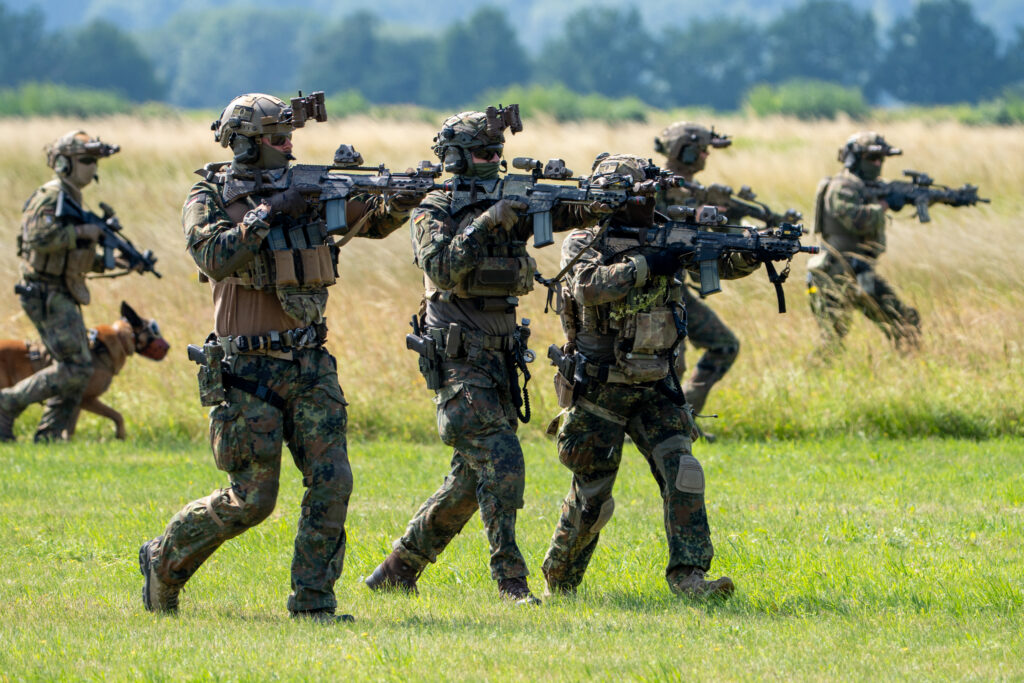
As the autocratic Russian bear growls and lashes out at Europe, the continent’s democratic member states are reevaluating their military service models to face the growing threat, as well as increasing U.S. pressure to do more to defend themselves.
And the consensus is that professional military service alone is out, and conscription and mixed service are back in.
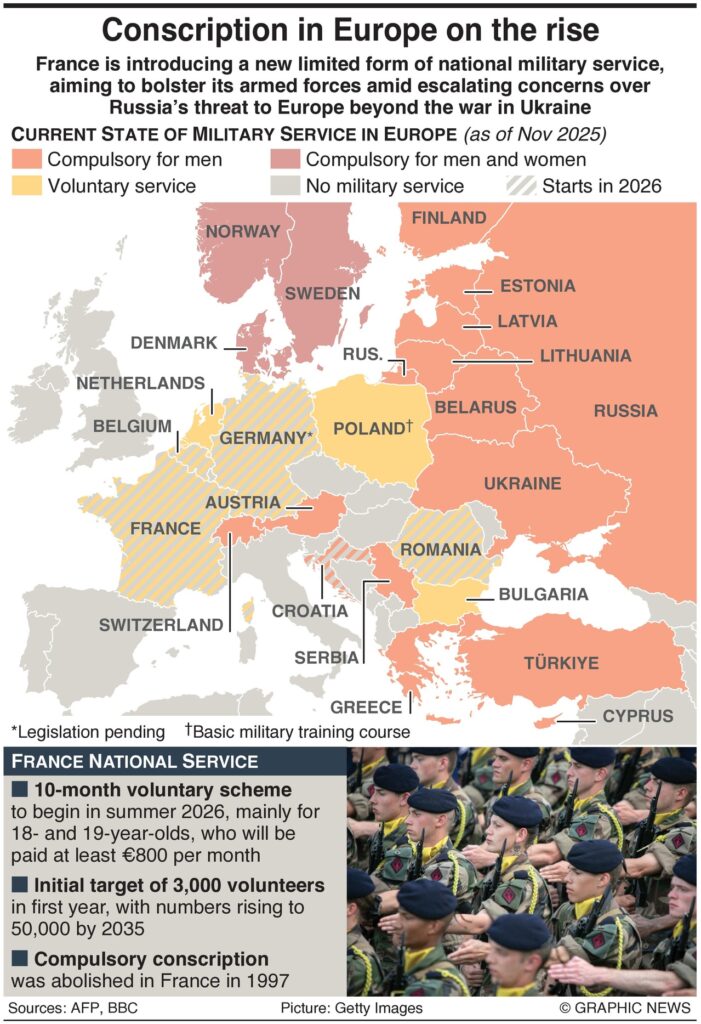
While some European NATO countries never totally ended conscription, such as Greece and Cyprus, and neutral countries such as Austria and Switzerland, many are reintroducing it or considering it.
Others are implementing a mixed service model.
France, for example, is reintroducing a limited form of military service more than 25 years after conscription was phased out. Then-President Jacques Chirac ended military service in 1996 as part of the “peace dividend” following the fall of the Soviet Union.
Until then, compulsory military training for young men had been part of national life since the French Revolution, which created the idea of the citizen-soldier.
The French plan won’t necessarily see a return to that model, but will see young men and women volunteering for paid 10 months of military training.
The new “national service” will be phased in gradually from next summer, mainly for 18- and 19-year-olds, who will receive at least $800 a month.
Initially, numbers will be restricted to 3,000 next year, but this should rise to 50,000 by 2035.
France currently has around 200,000 military personnel and a further 47,000 reservists. The new scheme should usher in a three-tier structure of professionals, reservists and volunteers.
As the BBC reported, French military chiefs hope the new plan will create a reservoir of trained personnel able to back up professional soldiers and replace them in non-frontline tasks.
They also hope many volunteers will stay on for full military careers.
“The new military service moves us in the direction of hybridization of the armed forces,” Thomas Gassilloud, president of the National Assembly’s defense committee, said. “We went too far in the direction of the all-professional.”
Belgium and the Netherlands, too, have introduced a voluntary military service, and Germany is planning something similar. Given its past, Germany has avoided showing military power, but earlier this year, Chancellor Friedrich Merz announced that due to Russia’s invasion of Ukraine, Germany’s defense “now has to be whatever it takes.”
Germany’s new military service plan will require all 18-year-old men to detail their suitability to serve and, from 2027, to undergo medical screening. Lawmakers are expected to vote on the plan by the end of 2025.
This, as Berlin aims to create Europe’s strongest conventional army in the next five years, surpassing France and Poland.
The Bundeswehr currently has around 182,000 troops. The new military service model aims to increase that number by 20,000 over the next year, rising to between 255,000 and 260,000 over the next 10 years, supplemented by approximately 200,000 reservists.
If these targets are not met, a form of compulsory enlistment could be considered by parliament. If war were to break out, the military would be able to draw on the questionnaires and medical exams for potential recruits.
Meanwhile, Lithuania was the first country to reinstate compulsory conscription for men in 2015, after suspending it in 2008. Others, like Sweden, reintroduced conscription in 2017 after a seven-year suspension. In 2023, Latvia reinstated compulsory service for men — voluntary for women — after abolishing it in 2006.
In October, Croatia voted to reintroduce compulsory service for men in 2026, after suspending it in 2008 shortly before joining NATO.
One of the biggest outliers in the European theater is the U.K. under the left-wing government of Keir Starmer. He shelved plans by his conservative predecessor to reinstate conscription, which ended in 1960.
And the British military is now at an all-time low in numbers and combat capability. A humiliating and dangerous situation for the once top-tier military.
READ NEXT: Trump Star Ruled Illegal















A little late don’t you think. BTW Russia is NOT the only one to be worried about. Lots of far left and criminal movements are to be watched as well. AND, Soros has his fingerprints all over them.