


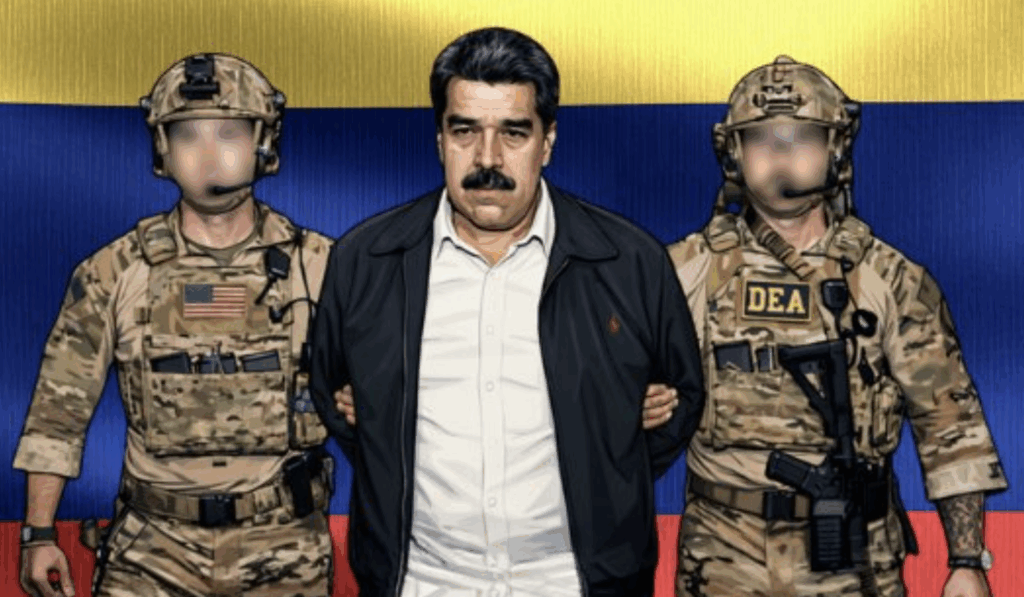
The arrest of Nicolás Maduro has been described by critics as an act of war. That description is mistaken. It misunderstands both the legal posture of Maduro himself and the nature of the action taken against him. The operation that resulted in Maduro’s capture was not a declaration of hostilities against Venezuela. It was the execution of a long-standing criminal indictment against an individual who, under U.S. law and widely accepted principles of international law, was never entitled to the protections of a lawful head of state.
WAR: President Donald Trump announced a large-scale US operation captured Venezuelan President Nicolás Maduro and his wife, who were flown out of the country. A major press conference is set for 11 AM EST. pic.twitter.com/RitwwC0EIJ
— @amuse (@amuse) January 3, 2026
Begin with a simple question. What makes an arrest an act of war rather than law enforcement? The answer is not the use of force alone. Police use force. States sometimes use military assets in support of law enforcement. The distinction turns on status and purpose. War is violence directed at a sovereign state as such. Law enforcement is coercion directed at a person subject to criminal jurisdiction. The Maduro operation fits squarely in the second category.
Maduro was not seized as the president of Venezuela. He was seized as an indicted narcotics trafficker. That fact matters, and it is not rhetorical. It is the organizing premise of the case.
In March 2020, federal prosecutors in the Southern District of New York unsealed charges against Nicolás Maduro for narco-terrorism, cocaine trafficking, weapons offenses, and conspiracy to import massive quantities of drugs into the U.S. The indictment alleged that Maduro led the Cartel de Los Soles, a transnational criminal organization embedded within Venezuela’s security services and political institutions. The charges were not symbolic. They carried potential life sentences. A $15M reward was publicly offered for information leading to his arrest. From that moment forward, Maduro was not treated by the U.S. as a protected sovereign. He was treated as a fugitive.
Critics often respond that indictments are cheap and that powerful states can always criminalize their enemies. But this objection ignores a crucial legal fact. The U.S. position was not merely that Maduro committed crimes. It was that he did so without sovereign immunity because he was not a legitimate head of state. That claim did not arise from convenience. It arose from recognition doctrine.
Following Venezuela’s fraudulent 2018 election, the country’s own National Assembly declared the presidency vacant and recognized Juan Guaidó as interim president under Venezuela’s constitution. More than 50 countries followed suit. The U.S. formally withdrew recognition from Maduro’s regime and described it as illegitimate. This matters because head of state immunity is not a metaphysical property. It is a legal consequence of recognition. States decide who they treat as governments. When recognition is withdrawn, immunity dissolves with it.
This principle is not controversial. Courts have long held that immunity flows from recognition decisions made by the political branches. When the executive branch states that an individual is not a recognized head of state, courts defer. That deference is not lawlessness. It is separation of powers.
As early as 2020, U.S. prosecutors described Maduro as a de facto ruler who had usurped power and corrupted state institutions to facilitate international drug trafficking. The indictment explicitly framed his authority as illegally obtained. This was not casual language. It was designed to foreclose the very immunity arguments his defenders now raise.
The picture that emerges from the charging documents is not of a political leader caught in a geopolitical dispute. It is of a cartel leader who happened to control a state. The Cartel de Los Soles, according to sworn allegations, functioned as a criminal enterprise that used Venezuela’s military, intelligence agencies, and airspace to move cocaine in industrial quantities. Prosecutors alleged that Maduro deployed cocaine as a weapon against the U.S. Whether one accepts every factual allegation is beside the point. The legal theory is clear. This was a narcotics conspiracy targeting the U.S., and U.S. courts therefore possessed jurisdiction.
Extraterritorial jurisdiction in drug cases is well established. When foreign conduct is intended to produce criminal effects inside the U.S., jurisdiction attaches. No declaration of war is required to arrest a drug trafficker whose product is poisoning American cities.
Still, some argue that even if Maduro were a criminal, seizing him required war because he controlled territory and armed forces. This is where history becomes instructive.
In 1988, Manuel Noriega was indicted by U.S. grand juries on drug trafficking and racketeering charges. At the time, he was the de facto ruler of Panama. Like Maduro, he claimed sovereign immunity. Like Maduro, he dismissed the charges as political. Like Maduro, he nullified elections and entrenched himself through force.
When U.S. forces entered Panama in December 1989, the stated objective was not conquest. It was to arrest Noriega, protect U.S. nationals, and restore Panama’s legitimate government. Noriega was captured on January 3, 1990, and flown to Florida to stand trial. His lawyers raised the same arguments Democrats now raised on Maduro’s behalf. They claimed the invasion was illegal. They claimed Noriega was immune. They claimed his capture shocked the conscience.
The federal court rejected all of it. The judge held that Noriega had no head of state immunity because the U.S. had never recognized him as Panama’s lawful leader. The court refused to adjudicate the legality of the military operation itself, treating it as a political question. And under the Ker Frisbie doctrine, the court held that even a forcible apprehension does not bar prosecution absent torture or extreme abuse. Noriega was convicted and imprisoned. No appellate court reversed that outcome. No international tribunal invalidated it.
This precedent matters because it establishes a template. An unrecognized, illegitimate ruler who leads a criminal enterprise may be indicted. He may be apprehended. He may be tried. None of this constitutes war in the legal sense.
The Maduro operation tracks this template closely. Like Noriega, Maduro was indicted while exercising de facto control. Like Noriega, his regime had been delegitimized internationally. Like Noriega, he was accused of turning a state into a narcotics hub. And like Noriega, he was arrested pursuant to a criminal indictment, not a treaty of surrender.
Notice what did not happen. The U.S. did not annex territory. It did not declare war on Venezuela. It did not dissolve the Venezuelan state. It removed an indicted fugitive and left the question of Venezuela’s governance to Venezuelans and the international community. That is law enforcement logic, not imperial conquest.
Some critics insist that any use of military force across borders is war by definition. But this collapses distinctions that international law has carefully preserved. States routinely use force in counterterrorism, piracy suppression, hostage rescue, and narcotics interdiction. The legality of such actions turns on status, consent, and purpose. In Maduro’s case, the target was not Venezuela. It was an individual whom the U.S. had long treated as a criminal and whom it did not recognize as a sovereign.
This distinction explains why the Noriega case has endured. It also explains why claims that Maduro’s arrest violates international law ring hollow. Law is not offended when a cartel leader is arrested. It is offended when cartel leaders are shielded by false claims of legitimacy.
There is a deeper point here. Recognition doctrine exists precisely to prevent violent usurpation from laundering itself into legal immunity. If dictators could immunize themselves by controlling territory, law would reward brute force. Courts have rightly refused to endorse that result.
Maduro’s arrest does not expand executive power beyond precedent. It applies settled doctrine to a particularly egregious case. It affirms that sovereignty is not a cloak for narco-terrorism. And it reinforces a principle that matters far beyond Venezuela. No individual is above the law merely because he commands uniforms.
To call this an act of war is to mistake enforcement for aggression, and it is now being done loudly by congressional Democrats who are demanding that President Trump reverse the arrest and restore Maduro to power. That position is indefensible. It asks the U.S. to side with an indicted narco-terrorist over its own laws, its own courts, and the lives of its own citizens. Maduro ran a cartel that weaponized the fentanyl crisis, killing hundreds of thousands of Americans. To demand his reinstatement is not a plea for peace. It is a demand that the rule of law yield to the protection of a criminal regime holding an entire nation hostage. The better description of what occurred is simpler and more accurate. An indicted fugitive was arrested. The law was enforced. History, doctrine, and precedent all point in the same direction.
If you enjoy my work, please subscribe: https://x.com/amuse.
Sponsored by the John Milton Freedom Foundation, a nonprofit dedicated to helping independent journalists overcome formidable challenges in today’s media landscape and bring crucial stories to you.
READ NEXT: Can The US Rally A Global Coalition For An All-Out War With China?













Let this be a warning to other states who are governed by criminals who ply in the drug or illegal arms trade. World court laws allow the capture and detainment until tried of anyone who commits any criminal, head of state to had of catels. toake due notice and considered yoourself warned. Iran’s leadership better wake or they can kiss their butts good bye too.
That’s simple.
He was NOT an elected President. He was a Drug Cartel boss.
Now he’s going to answer for that. Unless there is an Obama judge??
One place the author is not honest. Trump did not leave Venezuela to Venezuelans. If he did Gonzalez, the legitimate president, would be allowed to return to Venezuela and set up and head an interim government and election commission. Instead Trump gave power to corrupted puppet and declared that US now owns Venezuelans’ oil, infrastructure and other assets of value through forced investments and I don’t mean compensation for nationalized infrastructure, what he said is US rules Venezuela and owns what it has. With a puppet at head and no elections or democracy in sight.