

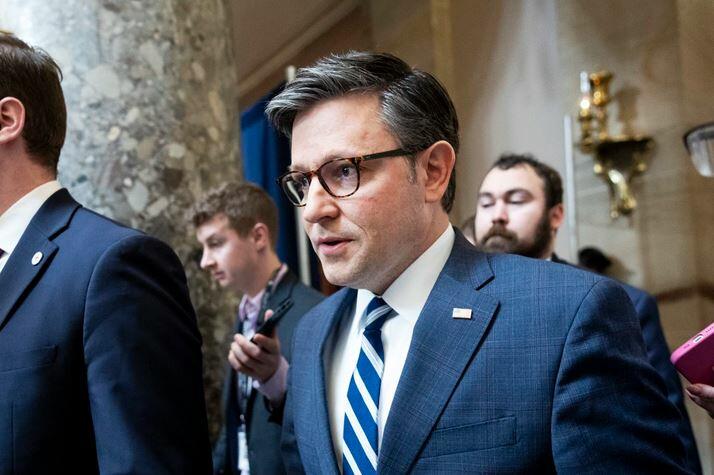
In a striking rebuke, a bloc of House Republicans broke with party leadership Tuesday, sinking a procedural effort to shield President Trump’s trade policies from scrutiny and warning it would erode Congress’ constitutional authority.
The House rejected the measure 217–214, underscoring growing fractures within the Republican conference over trade authority.
Three Republicans — Thomas Massie (Ky.), Don Bacon (Neb.), and Kevin Kiley (Calif.) — joined every Democrat in opposing the rule, citing concerns over constitutional authority and the economic fallout of the administration’s tariff strategy.
The vote reopens the door for lawmakers to force immediate repeal votes on Trump’s tariffs — something the House has not allowed in nearly a year.
The rebels expressed constitutional concerns and frustration with leadership tactics, saying the rule was improperly used to expand leadership power and shield executive trade policy from legislative oversight.
As reported by The Hill, Speaker Mike Johnson (R-La.) scrambled to sway the GOP holdouts, delaying the vote for seven hours — but ultimately failed to change the outcome:
“I don’t like putting the important work of the House on pause, but Congress needs to be able to debate on tariffs,” Bacon wrote on X after the vote.
“Article I of the Constitution places authority over taxes and tariffs with Congress for a reason, but for too long, we have handed that authority to the executive branch. It’s time for Congress to reclaim that responsibility. I also oppose using the rules votes to legislate. I want the debate and the right to vote on tariffs.”
I don’t like putting the important work of the House on pause, but Congress needs to be able to debate on tariffs. Tariffs have been a “net negative” for the economy and are a significant tax that American consumers, manufacturers, and farmers are paying. Article I of the…
— Rep. Don Bacon 🇺🇸✈️🏍️⭐️🎖️ (@RepDonBacon) February 11, 2026
The language in the rule on Tuesday would have reinstated a prohibition on calling snap votes to repeal the national emergency authority behind Trump’s tariffs through the end of July.
The rule failing to pass paves the way for Democrats to proceed with their plans to force a vote on a resolution repealing Trump’s national emergency declaration for tariffs on Canada. Rep. Gregory Meeks (D-N.Y.), chair of the House Foreign Affairs Committee, is expected to force a vote on his resolution that would repeal tariffs on Canada as soon as Wednesday.
A similar repeal resolution could also advance in the Senate. In October, four Republicans joined Democrats in approving a measure to end Trump’s tariffs on Canada. The effort, led by Sen. Tim Kaine (D-Va.), drew support from GOP Sens. Mitch McConnell (Ky.), Rand Paul (Ky.), Susan Collins (Maine), and Lisa Murkowski (Alaska).
Ahead of Tuesday night’s vote, Speaker Johnson defended his push to delay the House repeal vote, arguing lawmakers should wait for the Supreme Court to rule on the emergency powers case.
“The rationale for this — just extending it a little longer to July — is to allow the Supreme Court to rule on the pending case that everybody’s watching and waiting for,” Johnson said. “That process has been playing out. I think it’s logical to allow that to continue.”
While Trump’s tariff policies continue to enjoy strong support among segments of the Republican base, skepticism has been growing among fiscal conservatives, business-aligned Republicans, and members concerned about:
- Higher input costs for manufacturers
- Consumer price increases
- Retaliatory measures affecting U.S. exporters
- Expanded use of emergency powers
Behind the scenes, some Republicans are warning that tariffs — long central to Trump’s campaign messaging — have become a political liability in a midterm climate where voters remain focused on inflation and everyday expenses.
The internal divide reflects a longstanding philosophical split within the GOP between:
- Economic nationalists, who view tariffs as leverage and industrial policy
- Free-market conservatives, who favor limited trade barriers and stronger congressional oversight
Even so, Rep. Massie dismissed the effort as purely symbolic, arguing that Trump would veto any repeal resolution that reached his desk and that opponents lacked the votes to override such a veto, calling the maneuver political theater.
READ NEXT: Record Congressional Retirements Point To Deeper Institutional Failure

















So they want to control the tariffs that are bringing in Billions of dollars that Americans will not have to pay in taxes but still turn over our currency system to a private unelected Fed?
Congress is useless.
To be blunt if Congress does not agree to the tariffs that Trump has applied to other nations that has been bringing in trillions of dollars that is bringing in corporations to build factories in coronation our nation will sink just as the Roman nation did from within. Congress has been lazy for decades. The Democrats, which are not the Democratic Party it’s the Democrat party are acting like they’re all bought people not representing we the people, but representing their own wallets. As a member of a family that has been here on this continent since 1592 what I see happening in our nation, sickens me from local to federal government. In my humble opinion, our country has been faltering since 1913 when President Wilson sold our country to a private bank, the federal reserve bank
Well said.
Does Rep. Bacon even know the facts about these tariffs? Before he speaks about it, he needs to know the facts.