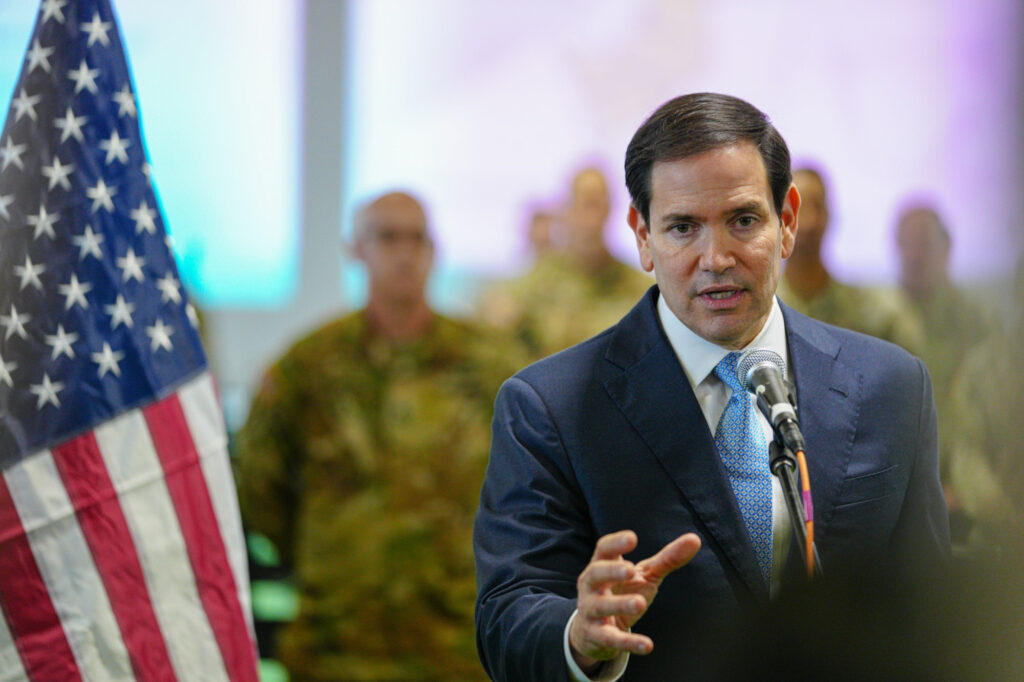
U.S. Secretary of State Marco Rubio delivered a message of reassurance to European leaders at the 62nd Annual Munich Security Conference on Saturday, emphasizing that the United States remains deeply committed to its transatlantic alliance despite recent tensions.
Addressing policymakers and defense officials in Munich, Rubio underscored the historical, cultural, and strategic bonds between the United States and Europe, calling their destinies intertwined.
We do not want allies shackled by guilt and shame.
— Secretary Marco Rubio (@SecRubio) February 14, 2026
We want allies who are proud of their culture and heritage and are willing to help us defend it. pic.twitter.com/IOKg9n1UNM
“For the United States and Europe, we belong together,” Rubio said. “We are part of one civilization – Western civilization. We are bound to one another by the deepest bonds that nations could share, forged by centuries of shared history, Christian faith, culture, heritage, language, ancestry, and the sacrifices our forefathers made together.”
A Calmer Tone After Friction
Rubio’s remarks come at a moment of strain in U.S.-European relations, particularly amid President Donald Trump’s renewed interest in acquiring Greenland, an autonomous territory of Denmark. The proposal has unsettled some European leaders and added to broader questions about the future direction of U.S. foreign policy.
His tone also contrasted with that of Vice President JD Vance, who used his address at the 61st Munich Security Conference in 2025 to criticize European governments over censorship and democratic backsliding. Vance’s speech drew strong reactions across Europe for its blunt critique of court rulings and political restrictions in several countries.
Rubio acknowledged that disagreements between allies are inevitable but framed them as evidence of concern rather than hostility.
“If at times we disagree, our disagreements come from our profound sense of concern about a Europe with which we are connected — not just economically, not just militarily,” Rubio said. “We are connected spiritually and we are connected culturally. We want Europe to be strong.”
He added that the two world wars of the 20th century serve as reminders that instability in Europe ultimately affects the United States. “The fate of Europe will never be irrelevant to our own,” he said.
Borders, Sovereignty, and Institutional Reform
In addition to emphasizing shared heritage, Rubio called for greater attention to border control and migration policy across the West. He described mass migration as “a crisis which is transforming and destabilizing societies all across the West,” arguing that controlling national borders is a matter of sovereignty rather than xenophobia.
“Controlling who and how many people enter our countries … is a fundamental act of national sovereignty,” Rubio said. He warned that failure to manage migration effectively poses risks to social cohesion and political stability.
The secretary of state also urged reform of global institutions such as the United Nations, suggesting that existing structures must adapt to a rapidly changing geopolitical landscape.
“We do not want our allies to be weak, because that makes us weaker,” Rubio said. “We want allies who can defend themselves so that no adversary will ever be tempted to test our collective strength.”
A Changing Geopolitical Landscape
Speaking to reporters before departing for Germany, Rubio described the current moment as a turning point in global affairs.
“The world is changing very fast right in front of us,” he said. “The old world is gone … and we live in a new era in geopolitics.”
Rubio indicated that ongoing private discussions with European allies will take place with the goal of clarifying mutual expectations and responsibilities in this new environment.
🚨 HOLY CRAP! Sec. Marco Rubio just got a MASSIVE standing ovation in Germany after he told Europe we need to move back toward Christianity and against 3rd world migration
— Eric Daugherty (@EricLDaugh) February 14, 2026
Marco is CRUSHING it and the whole world sees it! 🔥
We LOVE MARCO. 🇺🇸 pic.twitter.com/PmZFHR5W53
Vice President Vance did not attend the 2026 conference, leaving Rubio as the administration’s top representative in Munich this year. His speech appeared designed to steady relations and reaffirm the United States’ commitment to the transatlantic partnership, even as Washington presses for greater burden-sharing, institutional reform, and stronger border policies across allied nations.
As Europe confronts security challenges ranging from regional conflicts to internal political shifts, Rubio’s message signaled that, despite policy disputes, the United States sees its relationship with Europe as foundational and enduring.
READ NEXT: Rubio Shuts Down Controversial ‘Misinformation Agency’