










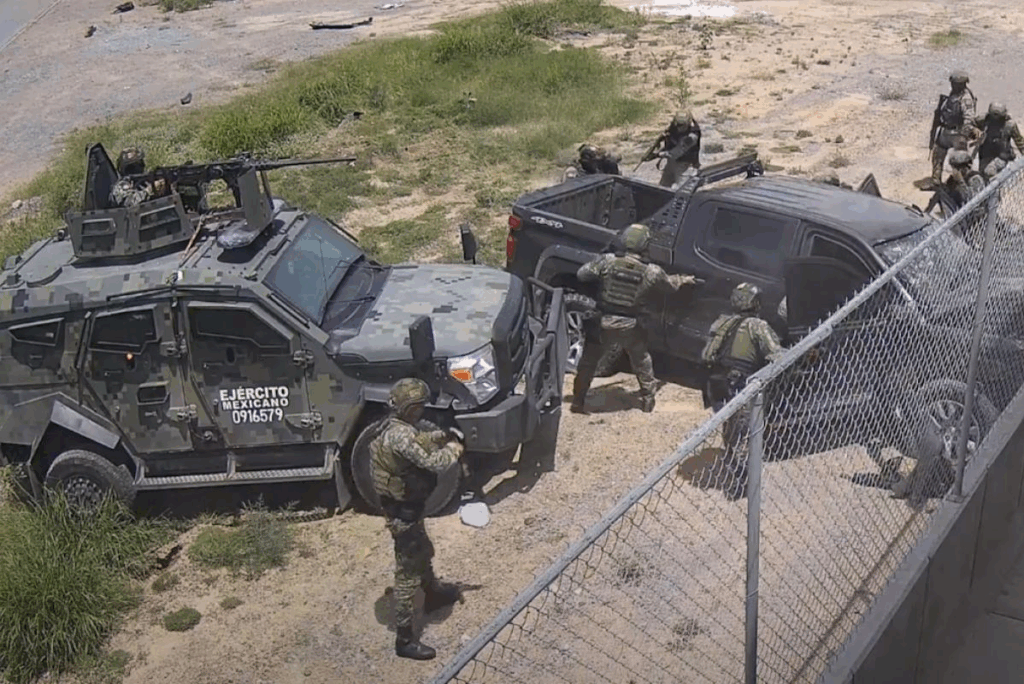
On Sunday, Mexican Army special forces killed one of the world’s most notorious drug lords, Nemesio Oseguera, or “El Mencho,” during a raid in Tapalpa on Mexico’s Pacific coast in Jalisco state.
The operation was carried out with U.S. intelligence support, sparking widespread retaliatory cartel violence, including 27 retaliatory attacks across the country that left nearly three dozen cartel members and two dozen Mexican National Guard soldiers dead.
Oseguero had long been in our sights. He was expanding the Jalisco New Generation Cartel CJNG) into a major power that took control of lucrative drug routes into the United States. The Drug Enforcement Agency (DEA) had offered a reward of up to $15 million for information leading to his arrest.
CJNG was designated a foreign terrorist organization by the U.S. last year. The drug kingpin’s body arrived in Mexico City Sunday afternoon in a heavily guarded convoy of National Guard troops.
Could this violence spill over into the United States? (RELATED: Army’s Anti-Drone Laser Action Draws Attention After El Paso Airport Shutdown)
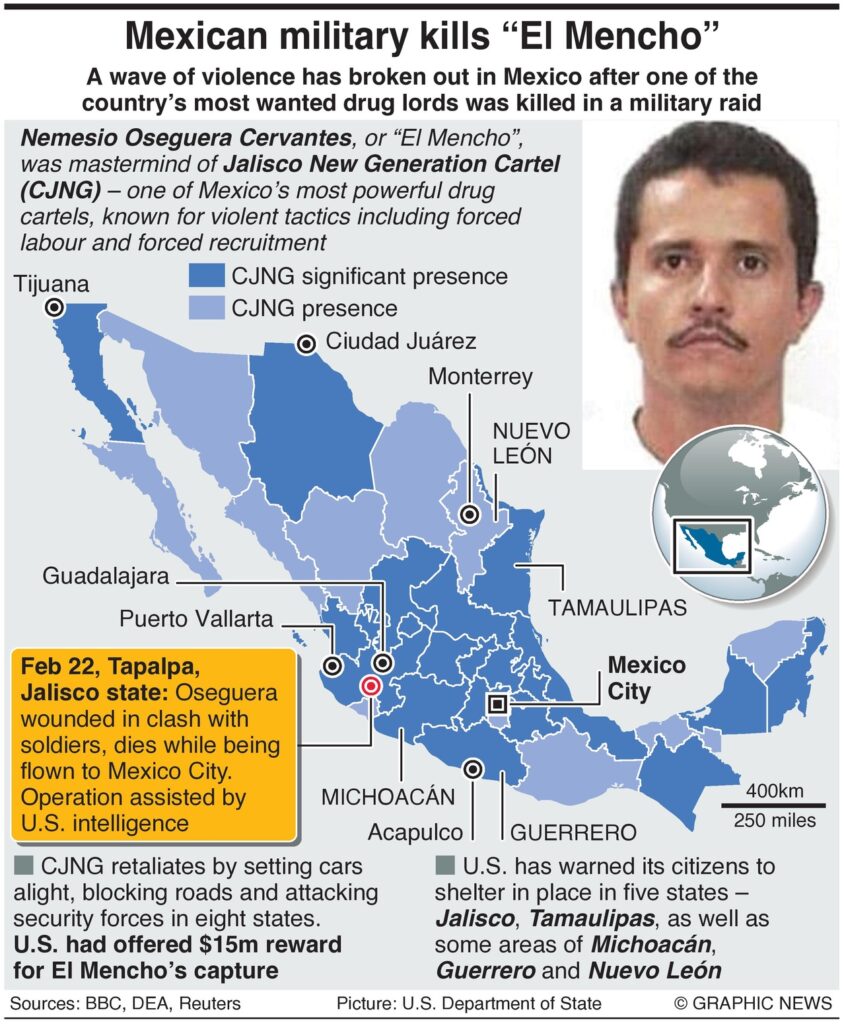
As chaos swept across parts of western Mexico, America’s southern neighbor braced for a further wave of violence Monday with Mexican officials canceling school in some states and warning communities to stay inside as reports spread of cartel members blocking roads.
The U.S. Embassy in Mexico City echoed Mexican warnings and issued alerts covering areas of 18 Mexican states — more than half the total. It warned Americans in eight cities, including popular tourist destinations such as Puerto Vallarta and Cancún, to shelter in place.
The cartel violence has since spread to half a dozen Western states. In Jalisco, armed supporters took to the streets, setting cars, banks, and supermarkets on fire, and breaking into buildings. Photographs taken in the immediate aftermath of Oseguera’s killing showed the burned-out wreckage of cars and buses blocking Guadalajara’s streets.
In Puerto Vallarta, a vacation resort on Jalisco’s Pacific coast, video footage showed black smoke billowing over the city and burning vehicles blocking a highway underpass. Other footage showed Mexican military UH-60 Blackhawk helicopters using miniguns to hit cartel convoys, demonstrating the paramilitary nature of the cartel threat.
As Christian Warrior Prepper noted:
Cartels respond to both pressures through visible violence. Roadblocks, arson, attacks on security forces, and transportation disruption serve several purposes:
Demonstrate continued operational capacity
Intimidate government authorities
Signal to rivals that command continuity remains intact
Reinforce deterrence
A similar pattern occurred when elements of the Sinaloa Cartel reacted violently to high-profile captures. When leadership is struck, escalation often follows quickly.
CJNG has historically shown strong tactical capability and willingness to engage Mexican military units directly. The current spread of violence aligns with that historical posture.
The Mexican government said various aircraft from the Air Force and the Special Immediate Reaction Force of the National Guard participated in the raid. During the operation, military personnel reportedly came under heavy attack.
Authorities also seized armored vehicles and heavy weaponry, including rocket launchers capable of downing aircraft and destroying armored vehicles. Three Mexican security personnel were injured.
Mexican President Claudia Sheinbaum has been under mounting pressure from the U.S. to intensify her offensive against drug cartels blamed for producing and smuggling drugs, particularly the synthetic opioid fentanyl, across the border.
White House Press Secretary Karoline Leavitt later posted on social media that the U.S. provided intelligence support. A U.S. defense official said Mexican forces conducted the operation with participation from a U.S.-Mexico task force.
The unit, known as Joint Interagency Task Force-Counter Cartel, was established by the Trump administration last month, working under the U.S. Northern Command, which covers American operations in all of North America, including the U.S., Mexico, Canada, and Greenland. (RELATED: After Hospital Ship Snub, US Envoy Challenges Greenland’s Leadership)
The task Force integrates intelligence personnel and law enforcement with the military. The Sheinbaum government has overseen more intelligence sharing with the U.S. than previous Mexican governments.
Shortly after U.S. forces captured former Venezuelan narco dictator Nicolás Maduro, Trump said cartels were “running Mexico” and suggested the U.S. would “start now hitting land with regard to the cartels.”
Sheinbaum has rejected U.S. military deployments inside Mexico but has cooperated on extraditions. In January, Mexico extradited 37 organized crime members to the U.S., with a total of 92 extradited under Trump so far, and she has agreed to accelerate further extraditions.
The operation to arrest Oseguero is another major example of Mexico appeasing Trump’s desire to reduce the power of the cartels smuggling drugs into the U.S. (RELATED: US Officials In Talks With Castro’s Grandson Over Cuba’s Future)
Meanwhile, the U.S. must consider a potential spillover of this cartel violence.
While there is no public reporting at this time indicating broad civilian attack planning inside the U.S., CJNG maintains an established operational footprint inside the U.S. tied primarily to trafficking and financial infrastructure.
Some analysts assess that cartel leadership determines that U.S. support materially enabled the targeting of El Mencho, and that selective intimidation or violence directed at American law enforcement or individuals directly connected to cartel disruption becomes a plausible risk.
READ NEXT: Serious Criminal Indictment Jolts Congressional Campaign
Sponsored
CHIP IN $26 NOW to lock in Founder Status and join me on the frontline! Your support at this critical moment helps fight with Trump and fuel the grassroots movement that’s defending America’s future. FIGHT WITH TRUMP — JOIN THE FRONTLINE and stand with patriots like you.














Now is a decisive time for Mexico. Will Sheinbaum rid her country of the cartels and their influence in their government or will she opt to enrich herself by fortifying her connections to the cartels. Mexico hangs in the balance.