

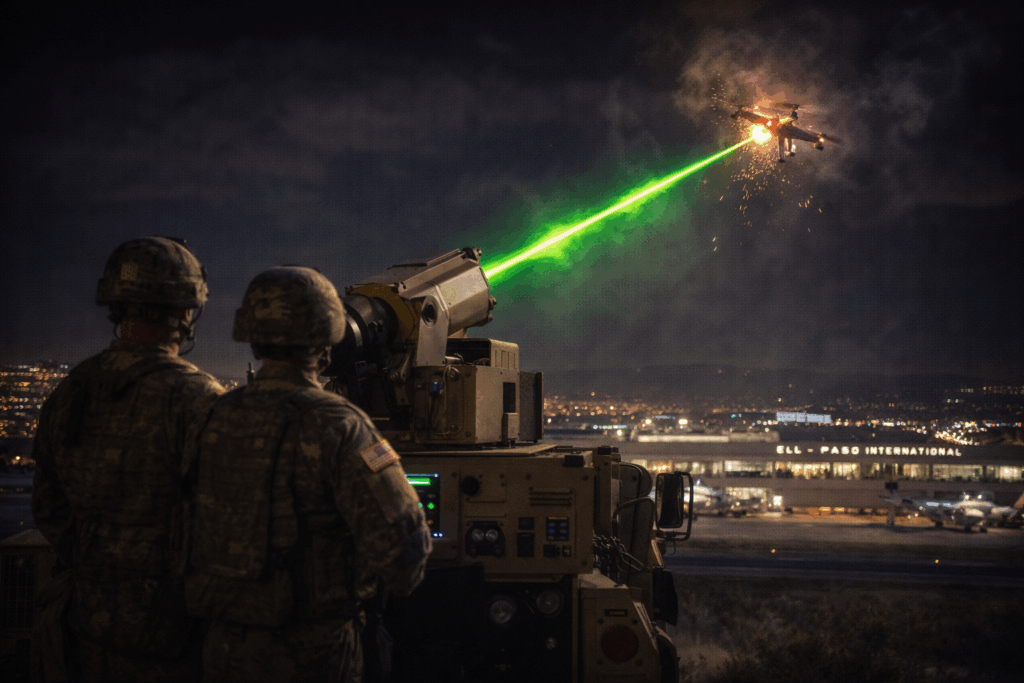
Team Trump just sent a powerful message to Mexico’s drug cartels. This past week the FAA suddenly closed the airspace above the El Paso airport in Texas. They initially said it was going to remain closed for 10 days. A few hours later, they reopened the airport.
We then saw reports of a Mylar party balloon being shot down, a cartel drone being downed, and an Army counter-drone laser being fired.
Details of the true story still remain murky, but let’s focus on the two most important parts. Even if the object (or one of the objects) shot down was a balloon and not a drone, the fact is that a military laser on loan to Customs and Border Protection (CBP) agents was used to do it.
“The [laser] anti-drone technology was launched near the southern border to shoot down what appeared to be foreign drones,” according to CBS News. This is a big deal. (RELATED: Why The Pentagon Must Rethink How America Wins Wars)
The second important part is that the laser is designed to shoot down drones, and Mexican drug cartels use drones across our border all the time, a nearly daily occurrence.
The Department of Homeland Security (DHS) says there were more than 60,000 cartel drone flights along the border in the second half of 2024 alone — an average of about 330 per day.
Fox News reported that:
Cartels use them for three primary missions along the southern border: counter reconnaissance to track Border Patrol and military positions; aerial denial, deploying swarms to threaten U.S. aircraft and create de facto no-fly zones for smuggling; and direct drug delivery, with some drones carrying large payloads.
Reports indicate cartel operatives have even traveled to Ukraine, volunteering on the front lines against Russia, to master advanced drone tactics — including fiber-optic-guided FPV drones immune to jamming. Those same techniques have appeared in Mexico’s cartel wars, with gangs targeting rivals using precision explosives.
Unfortunately, for many reasons, including Biden administration cowardice and lax attitude toward the border, as well as bureaucratic inaction and lack of coordination, nothing was being done about the drone threat. Significantly, Fox News added:
For years, the Federal Aviation Administration has blocked meaningful action against rogue drones — whether mysterious swarms over sensitive U.S. military bases or increasingly bold incursions by Mexican drug cartels. The FAA’s perennial fear? That military countermeasures, from electronic jamming to kinetic options, might endanger civilian or commercial aircraft.
Thankfully, now under Trump, the rules have finally changed. When cartel drones breached U.S. airspace near El Paso International Airport and, more seriously, approached sensitive military facilities, Team Trump decided to act. (RELATED: ‘Invisible Coup’? Scholar Raises Alarms Over Immigration Strategy)
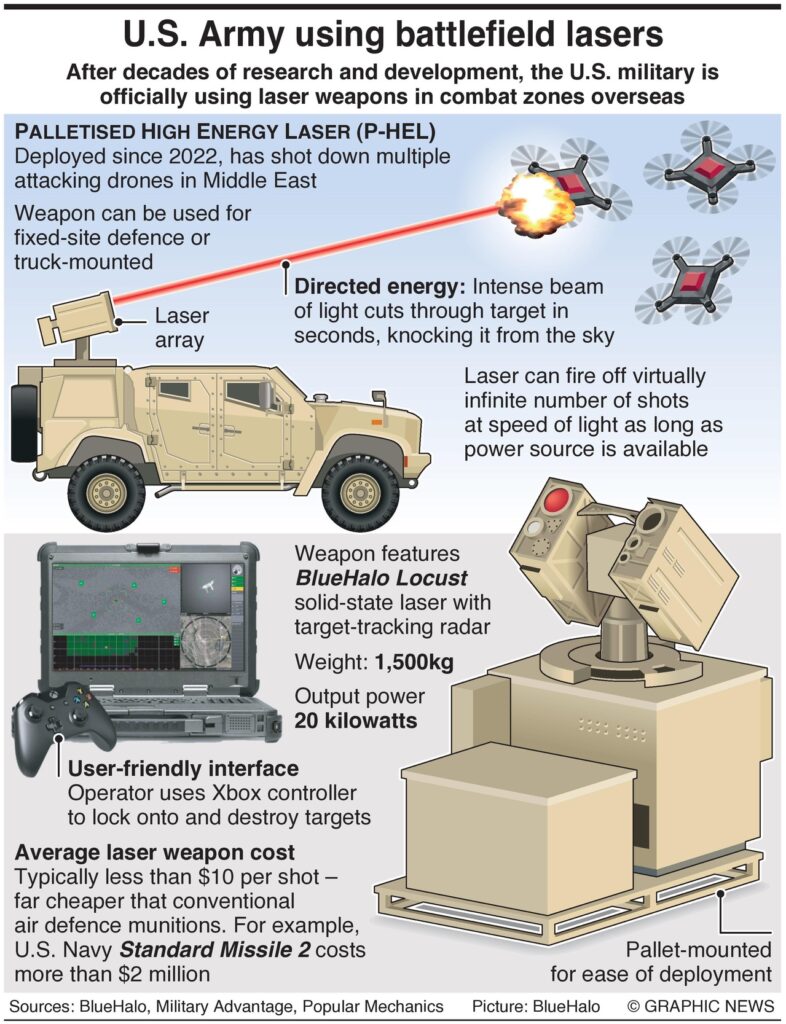
The Army counter-drone laser system used in this incident has been identified as an AeroVironment LOCUST weapon mounted on a 4×4 M1301 Infantry Squad Vehicle (ISV) or 4×4 Joint Light Tactical Vehicle (JLTV) based out of Fort Bliss, in El Paso.
The base is a major hub for those operations. It is also home to the 1st Armored Division and a large number of Army air defense units. These counter-drone systems had p[reviously only been used in combat overseas.
Apparently, The New York Times reported, the LOCUST use came as the FAA was working on “a safety assessment of the risks the new technology could pose to other aircraft” in our civilian airspace.
Prior to this, FAA “officials had warned the Pentagon that if they were not given sufficient time and information to conduct their review, they would have no choice but to shut down the nearby airspace.” It seems the FAA believed the Army was going to be testing the lasers for an extended period of time near the airport.
Meanwhile, as The War Zone (TWZ) reported:
At LOCUST’s core is a 20-kilowatt-class laser directed energy weapon. This is at the lower end of the power spectrum for this new era of laser directed energy weapons, and the system is explicitly geared toward the countering small drones mission set.
The turreted system also includes built-in electro-optical and infrared video cameras for target acquisition and tracking. It can be cued to threats by tertiary sensors, including small-form-factor high-frequency radars and passive radio frequency signal detection systems mounted on the vehicles themselves, as well as traditional radars, and other capabilities positioned elsewhere. The Army’s ISV and JLTV-based configurations both feature small radars.
As a relatively small system itself, LOCUST offers additional benefits in terms of mobility and flexibility. Road-mobile versions can readily deploy and redeploy to different locations in response to shifting threats…versions of the system can be readily airlifted by helicopters, allowing for rapid movement to remote locales.
The military has said lasers aren’t a “silver bullet” against drones, repeatedly noting challenges in using directed energy weapon systems. These include range, power, dwell time on target, sensitivity to vibration, humidity, dust, and sand, as well as fragile optics and cooling demands.
Still, despite the challenges and some risks, they do appear now to be in use at the Mexican border. As part of a layered defense that should include high-power microwave directed energy weapons, electronic warfare systems, and kinetic weapons, our border is now far more secure from cartel and other drone threats.
READ NEXT: Is The Pentagon Rethinking Its ‘Gold-Plated’ Strategy?



















Practice for our military ! MethHeCo never was our friend.