
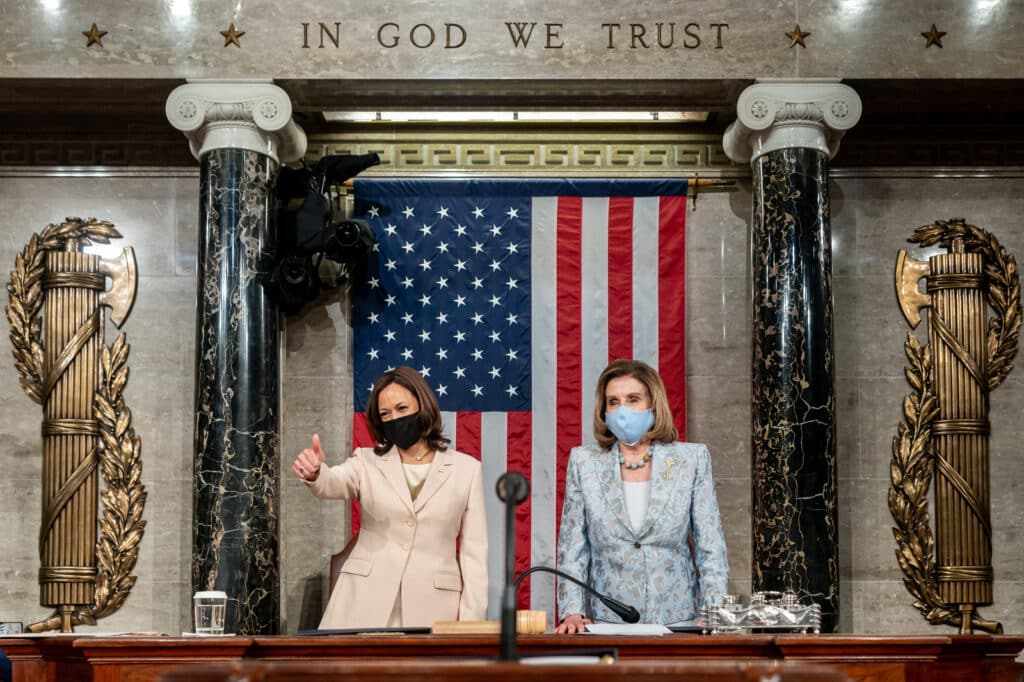
Former House Speaker Nancy Pelosi officially endorsed San Francisco Supervisor Connie Chan on Monday in the increasingly competitive race to succeed her in Congress, injecting new momentum into one of California’s most closely watched Democratic primaries.
The endorsement comes as Pelosi prepares to retire after nearly four decades representing California’s 11th Congressional District — a seat she has held since winning a 1987 special election and one that became synonymous with her rise to the pinnacle of Democratic leadership.
Pelosi’s backing is widely considered one of the most powerful endorsements in San Francisco politics, where her network and fundraising machine have shaped generations of Democratic candidates.
“I know and love this district. I know the Congress. And I know Connie,” Pelosi said in a statement announcing the endorsement. “I’m proud to endorse Democrat Connie Chan and ask you to join me in electing her to Congress.”
The timing of the endorsement is significant.
Recent polling has shown Chan battling for second place alongside former congressional aide and progressive activist Saikat Chakrabarti, while Democratic California state Sen. Scott Wiener remains the race’s best-known and perceived frontrunning candidate.
Pelosi’s endorsement could substantially reshape the contest by consolidating establishment Democratic support behind Chan at a critical moment in the campaign.
In a letter to district residents, Pelosi praised Chan as the candidate “best prepared” to continue representing San Francisco in Washington and emphasized both her political background and immigrant story.
“At a time when fundamental freedoms and democratic values are under assault, we need a leader in Congress who is prepared to fight — forcefully and effectively,” Pelosi wrote. “Connie Chan is the leader best prepared to carry forward the fight for San Francisco in the Congress of the United States.”
Pelosi also highlighted Chan’s background as a Chinese immigrant, arguing that her experience would bring a “unique perspective” to Congress.
Chan, who currently serves on the San Francisco Board of Supervisors, has built her campaign around progressive priorities including labor protections, immigration advocacy, and expanded social policies.
According to her campaign platform, Chan has pledged to fight what she describes as “inhumane abuses” carried out by Immigration and Customs Enforcement and Customs and Border Protection. She has also emphasized organized labor issues, promising to strengthen worker protections, raise wages, and combat “wage theft.”
Her campaign additionally supports expanded transgender medical procedures and policies.
The race to replace Pelosi has rapidly evolved into a broader ideological and generational fight inside California Democratic politics.
Chakrabarti — a wealthy former tech engineer best known for helping launch Rep. Alexandria Ocasio-Cortez’s congressional campaign — has repeatedly criticized Pelosi during the campaign and previously clashed with establishment Democrats during his time in progressive political circles.
But Chakrabarti has faced mounting setbacks in recent weeks.
A tech-backed super PAC supporting Wiener launched a barrage of negative advertising questioning Chakrabarti’s San Francisco roots and political authenticity. Meanwhile, Ocasio-Cortez herself repeatedly declined to endorse Chakrabarti despite his longstanding ties to her political movement.
Wiener has built a national reputation as one of the state legislature’s most aggressive progressive voices, and his candidacy has also generated controversy.
Some members of Pelosi’s longtime political circle reportedly viewed Wiener’s early entry into the race as disrespectful after he launched his campaign only weeks following Pelosi’s retirement announcement last November.
Wiener has also drawn criticism from conservatives and moderate Democrats over legislation he authored in the California Senate involving transgender healthcare access for minors and criminal justice reforms for minor-involved sex offender registration laws.
One law signed by Gov. Gavin Newsom in 2020 relaxed mandatory sex offender registration requirements for certain offenders convicted of vaginal intercourse with minors if the age difference was less than ten years — legislation Wiener defended at the time as aligning California law more consistently across similar offenses.
The primary is expected to become one of the most expensive and nationally scrutinized House races in the country as Democrats battle over the future direction of one of America’s most liberal congressional districts.
READ NEXT: California Democrats Propose $50 Million Fund For Illegal Immigrants As Wildfires Rage