

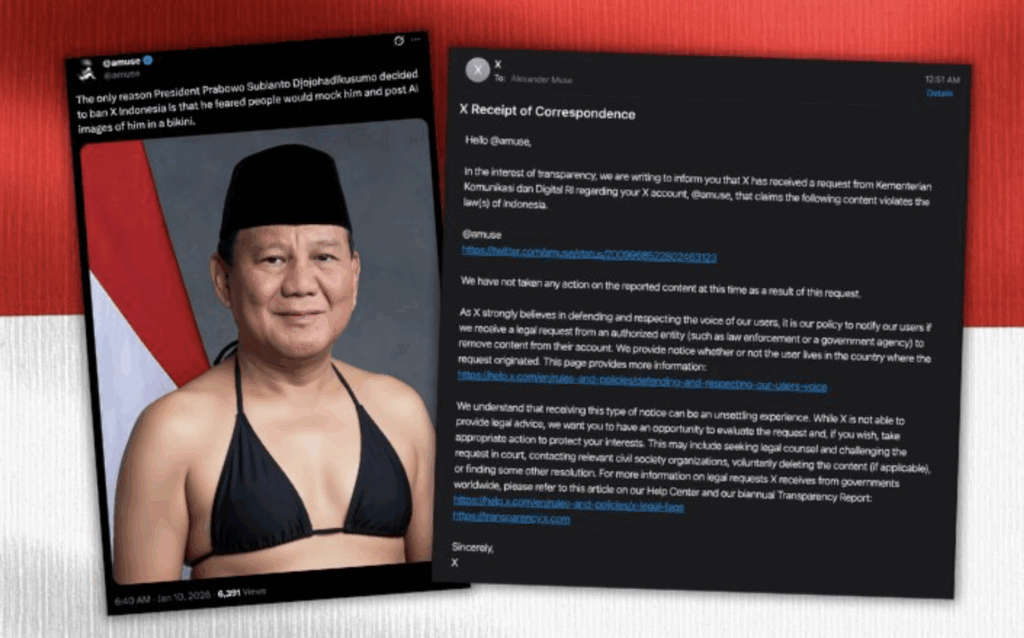
I did not set out to test the limits of Indonesia’s speech laws. I made a joke. After Indonesia’s government suspended access to 𝕏 and Grok, I responded with a line that would be unremarkable in any healthy republic. I wrote that the only reason President Prabowo Subianto Djojohadikusumo decided to ban 𝕏 and Grok in Indonesia was that he feared people would mock him by posting AI images of him in a bikini. I included such an image. To be fair, he actually looked pretty good in the bikini. The joke landed exactly as jokes usually do in open societies. Some laughed, some groaned, and the world moved on. In fact, the post was seen by fewer than 7,000 people.
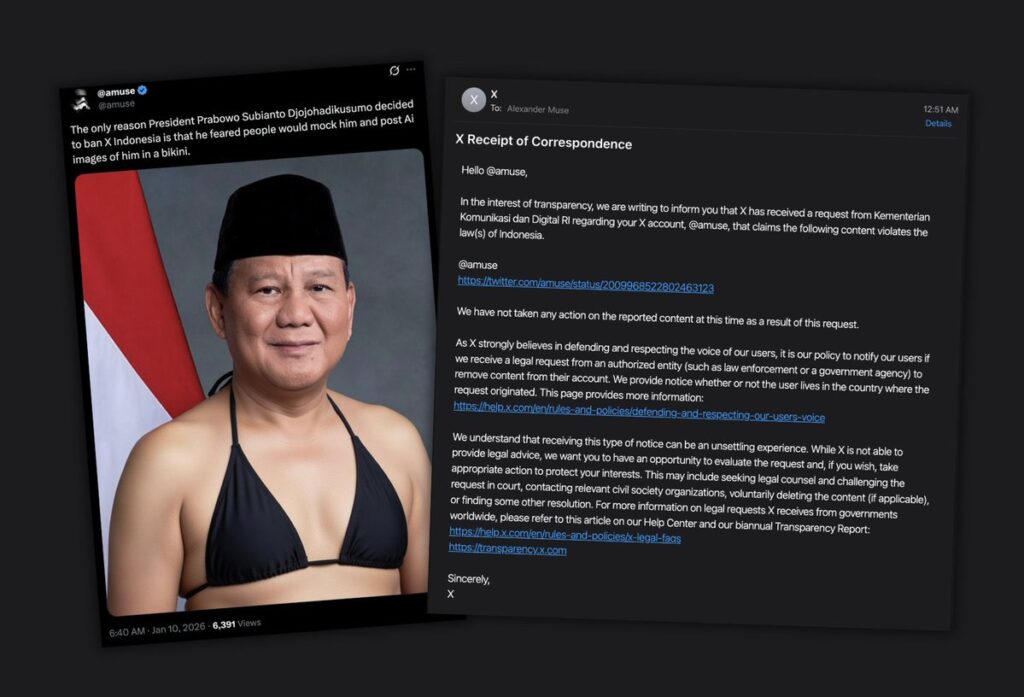
Indonesia’s government did not move on. Through the Kementerian Komunikasi dan Digital RI, the administration asserted that my post violated Indonesian law, citing provisions of the Electronic Information and Transactions Law and criminal defamation statutes that can carry penalties of up to six years in prison per offense. The message was formal, legalistic, and unmistakable in tone. It was meant to be taken seriously. It was meant to make me calculate.
This episode is not about my sense of humor, nor is it about the aesthetic merits of AI-generated swimwear. It is about how Thailand uses its speech laws, and how those laws are increasingly projected outward to chill speech in places where they have no legal force. It is about extraterritorial censorship masquerading as law enforcement. And it is about whether Americans should quietly accept that foreign governments may train them into silence through fear.
Indonesia does not enforce a monarchical lèse-majesté statute like Thailand’s Section 112, but the functional result is often similar. Indonesia relies on criminal defamation, insult provisions, and the Electronic Information and Transactions Law to regulate speech that offends powerful actors or state institutions. Intent does not reliably protect speakers. Public interest is not a safe harbor. Online distribution amplifies liability rather than mitigating it. These laws are written broadly, enforced selectively, and invoked most aggressively when criticism travels quickly or embarrasses authority.
If this sounds abstract, it should not. Indonesia’s enforcement record is concrete and recent. Haris Azhar and Fatia Maulidiyanti were charged under criminal defamation provisions after publicly discussing allegations involving a senior cabinet minister. The speech occurred in a journalistic context. The response was criminal prosecution. The lesson was unmistakable. Criticism of powerful officials, even when framed as analysis, carries personal risk.
Journalists and activists have repeatedly faced prosecution or detention under the ITE Law for online speech deemed insulting or disruptive. Content removal orders are often paired with criminal complaints, ensuring that legal pressure continues even after speech is taken down. The law does not merely correct falsehoods. It disciplines tone.
Indonesia’s revised criminal code has further entrenched this dynamic by reinstating penalties for insulting the president, vice president, and state institutions. Rights organizations have warned that these provisions invite abuse precisely because they blur the line between political critique and criminal offense. Together, these cases show that while Indonesia lacks a formal lèse-majesté statute, it operates a speech regime organized around fear rather than tolerance.
One might respond that this is Indonesia’s internal affair. Countries may govern speech within their borders as they choose. That reply would be plausible if Indonesia confined its enforcement to Indonesia. It does not. Modern authoritarian speech control operates differently. It does not require controlling speech everywhere. It requires making speech costly enough that people choose silence voluntarily.
Countries like Indonesia have learned that they do not need to police speech inside free speech havens like the U.S. to suppress it from those havens. Instead, they project their laws outward through legal threats, travel risk, and bureaucratic pressure. Brazil and India have adopted the same playbook, using platform demands, criminal statutes, and informal travel pressure to warn foreign critics that lawful speech at home becomes a liability abroad. Americans who criticize Indonesian officials or policies from U.S. soil are warned that their speech is criminal under Indonesian law and that charges can be activated the moment they enter Indonesian jurisdiction. The threat is not hypothetical. It is tied to mobility.
Southeast Asia operates through overlapping security cooperation. That reality allows Indonesia to make travel itself a lever. Critics are warned that transit or entry into nearby countries such as Cambodia or Malaysia may expose them to detention, questioning, or informal handoff if Indonesian authorities have flagged them. Formal extradition is unnecessary. Discretionary immigration enforcement and regional cooperation do the work. Speech that is fully protected under U.S. law becomes a liability once the speaker leaves U.S. territory.
A central tool in this strategy is the immigration watchlist. By quietly adding foreign critics to internal databases, authorities create a standing threat that follows indefinitely. No warrant is served. No court rules. The uncertainty itself chills. Journalists, academics, businesspeople, and online commentators are forced to ask whether a joke, a meme, or an analysis is worth the risk of detention, blacklisting, or regional disruption. Many decide it is not.
This is how extraterritorial censorship functions. It relies on asymmetric risk. The speech remains legal where it is spoken, but the speaker’s freedom of movement and professional life are placed under a cloud. When a foreign government can credibly threaten travel consequences for speech protected by the First Amendment, the practical effect is suppression beyond its borders.
It is important to be precise here. Indonesia knows it cannot touch Americans legally. Indonesian authorities are not confused about U.S. law. They know that the First Amendment flatly protects satire and mockery. They know the U.S. does not extradite for speech crimes. They know no U.S. court will enforce Indonesian defamation judgments rooted in political speech. They know U.S. platforms are not legally obligated to apply Indonesian law globally. The notice is sent anyway.
That fact matters. When a government takes an action it knows cannot result in enforcement, the only plausible explanation is intimidation. The message is not that you broke our law. The message is that we are watching you.
Platforms become the proxy. A foreign government flags speech it dislikes. The platform forwards a formal legal notice. The notice cites criminal law, penalties, and official authority. Even when the platform states that no action has been taken, the psychological work is already done. The speaker begins to calculate risk. That calculation is the chill.
The effect scales. This is not about one post or one account. The real audience is everyone watching. When prominent Americans receive foreign legal threats over jokes, the lesson others absorb is simple. Some subjects are not worth touching. Not because they are dangerous, but because foreign governments are willing to make life difficult.
Speech regimes built around insult and dignity protections are uniquely incompatible with Western free speech traditions. They criminalize political critique. They render intent unreliable as a defense. They treat humor as aggravation rather than mitigation. Exporting that framework, even informally, is an attempt to impose authoritarian sensitivities on republican societies. In the US, mocking leaders is not a pathology. It is a civic habit.
The outrage here is proportional to the precedent. If this tactic is normalized, the endpoint is obvious. China pressures U.S. users over national dignity. Turkey pressures satire about Atatürk. India pressures commentary on religion. Gulf states pressure content on morality. European states pressure speech under hate laws. Each claim is framed as culture. The cumulative effect is a lowest-common-denominator global speech regime enforced not by law but by fear.
This is why resistance matters even when there is no immediate legal risk. The most dangerous censorship is not the kind that puts people in prison. It is the kind that teaches people to stay quiet. When Americans treat foreign speech threats as normal, they concede that constitutional protections end where foreign sensitivities begin. They do not.
I have not yet decided whether to take the post down. If I do not, it effectively means I can no longer travel to Indonesia, and it may also affect travel to nearby countries such as Cambodia or Malaysia. That is the cost being imposed for a joke made on American soil. I am interested in what readers think. Should I comply and restore my freedom of movement, or should I leave the post up and refuse to participate in a system that relies on fear rather than argument? Reply and tell me what you would do.
If you enjoy my work, please subscribe: https://x.com/amuse.
Sponsored by the John Milton Freedom Foundation, a nonprofit dedicated to helping independent journalists overcome formidable challenges in today’s media landscape and bring crucial stories to you.
READ NEXT: Dem Demands Agency Be Abolished After Lawmakers Booted From Facility




















Blah, blah, blah – so Indonesian government does not think you are funny. You violated cultural sensitivites of a foreign nation and expect to be excluded from censorship? Thank the good Lord you are not any kind of ambassador! There are a myriad of other cultures and most have nothing in common with the USA.
So you missed the entire point of the piece and are determined to brag about your ignorance. No one in America should GAF about the censorship laws of other countries, nor bend our behavior to them. They can police actions and speech on THEIR territory, not OUR territory. Now as you roll your eyes at my response, ask yourself: Do you eat Bacon? Ham? Cool – you’ve already annoyed two of the other cultures you seem to be worried about. WE get to do things OUR way just as THEY get to do things THEIR way. If the twain don’t meet? So what?
Amuse —
Each liberty-embracing, freedom-loving, rugged individual citizen of the United States of America has a choice — to become informed, to understand what “God-given rights” actually means, why freedom isn’t free, and what can happen when a few lead the way, sparking a revolution of clear thought, common sense, and doing what needs to be done.
It is our duty as learned inalienable rights defenders to mock, deride, ridicule, satirize, and reject foolish control freaks who seek dominion over other humans. Period. Keep up the good work.
If I had the platform and recognition you have, I’d post something sarcastic – in America – that would be sure to inflame the Indonesian government, then travel there and get arrested, having ensured Stephen Miller and Trump were aware in advance. After I got arrested, I’d ensure a family member got the word out to DJT. My guess is that he’d make the appropriate noises, threats, tariff increases, etc. to ensure I was released, and that other countries know that they don’t get to imprison Americans for speech made on American soil. But don’t try that under a Commie(D) president… Of course, if the Indo gov whacks you in jail first….