

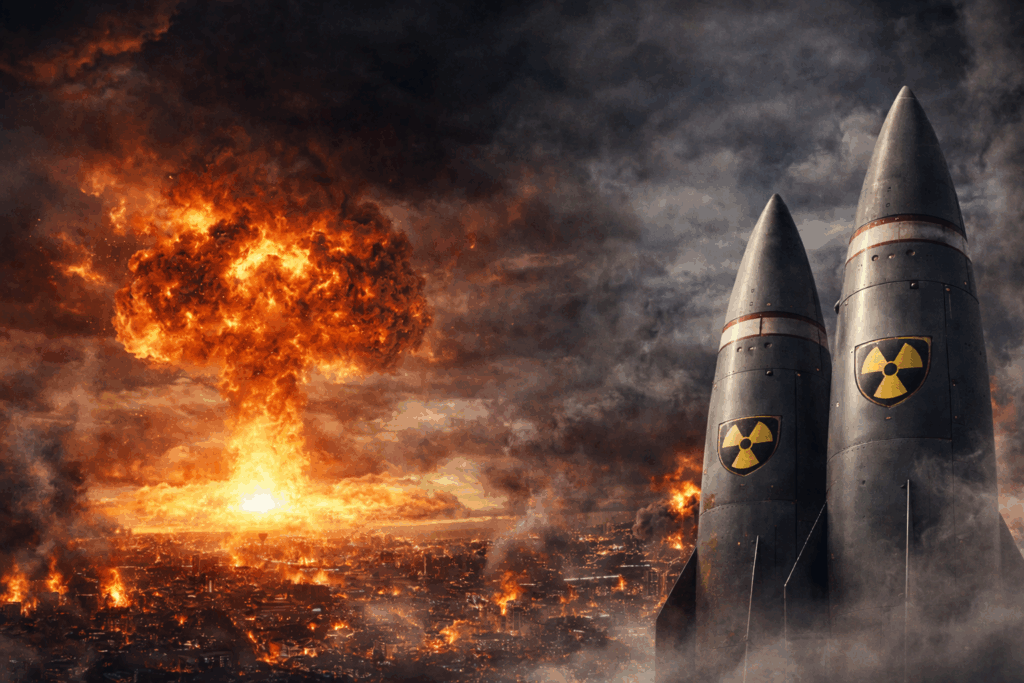
According to the liberal Bulletin of the Atomic Scientists, a left-leaning science-oriented advocacy group, the answer is a definitive yes. Its famous, or infamous, “Doomsday Clock,” an antinuclear political gimmick to some, but to others, a reasonable gauge of how close we are to human-made catastrophe, is now just 85 seconds to midnight.
Last year, it was set to 89 seconds to midnight. A hypothetical global catastrophe is represented by midnight on the Clock. How close the world is to “zero” is represented by the number of minutes or seconds to midnight.
Earth is closer than it’s ever been to destruction as Russia, China, the U.S., and other countries become “increasingly aggressive, adversarial, and nationalistic,” the group said, citing risks of nuclear war, climate change, potential misuse of biotechnology, and the increasing use of artificial intelligence (AI) without adequate controls.
Is this left-wing scaremongering, or is any of it based on geopolitical and strategic reality?
Launched in 1947 to hype the threat of nuclear war and scare everyone into being antinuclear, the Clock has evolved into a proxy mechanism for threats to humanity that also includes unchecked scientific and technological advances, such as biotechnology, AI, and robotics.
The Clock’s original setting in 1947 was seven minutes to midnight. It has since been set backward eight times and forward 18 times. The farthest time from midnight was 17 minutes in 1991, and the closest is 85 seconds in 2026.
Of course, remaining true to its left-wing ideology, it now includes climate change hysterics as a factor, as well. A factor I discount completely.
As even the liberal National Post acknowledged in 2018, “there are plenty of things to worry about regarding climate change,” but climate change is still not in the same league as total nuclear destruction.

However, in addition to the few valid concerns noted above, the group does still consider real nuclear threats. And this, not the climate change or anti-Trump nonsense, is where I find more credibility in their assessment.
These threats include escalating conflicts involving nuclear-armed countries, like the Russia-Ukraine war, but also May 2025’s conflict between nuclear-armed rivals India and Pakistan, and whether Iran is capable of developing nuclear weapons after strikes on its nuclear sites last summer by the U.S. and Israel.
These are very real concerns representing very real risks. There are also these additional major concerns factored into the Clock, as noted by the New York Times:
North Korea kept building its nuclear arsenal, tested missiles designed to carry nuclear warheads and tightened relations with Russia.
China increased its stockpile of nuclear warheads.
The last major nuclear arms control agreement between the U.S. and Russia moved closer to expiry in February this year, which would end 60 years of alleged nuclear “constraints” between the two powers.
The U.S. announced plans for a new missile defense system based on space-based interceptors, called the “Golden Dome,” raising the possibility of conflict in space.
All these, to varying degrees, are valid factors to consider when assessing the risk of nuclear conflict.
However, critics will argue that nothing can put us closer to a nuclear conflict than the Cuban Missile Crisis in 1962, or even the U.S. nuclear alert during the 1973 Yom Kippur War. They often use as an example the Clock being farther from midnight during the Missile Crisis than in the “far calmer 2007.”
To me, this is debatable, but too complex to discuss here.
Meanwhile, the conservative National Review noted in 2010 that the Clock overestimates the effects of “developments in the areas of nuclear testing and formal arms control,” something I wholeheartedly concur with.
Also, Trump’s Golden Dome can either prove destabilizing before it is completed or stabilizing once finished.
But, ultimately, Clock or no Clock, the reality is that the world now has numerous nuclear armed nations, some of them, like North Korea (and potentially Iran) considered rogue, others in perpetual conflict, and at least one major expansionist superpower, China, on a tear to catch up to the U.S. and Russia in nuclear weapons numbers and capabilities. Then there is exponentially expanding technology, like AI or quantum computing, that could provide a breakthrough that changes all our nuclear war paradigms with little or no notice.
To me, these newer, unprecedented risks point to a far more unstable nuclear balance of power today than during the bipolar, two-primary nuclear superpower era of the Cold War. And they do raise the overall risk of nuclear conflict far higher than before.
The opinions expressed in this article are those of the author and do not necessarily reflect the positions of American Liberty News.
READ NEXT: GOP Appeals Ruling Sure To Doom Rising Star Congresswoman

















This all must consider whether the so-called ‘leaders’ of these various countries are stupid enough as to allow their countries to become a wasteland, and themselves a dead, roasted, pile of dung.
Unless they are complete idiots, none of them would even think of ‘pushing the button’.
Yes, there are idiots running many countries, but none that I know of that are THAT crazy. Their own people would force them out of office if they actually wished to do such a thing. The average person does NOT wish to die in that way! They prefer the obvious way which is determined by old age ( I’m 79 … I know ).
Nuclear threats are used to intimidate the weak and the ill-informed. Such things are simply a power-play used on those who are willing to bow down to such an arrogant display.
And since the U.S. has a dominance in such a weapon, and the ability to pin-point that weapon, it makes, of course, a strong deterrent to anyone who would actually wish to use such a weapon on us.
God will see this through. He always has.