



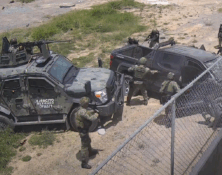



President Trump’s decision to destroy a Venezuelan Eduardoño‑style go‑fast boat crewed by members of Tren de Aragua was lawful, legitimate, and warranted. The reason is straightforward. When heavily armed TdA narcoterrorists pilot tactical speedboats packed with fentanyl toward American shores, they are not committing a garden‑variety smuggling crime. They are waging asymmetric war on the United States. The right category matters. We do not treat a truck bomb racing toward a crowded stadium as a customs violation. We disable it. A fentanyl‑laden fast boat is the maritime analogue. It is a delivery vehicle for a weapon that kills tens of thousands of Americans each year, a weapon that hostile actors deliberately deploy to destabilize our communities. Classifying such an action as mere crime collapses the basic distinction between policing and war. It also misdescribes the actors, who are organized, militarized, and politically enabled by an illegitimate regime in Caracas. To hit that boat was not law enforcement. It was self‑defense.
NARCO TERROR: Democrats want to put US lives at risk attempting to arrest heavily armed narcoterrorists instead of targeting them with missile strikes. pic.twitter.com/Z3hxbKgOld
— @amuse (@amuse) September 3, 2025
Consider the factual core that any fair analysis must begin with. On September 2, 2025, US forces tracked a fast boat that departed a Venezuelan port and entered international waters in the southern Caribbean. Human intelligence linked the crew to Tren de Aragua, a transnational criminal organization designated by the US as a Foreign Terrorist Organization, with leaders sanctioned for terrorism financing and mass criminality. Imagery released by the government shows a missile destroying the vessel at sea, killing eleven TdA terrorists. The platform and missile remain classified. The operation was directed by US Naval Forces Southern Command, working within 4th Fleet’s area of responsibility. Days earlier, the administration had pushed additional naval assets and Marines into the region to deter provocations from Nicolás Maduro’s regime. These are not the trappings of a routine Coast Guard boarding. They are the trappings of treating a terrorist proxy as a combatant.
The legal foundations are clearest when we start with first principles. Article 51 of the UN Charter preserves the inherent right of states to act in self‑defense if an armed attack occurs. That right is not frozen in 1945. It has adapted to non‑state actors who launch attacks of sufficient scale and lethality, especially when they are harbored by regimes that are unwilling or unable to stop them. After 2001, the world accepted that a state may use force against terrorists operating from another state’s territory when that other state shelters them or fails to suppress them. This is now standard practice. The same analytical structure applies here. TdA, a violent network that controls territory, fields heavy weapons, and runs cross‑border campaigns of coercion and violence, uses drugs, especially fentanyl, as a tool of war. The death toll from illicit fentanyl in the US rivals battlefield casualties. If a non‑state group were spraying a nerve agent that killed 70,000 Americans per year, no one would hesitate to call it an armed attack. The delivery mechanism would not matter. The lethality and the mens rea would. By parity of reasoning, interdiction through force is a lawful and proportionate response when seizure and arrest are not feasible without unacceptable risk.
A puzzled reader might ask whether drugs, unlike bombs, are too indirect to count as an armed attack. The answer is twofold. First, fentanyl is not ordinary contraband. It is potent enough to be weaponized at scale. Congress has seriously considered classifying it as a weapon of mass destruction, and senior officials have described cartel fentanyl strategy in those terms. Second, TdA’s use of fentanyl is not accidental spillover from criminal markets. It is deliberate, coordinated, and tied to state actors who have already been indicted for narco‑terrorism conspiracies. The intention to flood the US with poison in order to degrade public health and order is not a collateral effect of a vice economy. It is a method of war.
The second objection concerns sovereignty. Even if non‑state attacks can trigger self‑defense, does striking a boat tied to Venezuela infringe Venezuelan sovereignty. Ordinarily, cross‑border force is tightly constrained. But three features of this case blunt the objection. First, the strike occurred in international waters, not in Venezuela’s territorial sea. The law of the sea recognizes a broad commons where no state’s sovereignty controls. Second, the United States and many partners do not recognize Nicolás Maduro as the legitimate president of Venezuela. Since the fraudulent 2018 process, and especially after the 2024 farce, the US has treated the opposition as the rightful constitutional authority. Consent from the legitimate government in exile is a legal path that diminishes sovereignty concerns. Third, even setting recognition aside, the unwilling‑or‑unable doctrine permits defensive force when the host state cannot or will not neutralize the threat. Caracas has been not merely unwilling, it has been complicit, as years of indictments and sanctions make plain.
A third worry is proportionality and necessity. Was lethal force necessary against a small boat at sea. Could the US not have attempted a seizure. Here the operational context constrains the options. Eduardoño‑style go‑fast boats are designed to outrun and outmaneuver pursuit. They are often armed with belt‑fed weapons and shoulder‑fired rockets. Interdiction, especially at night, can expose US personnel to lethal ambush. The law of self‑defense does not require suicide missions. If reliable intelligence confirmed that the crew were TdA operatives, that the cargo included fentanyl and other narcotics destined for the US, and that capture posed a high risk of casualties, then a precision strike in open water is not only permissible, it is the most discriminating option. It ended the mission, it created no civilian collateral damage (except perhaps for a few innocent fish), and it signaled deterrence to similarly situated cells.
To situate the strike within established patterns, compare three precedents. First, the 1989 intervention in Panama rested in part on the growing recognition that a narco‑dictatorship using the drug trade to harm the US could be met with force. No one claims the current action is an invasion. The comparison is narrower. When a regime fuses its security services with transnational drug networks and declares hostility to the US, self‑defense authority expands, not contracts. Second, the post‑9/11 campaign against Al Qaeda and ISIS established that terrorist cells operating transnationally can be lawfully targeted before they strike, provided identification is strong and collateral damage is minimized. The TdA strike meets those criteria. Third, anti‑piracy norms at sea treat pirates as enemies of all mankind, hostis humani generis, who can be interdicted by any state in international waters. TdA’s combination of murder, kidnapping, human trafficking, and maritime predation makes it closer to piracy and terror than to commerce. The analogy is not perfect, but it is close enough to support interdiction authority where flags and registries are used as shields for predatory violence.
The Maduro factor strengthens the case further. Years before this strike, US prosecutors charged Maduro and senior officials with narco‑terrorism conspiracies, including allegations of coordination with FARC to weaponize cocaine flows against the US. That is the template for state‑enabled asymmetric war. No one claims that fentanyl is manufactured primarily in Venezuela. The claim is more precise. Venezuela has become a permissive platform for transshipment, training, finance, and sanctuary for actors who are happy to move whatever will kill Americans, whether cocaine, fentanyl, or precursor chemicals. When a regime calls up militias in response to a defensive naval posture, when it tolerates or directs a prison gang that turned a penitentiary into a town with a zoo and a pool, when it oversees security forces whose relatives are convicted abroad for narcotics crimes, it forfeits the benefit of the doubt. The law does not require the US to pretend that such a regime is a neutral bystander to a terror campaign.
Some will worry about precedent. If we can strike a drug boat today, what constrains us tomorrow. The constraint is the standard one. Necessity, proportionality, and careful identification. The strike was narrow in aim, limited in scope, and tied to a designated terrorist entity with a record of cross‑border violence and state support. It did not target civilian infrastructure. It did not degrade the living conditions of the Venezuelan people. It did not seek regime change. It sought to prevent an imminent poisoning operation from reaching our coastline. That is the minimum any state owes its citizens.
Others object that lethal force bypasses due process. That objection presupposes that the actors are entitled to the protections of ordinary domestic criminal procedure. But combatants who launch armed attacks are not entitled to advance notice and a jury trial before they can be stopped from delivering their weapon. The law of armed conflict and the law of self‑defense regulate force precisely because waiting for arrests can be catastrophic. There is no global rule that obliges a state to take needless risks with its citizens’ lives when facing transnational terrorist operatives at sea.
A deeper philosophical question lurks. How do we decide whether a threat belongs to the law enforcement model or the war model. The answer is not by label alone. It turns on structure and scale. TdA does not behave like a discrete criminal crew. It has a leadership structure, a territorial presence, training grounds, international logistics, and a documented campaign of violence across borders. Its use of drugs is strategic, not incidental. Its operations are linked to a regime that regards the US as an enemy. Those features trigger the war model. To force the law enforcement model here would be like insisting that a platoon of uniformed soldiers who embed in civilian boats cannot be targeted until they reach a harbor where a sheriff can read them their rights. That is not law. That is unreality.
The strategy behind the strike is not only to stop one boat. It is to reset expectations. For years, cartels and allied gangs have operated on the assumption that the worst consequence at sea is seizure, and that even then the legal attrition game will return many operatives to the field. A visible, precise, and legally grounded strike in international waters punctures that assumption. It communicates that using the sea as a highway for mass lethality will be met with force. Deterrence is not a slogan. It is a pattern of actions that changes the adversary’s calculus. A single action will not end TdA. But it can begin to restore the norm that proxy warfare against the American people, whether through rockets or through synthetic poisons, will not be tolerated.
Finally, it is worth noting that the strike is not a repudiation of law. It is an application of law to a form of violence that exploits legal gray zones. The law has always evolved to meet new technologies and tactics. Torpedoes, aircraft, missiles, and now weaponized supply chains have each forced refinements in doctrine. Treating fentanyl as a weapon when deployed by a terrorist organization under the protection of a hostile regime is such a refinement. It preserves the moral core of the law, which is to protect innocents from organized violence, and it does so with methods that are as discriminating as current technology allows.
The steelman case, therefore, is compact. There was a real and imminent threat, not a speculative one. The actors were part of a designated terrorist organization with state support. The location was outside any state’s sovereign waters. The method was the least escalatory available that could reliably neutralize the threat. The action fits comfortably within the modern understanding of self‑defense and the practice of states facing non‑state actors. It vindicates the duty of the US government to protect its people from organized mass poisoning. It also offers a template for how to resist the convergence of cartel power and rogue regimes in the hemisphere without broad war. We can be precise, firm, and lawful. This operation shows how.
If you enjoy my work, please consider subscribing: https://x.com/amuse.
Sponsored by the John Milton Freedom Foundation, a nonprofit dedicated to helping independent journalists overcome formidable challenges in today’s media landscape and bring crucial stories to you.
READ NEXT: Insider Revelations: Media’s Secret Battle To Bury Newest Shooter’s Motive



















Do so 24/7
Spec Ops
Cruise missile strikes
drones
seize assets
Nonsense democrats want to keep receiving bribes to their offshore bank accounts from the drug cartels, they don’t want anyone arrested!
President Trump believes in protecting our country, whereas Demonocrats would let that boat unload their drugs. Remember, for Lie-beral Demonocrats, ITS ALL ABOUT MONEY !!!