

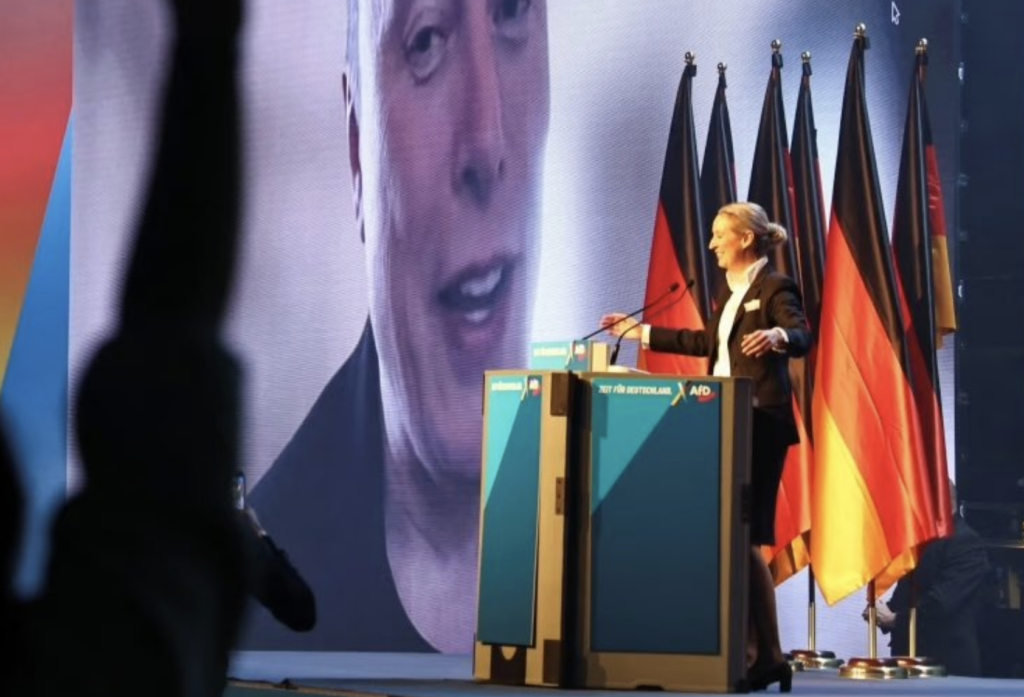
Democracy, properly understood, is not simply the process by which majorities enact their will. It is a system of constitutional protections, of limits on power, and of principled toleration for those with whom one disagrees. Germany’s decision, as of May 2, 2025, to label the Alternative for Germany (AfD) as a “right-wing extremist” party upends this understanding. In the name of defending democracy, Germany is laying the legal and political groundwork to dismantle it.
The Federal Office for the Protection of the Constitution (BfV), a domestic intelligence agency, announced that the AfD has now graduated from a party “suspected” of extremism to one officially declared as extremist. This is not a mere semantic shift. The classification, based on an 1,100-page report, grants the government sweeping surveillance powers over the AfD’s members and operations. All communications — email, phone calls, in-person conversations, are subject to monitoring. The government can now recruit and plant informants, deploy undercover agents and siphon taxpayer funds to do so. In plain terms, the political establishment has gained the legal authority to spy on, infiltrate and destabilize its most successful political rival.
And who comprises this establishment? As of May 6, 2025, Germany is governed by a new coalition composed of the center-right Christian Democratic Union (CDU), its Bavarian sister party the Christian Social Union (CSU) and the center-left Social Democratic Party (SPD). The coalition is led by CDU Chancellor Friedrich Merz. Although the SPD performed poorly in the February 2025 election, securing only 16.4 percent of the vote, their worst postwar result, they nonetheless hold key ministerial positions in finance, justice and defense. This governing coalition commands a narrow majority in the Bundestag with 328 out of 630 seats. Notably, every one of these parties stands to benefit politically from the surveillance and disruption of the AfD. The ruling coalition has not defeated the AfD in open political contest, but rather designated it a security threat and moved to disable it institutionally.
Imagine, for a moment, if President Donald Trump had declared the Democratic Party an extremist organization. Suppose this label allowed him to monitor every text message, every email, every meeting of every Democratic governor, senator and donor. Suppose further that the IRS began targeting Democrat-aligned nonprofits, the FBI embedded informants in Democratic campaign offices and the DOJ began debating whether the party itself should be banned. Such a regime would not be described as “democratic,” even if it retained voting rituals. It would be rightly condemned as a soft dictatorship.
Germany now finds itself at a comparable juncture. What distinguishes this case is the clarity of its logic: the ruling coalition does not trust the people to make the “correct” decision, so it has resolved to constrain their choices. The mechanism is legalistic, the language bureaucratic, the posture pious. But the principle is authoritarian. The voters’ will is legitimate only when it aligns with the regime’s.
It is worth pausing on the fact that this is unprecedented. Since the founding of the modern German state in 1949, only two political parties have been banned: the Socialist Reich Party in 1952 and the Communist Party in 1956. Both were fringe movements with limited national traction. The AfD, by contrast, is the second-largest party in the Bundestag, with 152 seats and more than 20 percent of the popular vote. To classify such a party as “extremist” is not to identify a threat from the margins, it is to disenfranchise a fifth of the electorate.
This, of course, is only the first step. The ultimate aim is to ban the party outright, or at least render it functionally irrelevant through legal attrition. The BfV’s classification opens the door for judicial reviews that could strip the AfD of public funding, bar civil servants from affiliating with it and prevent it from chairing parliamentary committees. Such policies ensure the party is marginalized regardless of electoral outcomes.
Some defenders of the move invoke Germany’s history, specifically, its failure to prevent the rise of Nazism. This analogy is deeply flawed. The Weimar Republic did not fall because it was too tolerant of political dissent. It fell because it lacked the institutional strength and cultural confidence to withstand anti-democratic forces. Ironically, today’s Germany is displaying the same weakness: not in tolerating extremism, but in refusing to trust its own people.
Worse still, the tools now available to the state invite abuse by their very nature. Undercover agents, once embedded, can easily entrap party members or manipulate internal dynamics. A provocateur need only suggest an illicit act and feign agreement from a colleague. A fabricated transcript, an edited audio clip, an accusation from a paid informant, all would suffice to initiate legal proceedings or leak scandals to the press. One cannot overstate how destabilizing this is. It converts political contestation into state-managed theater, where the outcome is predetermined and dissent criminalized.
If this sounds conspiratorial, consider what the BfV is now permitted to do. Surveillance no longer requires probable cause in the conventional sense. The classification itself serves as its own justification. Government officials need not demonstrate that a specific AfD member has broken the law, only that the party as a whole harbors views deemed incompatible with Germany’s constitutional order. But who defines compatibility? The answer, alarmingly, is the very parties the AfD threatens to replace.
This is akin to giving referees the power not only to penalize players but to rewrite the rules mid-game to ensure their preferred team wins. It is not justice, nor is it neutral administration. It is the codification of political bias, dressed up in the garb of democratic vigilance.
The AfD, like any party, has members whose views range from sensible to noxious. But the appropriate remedy is argument, not surveillance. If their ideas are truly abhorrent, they will fail in the arena of public debate. That is the wager of democracy. The moment one abandons that wager, one ceases to be a democrat in any meaningful sense.
Even the process of appeal is hollow comfort. While the AfD may challenge the classification in court, this will take years. In the interim, the damage will be done. Supporters will be chilled, donors intimidated, internal cohesion compromised. The judiciary itself is not immune from political pressure, and the longer the status quo persists, the more normalized it becomes.
International reactions have been telling. Italian leader Matteo Salvini asked whether this was another “theft of Democracy.” Elon Musk hosted AfD leader Alice Weidel on X, giving her a platform precisely because legacy media outlets have cast the party into informational exile. Even American officials have taken notice: Vice President JD Vance met with Weidel just days before the election. These gestures signal a growing unease that the West, in trying to purge populism, may be purging democracy itself.
What then should we make of this episode? It is a warning, not just to Germany but to every nation tempted to conflate dissent with danger. The institutions of democracy are not self-sustaining. They require trust—trust in voters, in debate, in the legitimacy of opposition. When a government loses that trust, it does not become a better guardian of democracy. It becomes its undertaker.
Germany’s surveillance of the AfD is not a prophylactic against tyranny. It is its prototype. The question is no longer whether voters can be trusted. The question is whether those who govern them can be.
Sponsored by the John Milton Freedom Foundation, a nonprofit dedicated to helping independent journalists overcome formidable challenges in today’s media landscape and bring crucial stories to you.
READ NEXT: Our Military Needs Enemy-Made Parts — Here’s Why


















If Germany is going to take such a hardline shift to the left, I no longer want to waste my tourism dollars there. If the gestapo wants to increase their authoritarianism, they can do it without my money.
Hitler redux?
And don’t forget, the IRS actually DID target conservative and republican groups, including the Tea Party.
The Nazis seized power, in part, by banning parties to their left..Hitler was able to consolidate power by reducing opposition, in the 1930s.