


Is war imminent? Every day we see increasing signs of Chinese preparations for an invasion of Taiwan. Their almost constant provocations, aerial incursions and military exercises and naval drills (often including live fire) are now seen by U.S. military officials as actual rehearsals for an invasion.
And now new imagery and videos of China’s massive new ‘invasion barges’ have appeared online.
The giant troop-carrying barges are capable of delivering fleets of tanks and thousands of troops directly onto Taiwanese roads. They also increase the number of places where viable landings can be made.
These vessels suddenly being built by China involve a temporary pier that can be connected to other similar vessels via a barge, or series of barges with jack-up supports placed on the shallow sea floor near the coast or beach for more stability.
The floating pier concept resembles the one used by the U.S. military in Gaza to send humanitarian aid inland from the sea. Bad weather damaged the U.S. effort and put it out of action.
But the Chinese vessels appear far bigger and sturdier. And China is quietly making a lot of them.
As The War Zone reports: “recent satellite imagery from Guangzhou Shipyard International (GSI) on Longxue Island, just southeast of the city of Guangzhou, confirms that three of the jack-up barges that were seen under construction there have departed.”
Another three are reportedly still under construction at the GSI facility, for a total of six vessels ready in short order.
Experts say the huge purpose-built barges resemble the floating Mulberry Harbors used by allied forces during the D-Day landings in WWII.
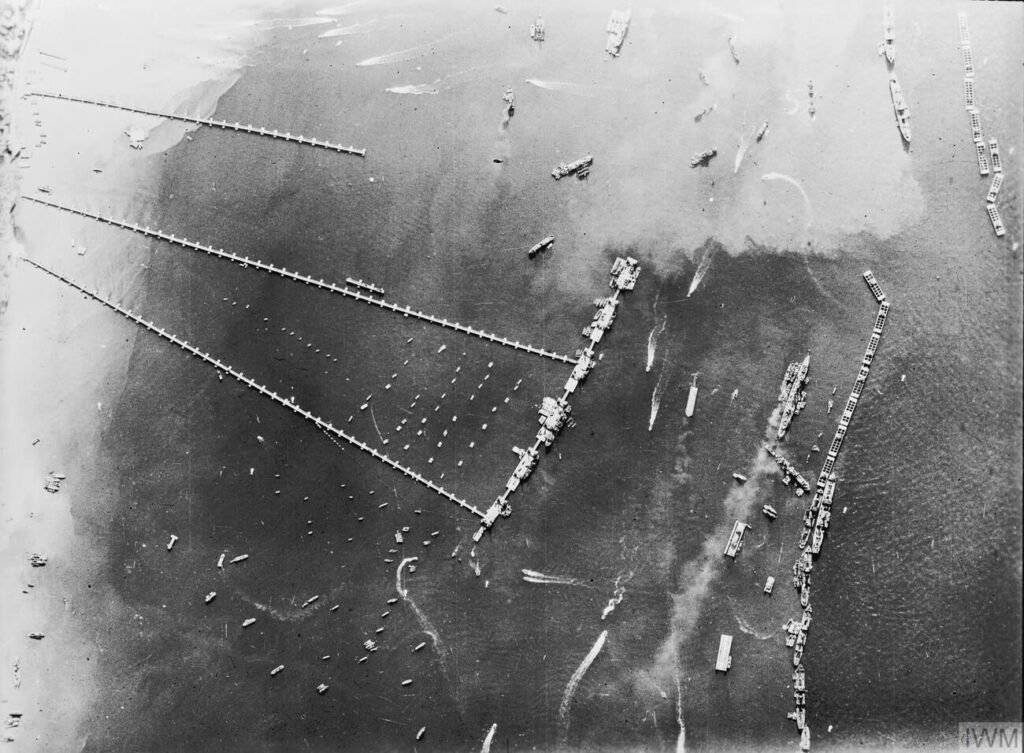
The War Zone continues comparing the U.S. and Chinese versions:
Where the Chinese system differs, however, is in its use of struts, which literally jack the barge up, making it more stable and resilient to bad weather and able to remain in action in heavier sea states. This should also result in a much higher throughput of cargo, vehicles, and personnel. On the other hand, the construction also makes for a notably large target and very static high-value target, suggesting that it would be most relevant after an initial landing, supporting the arrival of mass follow-on forces and supplies after a degree of tactical stability has been established.
As can be seen in the new video, the barge closest to the beach has four prominent jack-up legs, the second barge has six, and the third and final one appears to have eight.
What does all this mean? Well according to a few experts, these are clearly meant to be used in an invasion scenario that opens up the possible landing sites well beyond the few highly defended Taiwanese beaches currently foreseen.
As naval expert H.I. Sutton explains in Naval News, the extreme reach of these barges means that the Chinese military could now “land across rocky, or soft, beaches, delivering the tanks directly to firmer ground or a coastal road.
He adds: “Instead of relying on Taiwanese ports, China can now sail its own mobile port across the straits.”
Other experts concur.
Naval News notes:
Dr Emma Salisbury, Sea Power Research Fellow at the Council on Geostrategy, told Naval News that “Any invasion of Taiwan from the mainland would require a large number of ships to transport personnel and equipment across the Strait quickly, particularly land assets like armoured vehicles”. These mobile piers appear particularly suited to an invasion. Dr Salisbury continues “As preparation for an invasion, or at least to give China the option as leverage, I would expect to see a build-up of construction of ships that could accomplish this transportation”.
Damien Symon, a respected defence analyst who reviewed material shared, noted their suitability for docking with China’s large fleet of civilian ferries. China’s roll-on/roll-off (RORO) ferries are built to carry military vehicles including heavy main battle tanks. They are exercised in this role regularly.
Dr Salisbury agreed: “China is constructing a huge fleet of dual-use ships – commercial vessels that could be easily requisitioned for military use when needed. These include in particular roll-on/roll-off ships that would be perfect for transporting military vehicles – and have indeed been built with military specs in mind.”
The worrisome developments come after Chinese leader Xi Jinping issued a brutal New Year warning to Taiwan and a damaged deep-sea telecom cable off the coast of Taiwan in January was linked to potential Chinese sabotage.
Meanwhile, a massive swarm of Chinese fighters and warships was launched to circle and intimidate the island in October 2024.
Xi has repeatedly stated he wants the People’s Liberation Army (PLA) to be ready to invade Taiwan by 2027. It seems they are moving quickly toward that goal.
The opinions expressed in this article are those of the author and do not necessarily reflect the positions of American Liberty News.
READ NEXT: Celebrity Sports Icon Secretly Dating Trump Family Member?





















Rerun 1940 planned German invasion of UK