

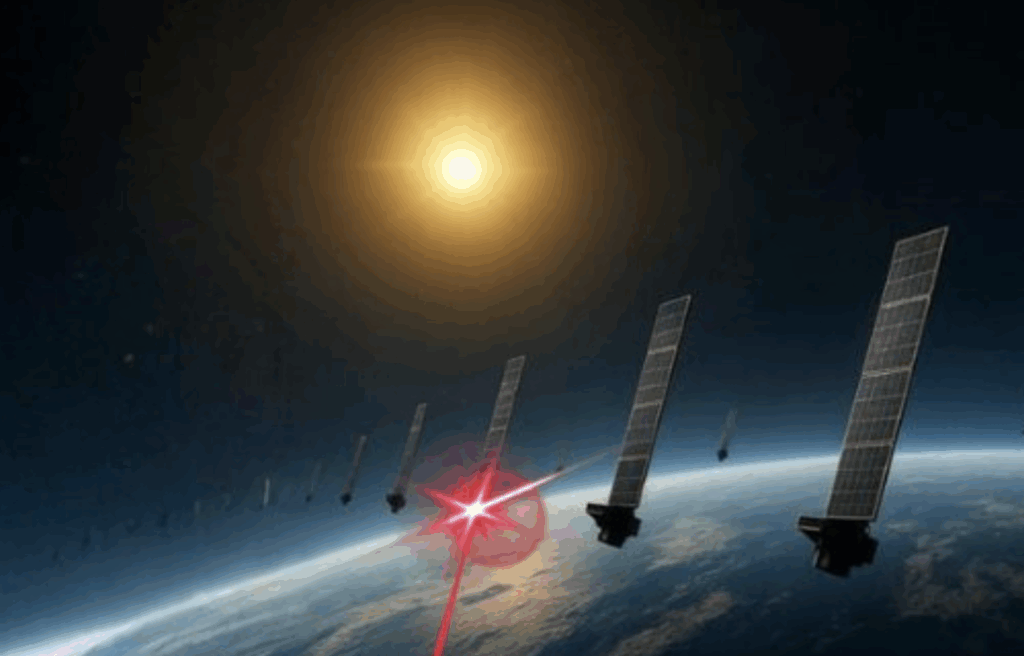
Starlink is often discussed as if it were merely a commercial internet service, a constellation of satellites meant to stream movies and route emails. That framing misses the deeper logic of its design. From its earliest public descriptions, Starlink was conceived as a system that could continue functioning in the presence of attack, interference, and partial destruction. The relevant comparison is not to traditional communications satellites, which are optimized to avoid failure, but to resilient networks, which are optimized to endure it. When viewed through that lens, the emergence of China’s compact high-power microwave weapon, the TPG1000Cs developed at the Shanghai Nuclear Technology Institute, does not reveal a fatal vulnerability. It reveals a class of threat Starlink was architected to absorb.
China Takes Step Towards 'Starlink Killer', Could Be Game-Changer In Ukraine https://t.co/z2ZeiHfWtw
— zerohedge (@zerohedge) February 8, 2026
Begin with the nature of the threat. High-power microwave weapons are not sniper rifles. They are more like floodlights. They project bursts of electromagnetic energy over an area, seeking to overwhelm unprotected electronics. Their advantage is breadth, not precision. They disrupt, scramble, and occasionally damage systems within their cone of influence. But they do not easily select targets, and they do not scale cleanly against distributed architectures. The same is true of laser dazzling and laser heating systems. These weapons are effective against singular, high-value assets whose failure modes are catastrophic. They are far less effective against swarms.
Starlink’s satellites are cheap by aerospace standards and intentionally so. They are software-defined, mass-produced, and treated as expendable. This design choice is often misunderstood as a weakness. In fact, it is the foundation of the system’s resilience. A Starlink satellite is not meant to last 15 years in pristine condition. It is meant to work well enough, long enough, and then be replaced. Failure is anticipated. What matters is how the system behaves when failures occur.
Consider first the satellites themselves. Starlink spacecraft already employ radiation-hardened components and design practices inherited from decades of spaceflight. Against high-power microwave exposure, the emphasis shifts from survivability in the absolute sense to survivability in degrees. Faraday-style shielding around sensitive avionics, hardened cabling and waveguides, and aggressive electromagnetic interference filtering on power and data buses all raise the energy threshold required to cause permanent damage. These measures do not make a satellite invincible. They make it harder to kill, easier to recover, and less likely to fail catastrophically.
A microwave burst that overwhelms a subsystem does not necessarily destroy the spacecraft. It may trigger a reboot. It may force a drop into safe mode. It may degrade performance temporarily. In the worst case, the satellite can be deorbited and replaced. This is not an afterthought. It is the intended failure mode. Starlink satellites are designed to fail gracefully, not dramatically. That distinction matters because high-power microwave weapons excel at causing transient disruption but struggle to produce reliable, permanent kills at scale.
The more important layer of defense, however, exists above the individual satellite. Starlink’s true moat is constellation-level resilience. No single satellite is essential. No narrow orbital shell carries the entire load. Coverage and throughput emerge from numbers, not from perfection. Losing dozens of satellites barely dents service. Losing hundreds is operationally survivable. This is the inverse of legacy military satellite architectures, where one successful intercept can mean mission loss.
SpaceX’s launch cadence reinforces this asymmetry. Satellites are built on production lines that resemble consumer electronics manufacturing more than bespoke aerospace workshops. Launches occur on a timescale of weeks. An adversary attempting a sustained microwave campaign faces a grim arithmetic. Destroying satellites faster than they can be replaced is prohibitively expensive. Even disrupting them temporarily imposes costs on the attacker without delivering decisive effects. The campaign becomes cost-imposing in the wrong direction.
Orbital dynamics further complicate the attacker’s task. Starlink satellites maneuver constantly. Their orbits are adjusted for collision avoidance, coverage optimization, and shell management. Against directed-energy threats, this mobility becomes a defensive asset. Orbits can be diversified vertically and laterally. Shell usage can be rotated unpredictably. Exposure time over hostile territory can be minimized. A ground-based microwave system requires precise timing and geometry. Constant motion erodes both.
Networking behavior adds another layer of resilience. Starlink’s mesh architecture routes around problems automatically. If a localized disturbance causes interference, data paths shift in milliseconds. Laser inter-satellite links reduce reliance on ground stations, allowing traffic to bypass threatened regions entirely. User terminals reconnect seamlessly to different satellites as conditions change. The result is not a blackout but a hiccup. Disruption, not destruction.
This distinction between disruption and destruction is central. High-power microwave and laser systems can harass Starlink. They can degrade performance in specific regions for limited periods. What they cannot do, short of sustained and overt attack, is shut the system down at scale. The architecture assumes interference and is built to route around it.
The ground segment deserves separate attention. If Starlink has an Achilles’ heel, it is not in orbit but on Earth. Fixed gateways are easier to target than moving satellites. SpaceX has responded by distributing gateways across allied territory, employing mobile and sea-based gateways, and increasing satellite-to-satellite routing to reduce dependence on any single ground node. Again, the pattern is dispersion and redundancy rather than hardening alone.
User terminals also participate in resilience. They can frequency hop. They can narrow susceptibility windows. They can temporarily shift modes during suspected microwave activity. These measures do not defeat high-power microwave weapons outright. They reduce the payoff of using them.
At the strategic level, escalation control matters. High-power microwave attacks are not as deniable as some suggest. Space-based sensors detect anomalies. Orbital forensics can correlate timing, geometry, and effects. Persistent attacks create unmistakable signatures. Attribution follows. Once attribution is clear, a gray-zone tactic becomes something else entirely.
This creates a deterrence problem for the attacker. A microwave campaign against Starlink risks escalation into cyber retaliation or space-to-space countermeasures. It invites scrutiny of the attacker’s own space assets, which tend to be more centralized, more expensive, and more fragile. Starlink’s distributed architecture is hard to coerce precisely because retaliation would impose asymmetric costs.
Statements from SpaceX and U.S. defense officials have long emphasized this philosophy. Elon Musk has repeatedly described Starlink as a network designed to keep working under adverse conditions, including jamming and attack. Pentagon officials have publicly noted that proliferated low Earth orbit constellations change the calculus of space conflict by denying adversaries clean, decisive targets. The logic is consistent. Resilience is the point.
The headline claim that China has developed a Starlink-killer weapon misunderstands the nature of both the weapon and the system. High-power microwaves are well-suited to attacking monolithic assets. Starlink is not monolithic. It is a disposable, regenerating mesh network in motion. Shutting it down would require sustained, overt attacks, massive expenditure, and acceptance of escalation risk.
That asymmetry is the countermeasure. Cheap satellites plus fast replacement invert the cost curve. The system does not need to win a duel with every new weapon. It needs to remain useful while imposing costs on those who try to disable it. On that measure, Starlink was architected correctly.
If you enjoy my work, please subscribe: https://x.com/amuse.
Sponsored by the John Milton Freedom Foundation, a nonprofit dedicated to helping independent journalists overcome formidable challenges in today’s media landscape and bring crucial stories to you.
READ NEXT: Ex-Cop’s Theory About Nancy Guthrie Leaves Fox News Stars Silent





















I heard Musk gave his company orders to “initiate protocol severance” which will kill Starlink and internet access throughout ALL of Europe. If that’s true what will Ukraine do ? There will be MILLIONS of unhappy campers in Europe and elsewhere. The female head of the EU tried to tell (control) Elon what to do but he showed her that he cannot be manipulated !!!