

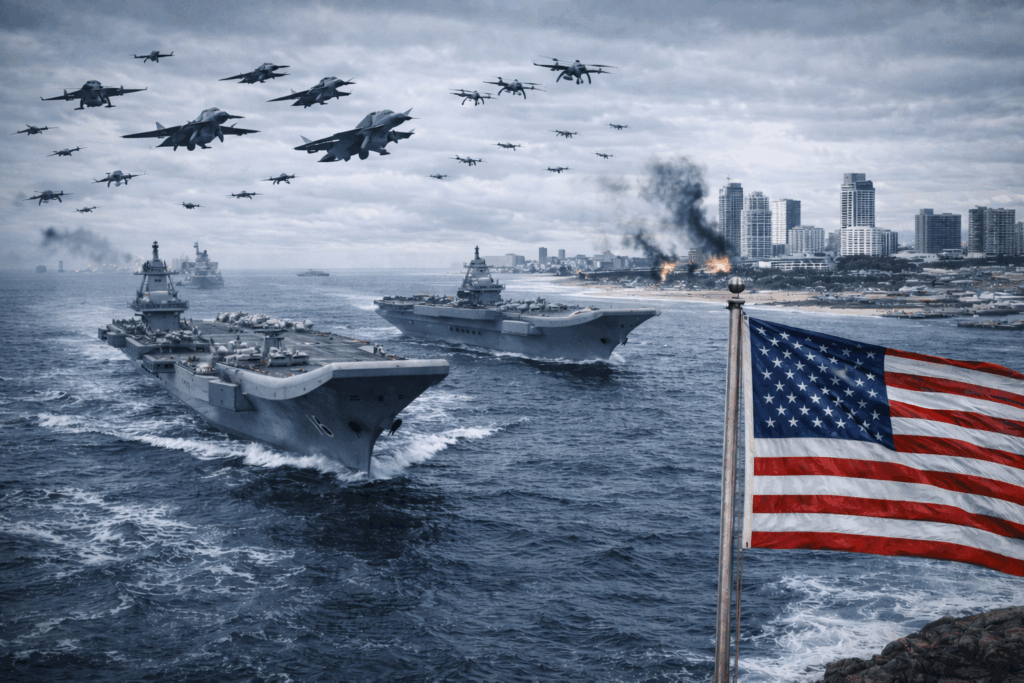
Real war plans, implied threat, or psyops? Recent reports show images and video from Chinese state television of Chinese military planners overseeing video monitors during a computer wargame in central China with simulated U.S.-China battles appearing near Mexico and Texas, the Gulf of America, as well as Cuba and the Caribbean.
The footage of hypothetical conflict scenarios in the Caribbean was recorded at a People’s Liberation Army (PLA) wargaming event held in Xuchang, Henan province, which was reportedly attended by 20 units from across the military and its academies.
It was later shown on the regime’s state-run China Central Television (CCTV). It also showed other apparent conflict scenarios involving Taiwan and the Sea of Okhotsk, as well as Japan, the disputed Kuril Islands, and Russia’s far east coast, perhaps all part of a broader war scenario.
The wargame event was also an opportunity to show off Chinese wargaming technology. Dozens of simulation systems were demonstrated — all of them developed in China.
Was this public display some sort of messaging? A reminder of U.S. vulnerability? Or unknown Chinese capabilities? Or Chinese anger at U.S. operations against Venezuela and its oil shipments to China?
As the South China Morning Post (SCMP) reported:
One screen in the report showed red and blue opposing unit “indicators” – represented by aircraft and ships – manoeuvring near the coasts of Cuba and Mexico. Some of the blue side congregated near Houston, Texas, and headed southeast into the Gulf of Mexico, while the red side was seen in the Caribbean Sea.
In a typical PLA drill, the red side usually represents the Chinese military while the blue side is the enemy.
During the CCTV report, a close-up focused on Cuba showed the lines of trajectory of aircraft and ships in the region in what was likely a simulation of a tactical operation. Chinese researchers were seen pointing to the screen and discussing the situation.
SCMP correctly notes that, “Despite closer economic ties with countries in the region, China has a minimal military presence in Latin America.”
However, it adds that, “But the fact that the PLA is modelling potential conflicts there suggests a shift in the Chinese military’s global ambitions.”
Others argue that the timing of this public display by China demonstrates its anger at the Trump administration’s “gunboat diplomacy” against Venezuela’s socialist narco leader, Nicolás Maduro. U.S. actions are disrupting oil deliveries to China as the U.S. military has seized several sanctioned oil tankers leaving Venezuela, and many others remain in port, fearing U.S. seizure.
China has received much of Venezuela’s seaborne crude exports in recent years through a network of illicit “dark fleet” tankers. These oil deliveries account for well over half of total shipments.
Earlier this week, China’s foreign ministry spokesperson Lin Jian criticized the Trump administration for its seizure of multiple tankers.
InfoWars notes that:
PLA’s decision to publicly broadcast wargaming scenarios, an unusually rare event, constitutes an external signal directed at the Trump administration in response to U.S. gunboat diplomacy in the Caribbean. The signaling reinforces the rationale for Trump’s move to secure the Caribbean basin first, thereby preempting potential Chinese naval encroachment.
But that encroachment is already vast and consists of various Chinese dual-use military-civilian infrastructure throughout Latin America, including ports, space, telecommunications, and other projects.
As The Diplomat notes:
For example, there has long been concern about China’s military use of its “Deep Space Radar” in Neuquen, Argentina. The radar is operated with little Argentine government oversight by an organ of the PLA, and uses communications frequencies commonly used by the Chinese military.
Another dual-use concern is the “exclusive” operation of the Peruvian port of Chancay by China Overseas Shipping Company (COSCO), which the U.S. government has sanctioned for its close ties to the PLA, as well as China’s insistence that COSCO be given a controlling stake in any change of ownership of ports in Panama.
The PLA’s wargaming of operations in Latin America also gives new meaning to the presence of the PLA Navy ship Silk Road Ark, which showed up in the Caribbean in December 2025. Silk Road Ark made port calls in Jamaica and Barbados, with the approval of their governments, which brought the PLA Navy vessel within miles of major U.S. military operations in the region under ‘Operation Southern Spear.’
The outlet adds:
During such a war, important U.S. military facilities in Florida, the Gulf of Mexico, and the U.S. East Coast would potentially be within range of China’s operation of electronic intelligence (ELINT) facilities in Cuba. There is public evidence, confirmed by the U.S. government, such facilities in multiple sites across Cuba, including Bejucal, Salao, and Wajay.
These are all threats the U.S. is aware of and is hopefully intent on neutralizing or removing under President Trump’s new national security focus on securing the Western Hemisphere.
However, another plausible explanation for this public display of potential Chinese-U.S. combat on America’s doorstep is simply psychological warfare or operations (psyops).
Simply posting these purely fictional scenarios makes U.S. war planners think they may mean something, wasting time and effort analyzing possible messaging or potential threats we may have missed.
As I just did here.
The opinions expressed in this article are those of the author and do not necessarily reflect the positions of American Liberty News.
READ NEXT: Former Sen. Jon Kyl Shares Devastating Health Update, Plans To Step Back

















They may be making an exodus from this hemisphere shortly along with some other folks that do not need to be here. Their vassals here are currently grinding to a halt because their drug business has been stymied.