

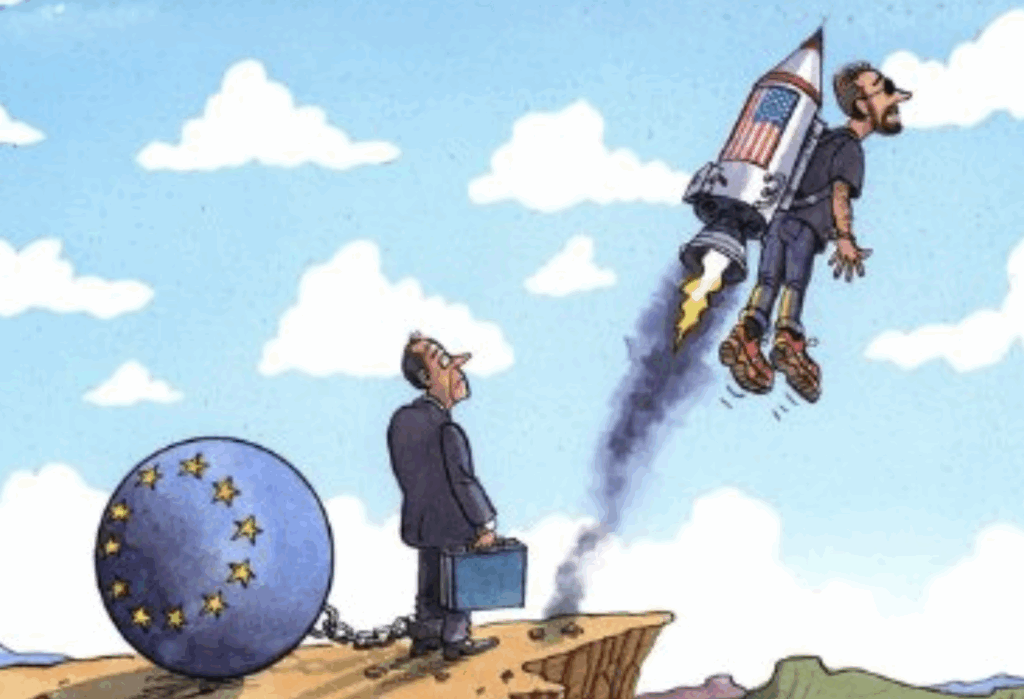
Europe’s economic malaise is often discussed in abstractions. Analysts cite demographics, regulation, or global competition. These explanations are not wrong, but they are incomplete. The scale of the decline is measurable and recent. When Steve Jobs introduced the iPhone in 2007, the EU’s GDP was larger than that of the U.S. Today, Europe’s economy is roughly 40% smaller than America’s and falling further behind. Beneath this reversal lies a deeper failure, a philosophical one. Europe has steadily rejected self-determination, liberty, and justice as organizing principles, and nowhere is this clearer than in its system of higher education. The consequences are visible in innovation data, productivity growth, and ultimately in the continent’s shrinking share of global economic power.
Recent online triumphalism from European commentators makes this contrast impossible to ignore. Many have taken to social media to proclaim European superiority over the U.S., citing welfare states, regulation, and, above all, free college. The timing is telling. These claims surged after President Trump appointed a special envoy to Greenland to explore closer alignment with North America, after Greenland’s long-standing rejection of EU membership again entered public debate, after the EU fined 𝕏 for insufficient censorship, and after the U.S. sanctioned European officials, including former EU Commissioner Thierry Breton, for attempting to coerce American speech platforms. In response, Europe did what it often does. It asserted moral superiority and dismissed economic reality.
The claim that Europe offers free college deserves scrutiny. It is not entirely false, but it is deeply misleading. Tuition at many European universities is low, sometimes as little as $1K per semester. In the U.S., sticker prices can exceed $40K per year. On its face, this seems like a decisive advantage. But this framing omits the most important fact. In the U.S., higher education is open access. Anyone may attend if they can assemble the means through work, scholarships, grants, loans, or delayed repayment. In Europe, access itself is rationed. Roughly 60% of students are barred from university entirely, regardless of willingness to pay.
This difference is not accidental. It reflects fundamentally different views of liberty and justice. The American system treats higher education as an opportunity to be pursued. The European system treats it as a privilege to be allocated. Early tracking, centralized exams, and rigid credential pipelines decide the futures of children at astonishingly young ages. Once sorted out of the academic track, reentry is rare. The result is an intentionally elitist system that limits participation in advanced education to a narrow slice of the population.
The defenders of this model argue that it preserves quality. By selecting only the best students, Europe supposedly concentrates talent and avoids dilution. This sounds plausible until one examines the outcomes. If the system truly identified and cultivated the best minds, Europe should dominate in discovery, invention, and commercialization. It does not. The data show the opposite.
A 2024 study of global patent activity found that no university from an EU member state ranks among the world’s top 50 patent-producing universities. Those rankings are dominated almost entirely by American and Chinese institutions. More striking still, over 70% of European universities report zero direct patent activity. The vast majority of EU higher education institutions have produced no patentable inventions at all. This is not a marginal gap. It is a structural collapse.
In the U.S., by contrast, universities across the spectrum generate patents, spin out startups, and partner with industry. Elite private institutions do this, but so do large public universities. The American system does not rely on perfect foresight at age 12 or 14. It relies on scale, experimentation, and second chances. More students enter the system, more ideas are tested, and more successes emerge. Many fail. That is the point.
The patent gap reveals something deeper than bureaucratic inefficiency. It exposes a failure of academic culture and regulatory instinct. European universities are not structured to commercialize research or encourage entrepreneurial risk. They are insulated from market feedback, constrained by centralized funding rules, and governed by layers of political oversight that treat deviation as a defect. This same instinct now governs industrial policy. The EU’s decision to ban all charging cables except USB-C is a small rule with a large meaning. It freezes a single design choice into law, substitutes bureaucratic consensus for competitive discovery, and signals to innovators that improvement will require permission. Innovation requires freedom to fail and freedom to try again. Europe increasingly offers neither in universities or in markets.
— @amuse (@amuse) December 26, 2025
The consequences extend far beyond patents. Europe consistently underperforms in startup formation, scale-up, and venture financing. All seven of the world’s trillion-dollar technology firms are American. Europe has produced none. Only 28 European companies exceed $100B in valuation, compared to many dozens in the U.S. Over the past decade, European firms raised roughly $800B less in technology funding than their American counterparts. Capital flows where opportunity exists, and Europe has made itself inhospitable to both.
A telling example is DeepMind. Founded in the U.K., it developed world-leading artificial intelligence research. But it could not secure sufficient funding in Europe’s risk-averse environment. In 2014, it was acquired by Google. Its technology now underpins American AI leadership. Europe educated the talent, then exported the value.
This pattern repeats across sectors. European researchers and engineers frequently migrate to the US, where capital, scale, and institutional flexibility allow ideas to grow. Europe becomes a training ground for competitors. This is not a coincidence. It is the predictable outcome of an education system that restricts access and discourages ambition.
Europe’s own institutions acknowledge the problem. The European Commission’s 2023 Innovation Scoreboard shows the EU trailing the U.S., South Korea, and Canada by 8% to 26% on composite innovation indicators. The European Research Council has warned that only a small number of European universities rank among the world’s leading research institutions, and that Europe lags in high-impact scientific publications. Persistent skills shortages plague cutting-edge industries. Academia-industry linkages remain weak. These are official diagnoses, not hostile caricatures.
The educational roots of this failure are obvious. Fewer students reach university. Fewer pursue STEM fields. Fewer become researchers. Europe has a smaller scientific and technical labor force relative to its population than the U.S. or China. By design, it narrows the funnel at every stage. It then expresses surprise when fewer breakthroughs emerge.
Some defenders respond that vocational training compensates for restricted university access. This misunderstands the nature of modern innovation. Advanced economies require not only skilled technicians but also large populations capable of abstract reasoning, experimentation, and interdisciplinary work. Innovation is not centrally planned. It emerges from dense networks of educated individuals interacting unpredictably. Europe has thinned those networks.
The economic effects are no longer theoretical. Over the past two decades, European productivity growth has lagged far behind that of the U.S. Former ECB President Mario Draghi warned of a future of slow agony for Europe unless structural reforms occur. A 2024 European Commission report explicitly blamed economic stagnation on low investment in research and innovation, coinciding with underinvestment in skills and an inability to scale new technologies. The productivity gap with the U.S. continues to widen.
Education policy does not operate in isolation. Europe’s broader rejection of self-determination compounds the problem. Greenland’s history illustrates the point. When Denmark joined the European Economic Community in 1973, Greenland was not meaningfully consulted. The territory later fought for home rule, voted to leave the EC, and preserved the option of full independence or closer alignment with North America. Europe’s instinct is centralization. Self-determination is tolerated only when it cannot be suppressed.
The same impulse governs speech regulation. The EU’s efforts to force American platforms like 𝕏 to censor lawful expression reflect a belief that bureaucratic authority outranks individual liberty. When the U.S. sanctioned European officials for attempting to coerce American companies, the response was indignation, not introspection. Yet innovation depends on open discourse, intellectual risk, and tolerance for dissent. Europe regulates these out of existence.
— @amuse (@amuse) November 22, 2025
One cannot discuss Europe’s educational decline without addressing migration policy. Europe has imported large populations from countries with extremely low average educational attainment and even lower average IQ scores, including Pakistan and Afghanistan. These migrants overwhelmingly lack the skills necessary for advanced education and innovation. Most do not assimilate. The fiscal burden of permanent dependency diverts resources away from domestic students and research investment. The result is fewer opportunities for native Europeans and further erosion of human capital.
This is not a claim about individual worth. It is a claim about policy arithmetic. An economy that limits university access for its own citizens while importing millions who cannot participate in advanced education is choosing stagnation. It reduces the tax base, increases welfare obligations, and starves institutions that generate growth.
Steelmanning the case against Europe’s current higher education model leads to a clear conclusion. By capping university participation around 40%, compared with roughly 65% in the US, Europe produces fewer scientists, inventors, and entrepreneurs. The ones it does produce are forced to head to America to seek opportunities for employment and investment. The measurable outcomes are fewer patents, fewer world-leading firms, slower productivity growth, and declining global relevance.
Incremental reforms will not suffice. As European Research Council President Maria Leptin has argued, Europe must dramatically expand frontier research and cultivate many more world-class universities. Kiel Institute economists warn that the absence of EU universities among top patent performers does not bode well for competitiveness. Red tape must be cut. Commercialization must be rewarded. Most importantly, access to higher education must be broadened.
Liberty is not merely a moral preference. It is an economic engine. Systems that trust individuals to choose, to fail, and to try again outperform systems that allocate opportunity from above. Europe has chosen allocation. The results are now undeniable.
If Europe wishes to reverse its decline, it must abandon the illusion that free tuition compensates for closed doors. Justice requires access. Innovation requires scale. Prosperity requires liberty. Until Europe embraces these principles, its universities will continue to underperform, and its economy will continue to fall behind.
If you enjoy my work, please subscribe: https://x.com/amuse.
Sponsored by the John Milton Freedom Foundation, a nonprofit dedicated to helping independent journalists overcome formidable challenges in today’s media landscape and bring crucial stories to you.
READ NEXT: Trump Revives Forgotten Presidential Playbook — On Purpose


















EU going Medevil again??