

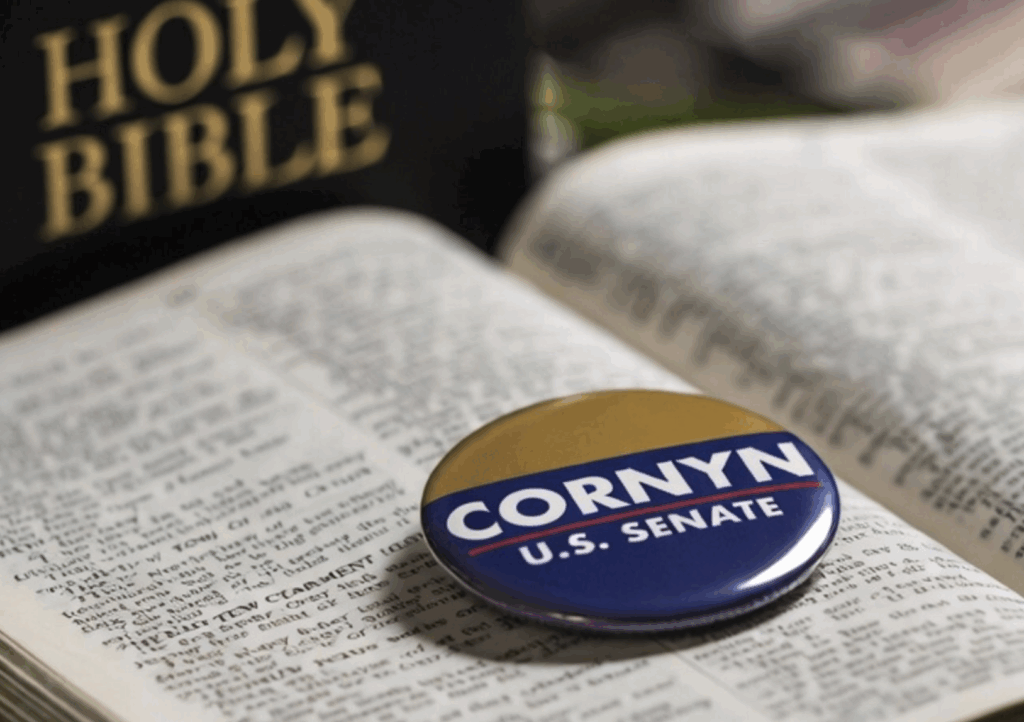
Several days ago, I published an op-ed that drew immediate and intense reaction. The article examined a story published in Baptist News Global, written by Mark Wingfield, which claimed under a headline that Ken Paxton’s pastor had joined Senator John Cornyn’s faith team for his 2026 Senate campaign. My argument was straightforward: the headline was false, the framing was misleading, the factual claims about Paxton’s legal history were wrong, and the entire enterprise was opposition research dressed in clerical clothing. I backed every charge with evidence I had gathered on my own. I did not know, at that moment, how much larger the story was about to become.
— @amuse (@amuse) March 12, 2026
Within hours of publication, my inbox began filling. By the next morning, a source with direct institutional knowledge of Prestonwood Baptist Church, one of the largest evangelical congregations in the state of Texas, made contact. This individual is a deacon of the church. The deacon’s account, which was subsequently confirmed by members of Ken Paxton’s own team, does not merely validate the thesis of my original reporting. It detonates it into something far more consequential. What I reported was bad. What I am about to tell you is worse.
The deacon’s account can be reduced to five declarative propositions, each of which, taken alone, would constitute a significant news event. Together they represent something that warrants the full attention of every Republican primary voter in Texas, every journalist who covered the original Baptist News Global piece without skepticism, and every donor who has funded John Cornyn’s campaign on the premise that he is a man of integrity.
Paxton's pastor joins faith team for Cornyn – Baptist News Global https://t.co/g4Dg3YW8ha
— Senator John Cornyn (@JohnCornyn) March 12, 2026
First: the Baptist News Global article is, in the deacon’s words, a misrepresentation of the facts as they relate to Prestonwood Baptist Church and its leadership. Not an oversimplification. Not a matter of editorial judgment. A misrepresentation. Second: Ken Paxton is not currently a member of Prestonwood Baptist Church and has not been a member for at least eight years. This is not disputed within the church. It is institutional knowledge. Third: Ken Paxton had no involvement whatsoever in the investment matter referenced in the article. The deacon’s language on this point is emphatic and unambiguous. Paxton did not recommend the investment. He did not make any introduction related to it. He did not participate in it in any capacity. Fourth: Dr. Jack Graham has not endorsed Senator John Cornyn’s Senate campaign and does not intend to do so. Fifth: Dr. Jack Graham is not a member of any spiritual advisory team organized by or affiliated with Senator Cornyn’s campaign.
Read those five points again. Let them settle. The entire thesis of the Baptist News Global piece, that Paxton’s own spiritual shepherd had chosen Cornyn over Paxton, rests on the claim that Jack Graham joined Cornyn’s faith team. Jack Graham says he did not. His own church says he did not. His church says he has no intention of doing so. The headline that Cornyn’s campaign posted triumphantly on 𝕏, linking to the article as though it were gospel, is a headline describing something that never happened.
What is the appropriate word for that? Not spin. Not framing. Not aggressive opposition research. The word is lie.
I want to be precise about what I am and am not claiming. I am not asserting, without evidence, that Cornyn personally directed anyone to fabricate anything. What I am asserting, based on the deacon’s account and corroborating sources within Paxton’s team, is that Cornyn’s campaign amplified and exploited a piece of claimed journalism that contained material falsehoods about Jack Graham’s position, misrepresented Paxton’s membership status, falsely implicated Paxton in an investment matter he had nothing to do with, and produced a political effect, namely the impression that Paxton’s own pastor had repudiated him, that had no foundation in reality. When you benefit from a lie, you bear some responsibility for the lie. That responsibility increases when you use your official campaign infrastructure to amplify it.
There is more. I have been pursuing, since the original piece, a question I raised only obliquely in that first article: who actually wrote this story? Mark Wingfield’s byline appears on it. But bylines in advocacy journalism are not always what they seem. I am not in a position to make a definitive claim about authorship. What I can report is that the circumstantial evidence pointing toward significant involvement by Cornyn’s campaign operation in the drafting or direction of the piece is substantial enough to warrant serious journalistic investigation. Consider the convergence of factors. The piece appeared at a moment calculated for maximum political damage, shortly before the Republican Senate primary runoff. It contained specific legal claims about Paxton that required familiarity with the architecture of his prosecution, the kind of familiarity that comes from opposition research files, not pastoral care. It mischaracterized Graham’s affiliation with the faith team in a way that benefited Cornyn’s campaign precisely. It omitted, entirely, the complete exoneration of every charge against Paxton, the single fact that would most alter a reader’s assessment of the allegations. And it was immediately amplified by Cornyn’s campaign account before any serious fact-checking could occur.
Political campaigns do not typically send reporters to write favorable stories. They generate the material, shape the frame, supply the sources, and arrange the publishing. The reporter’s name provides the cover. The political benefit flows to the campaign. This is not a novel technique. It is as old as the penny press. What is notable in this case is that the church itself, speaking through a deacon with direct knowledge, is now disputing the central factual premises of the piece. If Wingfield had done the basic journalistic work, if he had called Prestonwood and asked whether Graham had in fact joined this faith team, if he had asked whether Paxton remained a member, if he had asked whether Paxton had any role in the investment matter, he would have been told what the deacon has now told me. He was not told those things because, the evidence suggests, those questions were never asked. Why? Because the story was not reported. It was constructed.
This matters beyond the internal politics of one Republican Senate primary. It matters because it represents a pattern. The campaign against Ken Paxton has always relied on a simple and effective mechanism: repeat charges with confidence, omit exculpatory context, and trust that the volume of accusation will overwhelm the public’s capacity to evaluate each claim on its merits. This is precisely what was done to Donald Trump for 8 years, and it is precisely what has been done to Paxton for a decade. The Servergy matter, which I addressed at length in my original piece, resulted in complete exoneration. Every charge was dismissed with prejudice. All of them. On June 18, 2025, the last remaining legal thread was cut. A decade of lawfare, every piece of it politically motivated by allies of Joe Straus and later Dade Phelan, ended in total vindication. Mark Wingfield’s article did not mention this. It could not mention it, because mentioning it would have destroyed the narrative the article was designed to create.
The deacon’s confirmation that Paxton had no involvement whatsoever in the investment matter is particularly significant in light of what the original Baptist News Global piece implied. Wingfield wrote that Mike Buster, the longtime executive pastor of Prestonwood, was allegedly among those defrauded in a securities matter in which Paxton was implicated. As I reported, this is false in its framing. Buster’s legal dispute was with Rep. Byron Cook and Joel Hochberg, over a mineral-rights investment scheme. Paxton was not named in that suit. But the article’s juxtaposition was deliberate: place Buster’s name in proximity to Paxton’s name in proximity to the word “fraud,” and let the reader’s mind connect the dots that the facts refuse to connect. A source inside the church has now confirmed what the court record already showed. The juxtaposition was a fiction. Paxton had no involvement. Not tangential involvement. Not disputed involvement. No involvement whatsoever.
This is the kind of thing that should end careers. A denominational news organization, one that presents itself as a journalistic institution bound by professional standards, published claims that a source directly inside the relevant institution now describes as a misrepresentation. The Society of Professional Journalists Code of Ethics does not provide for this outcome. It demands verification before publication, context that allows readers to accurately evaluate claims, and a clear distinction between reporting and advocacy. Wingfield’s piece failed on every count. Baptist News Global has not, to my knowledge, issued any correction. The Cornyn campaign has not retracted the post. The story is still up. The damage continues to accumulate.
Let me say something about Jack Graham specifically, because he deserves it. I do not agree with his involvement with the National Immigration Forum or his advocacy for amnesty-adjacent immigration policies. I said so in my original piece and I will not walk it back. But Graham is a 73-year-old pastor who has led one of the great evangelical congregations in America for more than 30 years. He has a reputation, earned over decades, for integrity and pastoral faithfulness. Having his name affixed, without his consent, to a political endorsement that he explicitly never made, and having that false endorsement used as a weapon in a primary election fight, is an injustice to him personally. He did not volunteer for this. His church did not volunteer for this. And his church is, apparently, deeply and legitimately upset about it.
The deacon who contacted me was not casual in tone. The words used to describe the church’s response to the Baptist News Global article included upset and genuine institutional disturbance. When a megachurch of Prestonwood’s size and stature, a congregation that includes thousands of Republican primary voters, signals that Cornyn’s campaign has used them without consent, the political implications are not small. Cornyn’s campaign attempted to launder a fabricated endorsement through a legitimate institution. The institution is pushing back. This is exactly what should happen, and it reflects well on the church and its leadership that they are not allowing the falsehood to stand unchallenged.
It is worth pausing to consider the scale of the political miscalculation involved here. Cornyn’s campaign apparently believed it could post a headline claiming Paxton’s pastor had abandoned him, ride the news cycle for a few days, and watch it shape the final weeks of the primary. What it could not account for was that the specific facts were wrong enough to provoke a response from within the institution itself. If Jack Graham had in fact voluntarily joined the faith team, the story would have been significant but legitimate. A pastor making a political choice is a pastor’s right. But Graham did not make that choice. He was assigned that choice by someone else’s narrative. And when a man of his standing is falsely assigned a choice he did not make, in a political context, in writing, with his name attached, the correction that follows is not a private correction. It is a public demolition.
I want to return, one final time, to the question of authorship. I raised it because I think it deserves to sit in the reader’s mind as an open question, not a closed verdict. Who benefits from this story? Cornyn’s campaign. Who had access to the specific opposition research details it contained? Cornyn’s campaign. Who has the motive to use a religious publication as a vehicle rather than a mainstream outlet, specifically to avoid the kind of immediate fact-checking a mainstream publication might have applied? Cornyn’s campaign. Who amplified the story within minutes of publication? Cornyn’s campaign. What did the story not contain? Jack Graham’s actual position. What did the story contain? Every element of a professionally assembled opposition research document. I am not saying Cornyn’s people wrote it under Wingfield’s name. I am saying the circumstantial case is strong enough that someone with subpoena power, or even a diligent reporter with persistence, should find out.
John Cornyn posted that headline as evidence of Paxton’s isolation from his own faith community. The deacon of Prestonwood Baptist Church, speaking on behalf of an institution that was apparently mobilized by my original reporting, has now confirmed that the headline described a fiction. The pastor did not endorse Cornyn. The pastor has no intention of endorsing Cornyn. The pastor was never on a faith team. Paxton has not been a member of the church for 8 years. Paxton had nothing to do with the investment matter used to smear him. Every operative claim in that article is wrong.
What does it say about a Senate candidate that his campaign is willing to conscript a megachurch pastor’s name, without that pastor’s consent, in service of a political lie? It says something simple and clarifying. It says that John Cornyn’s campaign, when it cannot win on the merits, will invent the facts instead. Texas Republican primary voters now have the information they need to evaluate that choice.
Ken Paxton’s name has been dragged through a decade of fabricated charges, political prosecutions, and media-enabled smears. He was impeached by a faction controlled by the establishment he had spent his career fighting. He was acquitted. He was prosecuted. The charges were dismissed. He was exonerated. And now, in the final weeks of a primary campaign, his former church has been weaponized by his opponent’s campaign to manufacture the impression that his spiritual community has turned against him. The church says that is a lie. A deacon said so, directly, to me. Paxton’s team confirmed it. I am publishing it now.
If you enjoy my work, please subscribe: https://x.com/amuse.
Sponsored by the John Milton Freedom Foundation, a nonprofit dedicated to helping independent journalists overcome formidable challenges in today’s media landscape and bring crucial stories to you.
READ NEXT: Report: China Intensifies Focus On Trump — Officials Take Notice
















Don’t underestimate the power of The Love Of Money.