

In Taylor Sheridan’s Yellowstone universe, the “Train Station” is more than a plot device. It is a frontier myth brought to life: a stretch of no man’s land along the Montana, Wyoming, and Idaho border where the Dutton family disposes of those who cross them. The area, as described in the series and later contextualized in the prequel 1923, exists in a legal gray zone, a patch of wilderness supposedly left unsurveyed or unclaimed when the borders were drawn. Sheridan’s characters claim that crimes committed there fall into a jurisdictional void, a place where the law does not reach and justice is whatever the Duttons say it is. Symbolically, the Train Station represents the uneasy balance between law and lawlessness, civilization and savagery, that defines the American West.
That story, while fictional, resonates today because the real American West remains a place where law, property, and public rights still collide in ways that recall its mythic past. The Supreme Court’s recent refusal to hear the Wyoming “corner-crossing” case underscores that reality. When the Court declined to review the Tenth Circuit’s ruling in Iron Bar Holdings v. Espy, it left standing a precedent that effectively allows hunters and public land users to move diagonally across private corners to access public land, so long as they never touch private ground. In plain English, that means hunters can now “cross the Duttons’ corners” without trespassing, at least in six western states.
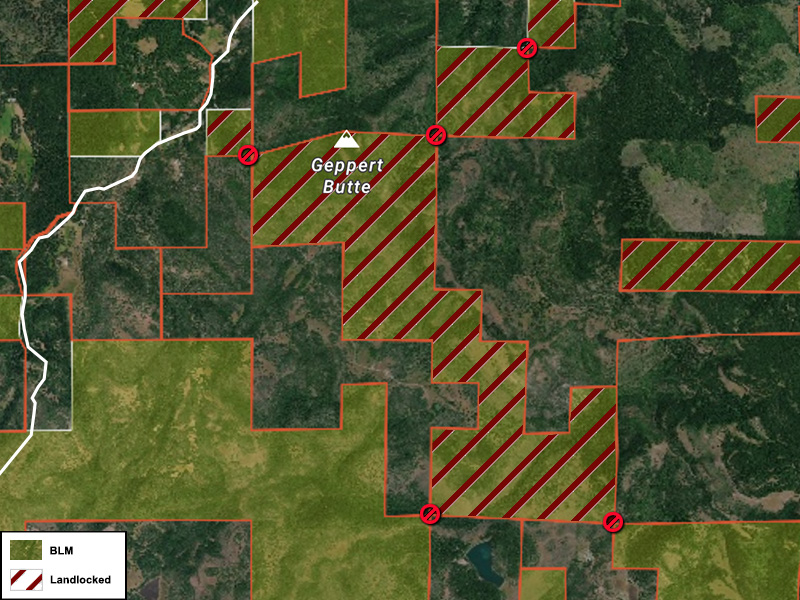
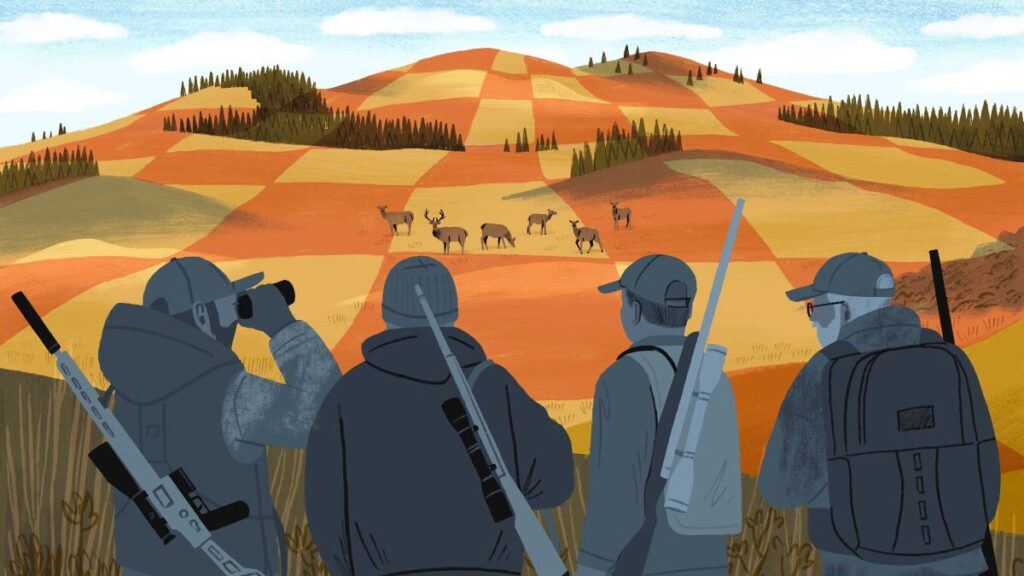
The dispute began in 2020 near Elk Mountain, Wyoming, where four hunters from Missouri used a ladder to step from one public parcel to another at the exact corner where public and private lands meet in a checkerboard pattern. This pattern dates back to 19th-century railroad land grants that divided the West into alternating squares of public and private property. Over time, that pattern left millions of acres of public land effectively “locked” behind private property, accessible only by crossing a corner where four parcels meet.
The hunters, careful not to set foot on the private surface, claimed they were merely crossing through shared airspace to reach public land. The ranch owner, Iron Bar Holdings, owned by North Carolina businessman Fred Eshelman, disagreed. He argued that by passing through the airspace above his land, the hunters had trespassed. They were charged criminally but acquitted by a Wyoming jury in 2022. Eshelman then filed a civil suit seeking nearly $9 million in damages, claiming the act devalued his property. The case soon became a flashpoint for the enduring tension between private property rights and public-land access.

The Tenth Circuit Court of Appeals ruled in favor of the hunters in March 2025, citing the Unlawful Inclosures Act of 1885, a little-known federal statute that prohibits blocking access to public land. The court reasoned that because the hunters neither set foot on private ground nor caused damage, their brief traversal of airspace at the corner did not constitute trespass. When SCOTUS denied certiorari on October 21, 2025, that ruling became binding precedent across the Tenth Circuit’s jurisdiction, Colorado, Kansas, New Mexico, Oklahoma, Utah, and Wyoming.
The decision means that millions of acres of “corner-locked” public land are now accessible to hunters, hikers, and other outdoor users, at least in those six states. But the ruling also ignited unease among ranchers and landowners across the West. For them, it marked a significant erosion of traditional property rights. If ownership extends from the surface upward into the air, how can a stranger lawfully move through that space without permission? The decision, in effect, limits the vertical reach of property ownership in favor of federal access rights.
The precedent also raises deeper questions about the nature of property itself. American law has long held that property rights extend from the surface to the sky and to the center of the Earth, limited only by public necessity, such as air travel or mineral rights. Yet here, the Tenth Circuit introduced a narrow exception: the right of the public to pass through a geometrical point of contact between lands. This legal balancing act, between the inviolability of private land and the public’s right to reach its own property, feels like a 21st-century echo of the old range wars that defined the West.
For public-land advocates, the ruling is a victory. They argue that the checkerboard system was an accident of history, not a moral claim of ownership. To them, denying access to millions of acres of public land simply because they are boxed in by private parcels amounts to privatization by default. They point to the 1885 Act’s clear intent: to ensure that no landowner could use fencing or threats to obstruct public lands. They see the Tenth Circuit’s reasoning as a long-overdue correction.
But for property-rights defenders, this is another sign that private ownership in the West is under siege. They argue that the decision effectively transforms private landowners into involuntary gatekeepers of public lands without compensation or recourse. It also sets a precedent that could expand federal interpretation of property boundaries in ways that weaken state-level control. The rancher’s airspace argument, dismissed here, will almost certainly return in other forms as state legislatures and courts confront similar disputes.
What happens next depends largely on where you stand. Within the Tenth Circuit, the matter appears settled: corner crossing, so long as it does not involve physical trespass or damage, is lawful. But beyond those six states, the legal landscape remains as fragmented as the checkerboard itself. In the Ninth Circuit, covering states like Idaho, Montana, and Washington, the issue is still unresolved. State trespass laws vary, and law enforcement discretion may still lead to arrests or prosecutions even when federal precedent would favor the defendant. In that sense, the West remains a patchwork of overlapping jurisdictions and competing claims, a living embodiment of its own unsettled past.
The cultural resonance of this legal moment cannot be missed. The West has always been defined by its edges: where the law meets the wilderness, where order contends with freedom. Sheridan’s fictional “Train Station” dramatizes that tension by situating justice in a legal void. The real West, it turns out, still contains such voids, only now they are found in the fine print of property deeds and the invisible lines of federal maps.
There is a deeper irony here. The Duttons’ Train Station exists to defend a family’s claim to land “at all costs.” In the corner-crossing case, it is the public, not the patriarchs, who are reasserting their claim to the land, public land, owned collectively by all Americans. Yet the dynamic feels familiar: competing moral visions of what ownership means, each appealing to frontier virtue. The hunter’s ladder and the Duttons’ cliff both express the same idea, the West is a place where the law bends to the will of those who claim to know it best.
To understand why these tensions endure, one must look back to the origins of Western property law. The checkerboard pattern was not an accident but a deliberate policy of the federal government in the 19th century. To incentivize railroads and settlement, Congress granted alternating sections of land to private companies while retaining the rest as public domain. This grid pattern carved the landscape into alternating squares, an arrangement that still shapes property disputes today. The system produced prosperity and conflict in equal measure. It also ensured that, 150 years later, the West would remain a laboratory for testing the limits of property rights.
Sheridan’s fictional no man’s land is, in its way, a mirror held up to the modern West. Both are places where the law meets its limits and morality fills the void. The corner-crossing case did not involve bloodshed or cattle rustling, but it carries the same question that has haunted the region since statehood: who truly owns the West, the individual, the community, or the nation? The Supreme Court’s silence suggests that question will continue to be answered locally, through conflict, compromise, and the quiet persistence of frontier law.
In the end, both the Train Station and the Elk Mountain corner embody the same paradox. They are places where law gives way to custom, where justice depends on who gets there first. Sheridan’s myth and the Court’s inaction together remind us that the American West is not fully tamed. Beneath the veneer of modern property law lies the same moral geography that has always defined it: vast, contested, and precariously balanced between freedom and order.
If you enjoy my work, please share my work and subscribe: https://x.com/amuse.
Sponsored by the John Milton Freedom Foundation, a nonprofit dedicated to helping independent journalists overcome formidable challenges in today’s media landscape and bring crucial stories to you.
READ NEXT: Putin Makes A Chilling Move — And Trump Isn’t Holding Back



















The court’s ruling didn’t really fix the original problem. So, who has jurisdiction over all these jigsaw puzzle pieces of land? Should and can the BLM sell these plots of land to the adjacent landowners or should there be a legal path purchased by the BLW to get people
‘tourists’ from one plot to another?
Isn’t this the same as if they flew by helicopter or airplane?
Best Westerns TV & moives & see WEST Channel:
Lawman
Wanted Dead or Alive
Have Gun Will Travel
The Wild Wild West
Branded
High Chapperal
Undefeated
Major Dundee
Laramie
Tales Wells Fargo