







Will he try? In his most recent comments on this hot topic, President Donald Trump told Meet the Press moderator Kristen Welker Sunday, “I’ll be an eight-year president; I’ll be a two-term president. I always thought that was very important.”
But in March he told her that he is “not joking” about seeking a third term as president, while some of his supporters speculate on possible ways to bypass the Constitution’s two-term limit.
And in his Sunday interview, Trump said again that he’s received strong requests from allies to run. Rep. Andy Ogles and Steve Bannon, have both pushed for third-term scenarios, with Ogles proposing a constitutional amendment to allow three nonconsecutive terms.
Posts on social media reflect MAGA enthusiasm for “Trump 2028.” (RELATED: Army Official Beats MAGA Accusations But Fallout Remains)
Despite teasing the possibility, Trump told Welker, he’s aware of the realities standing in the way. “It’s something that, to the best of my knowledge, you’re not allowed to do.”
Trump’s rhetoric about a third term may just be strategic, projecting strength and delaying lame-duck status.
Or not.
Prior to Franklin D. Roosevelt (FDR), no president had served more than two terms – a tradition started by George Washington and respected for more than 150 years.
But Roosevelt was elected four times, dying in office in his fourth term. Some have likened FDR to America’s first elected dictator.
In response, legislators moved to pass the 22nd Amendment in 1951. The goal was to codify the two-term tradition and prevent any future president from holding office for more than two terms.
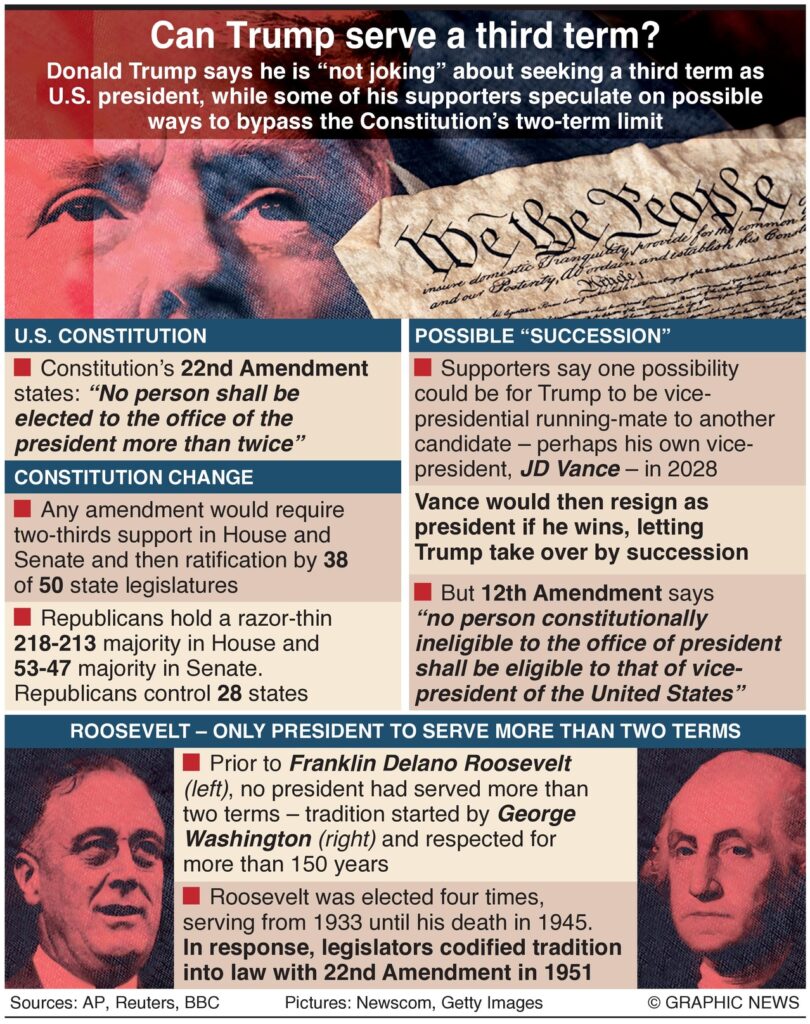
The Constitution says that “No person shall be elected to the office of the president more than twice.” This is understood to apply to either consecutive or non-consecutive terms. However, some Trump supporters, and even Trump himself, have suggested there could be ways around that.
They argue that the 22nd Amendment only explicitly bans someone being “elected” to more than two presidential terms – and says nothing of “succession.” (RELATED: Democratic Governor Navigates Trump Relations Ahead Of 2028)
This is an argument I find convincing.
In an interview with NBC, Trump said one possibility would be for his vice president, JD Vance, to run for president in 2028 with Trump as his vice presidential candidate.
Vance would then resign as president if he wins, paving the way for Trump to return to the White House as president.
This would be akin to Vice president Johnson taking office after John F. Kennedy’s assassination early in his term in office and then running for election, followed by reelection, which Johnson could have done, but chose to decline.
However, this might be when the 12th Amendment comes into play.
In its Eligibility Clause, the amendment states that “no person constitutionally ineligible to the office of President shall be eligible to that of Vice-President of the United States.”
Legal scholars argue that the 12th Amendment’s eligibility clause means that since Trump is ineligible to be president again (due to the 22nd Amendment’s two-term limit), he is also ineligible to be vice president.
This closes a potential loophole where a two-term president might run as vice president and later ascend to the presidency.
There’s no mechanism in the 12th Amendment that allows Trump to bypass the 22nd Amendment’s term limit for a third presidential term. Any third term would require repealing or amending the 22nd Amendment, as noted previously.
Still, proponents of a third Trump term counter that the 12th Amendment, ratified in 1804, predates the 22nd Amendment and likely refers to baseline eligibility criteria (age, citizenship, residency) rather than term limits. Since Trump is not “elected” to a third term, he may remain eligible to serve as vice president and thus ascend to the presidency.
If challenged, the scenario would likely reach the Supreme Court. Given its current composition (six of nine justices appointed by Republicans, including three by Trump), some speculate a favorable ruling for Trump, though legal scholars like Laurence Tribe argue the Court would unanimously uphold the 22nd Amendment’s intent.
Others, like Michael Klarman, express caution due to recent rulings expanding presidential power.
But there are at least three other ways Trump could serve again in the White House.
1. Constitutional Amendment: The 22nd Amendment would need to be repealed or amended to remove the two-term limit. This requires approval by two-thirds of both the House and Senate, followed by ratification by three-fourths (38) of the state legislatures. This is a complex and lengthy process, historically rare for significant changes.
2. Constitutional Challenge: A legal challenge could be mounted to reinterpret or overturn the 22nd Amendment, potentially through a Supreme Court ruling. However, this is highly speculative, as the amendment’s language is clear, and no precedent exists for such a challenge to succeed.
3. Non-Presidential Role: If the question implies serving in a different capacity (e.g., Secretary of State or another office), Trump could theoretically hold such a position without necessarily assuming the presidency.
While the 12th Amendment and practical political norms make it unlikely for a former two-term president to serve as vice president, laws and norms haven’t kept Trump from doing much before.
The opinions expressed in this article are those of the author and do not necessarily reflect the positions of American Liberty News.
READ NEXT: CNN Facing Widespread Ridicule After Cartel Interview Takes Unexpected Turn [WATCH]























If the Speaker of the House doesn’t have to be a member of the House, could Trump be elected by the House to be the Speaker of the House? Then if the President and Vice President resigned would that make Trump the President for a third term?