

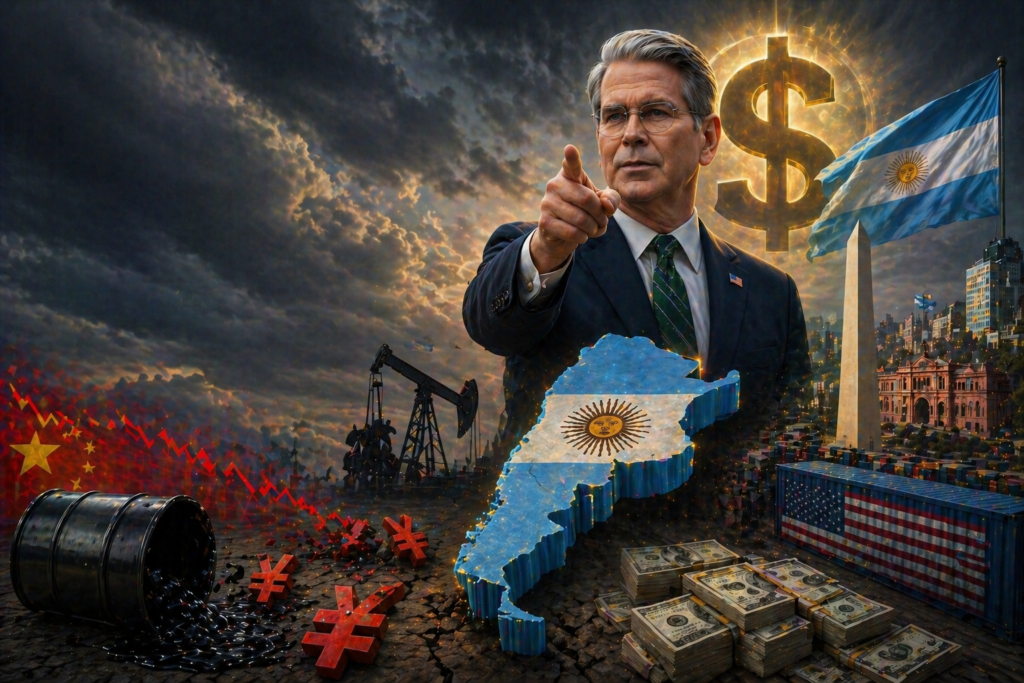
For 50 years the dollar has been the operating system of global finance, and for 50 years our adversaries have been trying to write a competing one. The decisive question of the 2020s is whether they will succeed. Until April 22, 2026, the honest answer was that Washington had no coherent strategy for stopping them. Treasury Secretary Scott Bessent has now supplied one. In testimony before the Senate Appropriations Subcommittee on Financial Services and General Government, and in subsequent statements on 𝕏, Bessent confirmed that “many” Gulf allies and “numerous” Asian allies have requested permanent dollar swap facilities with the United States, and that Treasury intends to respond by building, in his exact phrasing, “new U.S. dollar funding centers in the Gulf and Asia.” This is the most consequential reorientation of U.S. international monetary policy since the 1971 Nixon Shock, and the legacy press has done its usual job of obscuring why.
Discussions with countries, including our Gulf and Asian allies, about U.S. dollar swap lines are part of ongoing, routine conversations that @USTreasury has been having with our partners over a number of years. They are a testament to the U.S. dollar’s primacy and the strength…
— Treasury Secretary Scott Bessent (@SecScottBessent) April 24, 2026
The mechanics matter, because confusion surrounding them is the principal political vulnerability of the strategy. A swap line is not a loan and it is not a bailout. It is a contractually-bounded currency exchange in which a foreign central bank delivers a deposit of its own currency to Treasury or the Federal Reserve and receives an equivalent dollar deposit, with both parties committing to reverse the trade at a specified future date and at the same exchange rate. The foreign central bank pays interest on the dollar borrowing. The U.S. holds the foreign currency as collateral for the duration. Counterparty risk sits at the central-bank level, not the commercial-bank level. The structure is so conservative that the Federal Reserve’s swap operations, including peak utilization of roughly $585 billion during the 2008 crisis and $450 billion during the 2020 crisis, have generated no documented losses to US taxpayers across the major episodes examined in the academic finance literature. As Bessent told Congress in defending the Argentina arrangement, “in most bailouts you don’t make money. The U.S. government made money.”
What Bessent is now doing is taking that demonstrated playbook and scaling it into the central instrument of 21st-century American economic statecraft. The strategic logic, which Bessent has stated plainly, runs as follows. Additional swap lines, in his words, “can benefit our nation by reinforcing dollar usage and liquidity internationally, maintaining smooth functioning in dollar funding markets, promoting trade and investment with the United States, and, in hypothetical stress scenarios, preventing disorderly sales of U.S. assets.” He went further and named the actual game: “Dollar dominance and reserve currency status are strengthened by constant long-term initiatives, including countering the growth of problematic, alternative payment systems.” Translation for those who do not speak Treasury, this is about killing the petroyuan in its cradle.
To see why this matters, consider the architecture Beijing has spent the past decade methodically constructing. The People’s Bank of China has established more than 40 bilateral yuan swap arrangements with foreign central banks. The Cross-Border Interbank Payment System, China’s parallel to SWIFT, has expanded continuously through 2025, connecting thousands of indirect participants and reaching well over 100 countries and regions. The mBridge cross-border central bank digital currency project, in which Saudi Arabia is a participant, provides yuan-denominated settlement rails that bypass SWIFT entirely. The Council on Foreign Relations argued in March 2026 that rising cross-border yuan payments may be weakening a key U.S. sanctions tool, and a March 2026 House Select Committee investigation documented that China has effectively become the clearing market for sanctioned oil from Iran, Russia, and Venezuela. Iran’s 25-year cooperation agreement with Beijing routes a substantial majority of Iranian oil exports through yuan-denominated channels, often processed by smaller Chinese refineries to obscure the trade flows. Venezuela has settled the bulk of its oil exports to China outside the dollar system since 2018. The China-Russia-Iran-Venezuela-Cuba axis is not a coincidence and it is not a fringe alliance. It is a deliberately constructed parallel financial system, and Xi Jinping’s previously private 2024 instructions, since published in the Communist Party’s flagship ideological journal Qiushi, direct officials to build a strong currency widely used in international trade and foreign exchange, with a powerful central bank capable of attracting investment and influencing global pricing.
A serious analyst should not overstate this. Peterson Institute analysis in May 2025 argued persuasively that Chinese alternatives are significant but not systemic, meaningful as safety valves for sanctioned actors and political hedgers but still too small, too fragmented, and too institutionally constrained to rival the full dollar system in the near term. SWIFT data confirms the scale problem, the yuan accounted for roughly 4.33% of global payments by value in early 2025, far behind the dollar. The IMF’s reserve data for the fourth quarter of 2025 shows the yuan at only 1.95% of disclosed reserves against the dollar’s 56.77%. The point, however, is not that Beijing has won. The point is that Beijing is playing a network-effects game in which marginal additions to the yuan settlement system compound, and that the United States until very recently had no answer to the marginal-addition problem.
Bessent’s swap line strategy is precisely that answer. Consider what an expanded permanent swap facility with the United Arab Emirates actually does. The UAE holds approximately $285 billion in foreign reserves, a net international investment position roughly $1 trillion positive, and sovereign wealth funds totaling more than $2 trillion. The dirham is pegged to the dollar. Defending that peg in normal times requires reliable dollar inflows from oil exports. The 2026 Iran war, which began with the February strikes on Iranian nuclear infrastructure and accelerated with Iran’s March 4 closure of the Strait of Hormuz, compressed those inflows dramatically. Brent crude pushed past $120 per barrel, QatarEnergy declared force majeure on all exports, and collective Saudi, Emirati, Kuwaiti, and Iraqi production dropped by roughly 10 million barrels per day at the peak. UAE central bank governor Khaled Mohamed Balama raised the swap line proposal directly with Bessent and Federal Reserve officials at the spring meetings in Washington, and UAE officials told the Wall Street Journal that the binary alternative was clear. Either the United States provides the dollar backstop, or the Emirates begin pricing oil sales and other transactions in yuan. As one prominent macro strategist warned in April 2026, the conflict could be remembered as a key catalyst for erosion in petrodollar dominance and the beginnings of the petroyuan. This is the inflection point that Bessent has correctly identified and acted upon.
A permanent dollar swap facility with Abu Dhabi accomplishes several things simultaneously. It eliminates the partner’s incentive to ever experiment with yuan settlement at scale, because dollar liquidity becomes guaranteed in perpetuity. It deepens UAE-U.S. financial integration to the point where the Emirates’ substantial U.S. investment commitments become self-reinforcing rather than fragile. It signals to every other Gulf monarchy that dollar primacy is a club with permanent membership benefits, not a Cold War-era arrangement that might be revoked. It creates, in Bessent’s exact words, new U.S. dollar funding centers in the Gulf and Asia, meaning that even when New York is closed, dollar liquidity remains globally available through partner central banks. The Federal Reserve’s own staff research has stated the operational logic directly, that swap lines and the related repo facility have enhanced the standing of the dollar as the dominant global currency because approved users know that in a crisis they have access to a stable source of dollar funding. Subsequent academic work using 2020 data found empirically that swap lines reduced strains in global dollar funding markets, narrowed basis spreads, and reduced the sensitivity of funding stress to deteriorating risk sentiment. Permanent swap lines are not a courtesy extended to foreign governments. They are the mechanism by which official actors lock in the dollar’s privileged position.
The fiscal stakes are considerable. Recent academic work published through the National Bureau of Economic Research estimates that loss of the US safe-asset exorbitant privilege would reduce sustainable U.S. debt capacity materially, with debt levels up to 30% lower absent that special status. At current debt levels approaching $36 trillion, that translates to trillions of dollars in foregone borrowing capacity at advantageous rates. Federal Reserve staff research has separately found that a $100 billion decline in foreign official inflows into Treasuries would raise five-year Treasury yields by roughly 40 to 60 basis points in the short run. Every basis point of yield differential that the United States enjoys versus other sovereign borrowers is a direct subsidy from the global financial system to the American taxpayer, paid in the form of cheaper mortgages, cheaper auto loans, cheaper student loans, and cheaper federal interest payments. Foreign central banks currently hold roughly 56.77% of their disclosed reserves in dollars. Each percentage point of that share is worth real money to American workers and American homeowners.
A reasonable reader will ask, how can we be confident the operational risk is low? The Argentina template provides the answer. Congressional research documents that Treasury announced a $20 billion currency swap line financed through the Exchange Stabilization Fund in October 2025, that Argentina drew $2.5 billion against the facility through the end of October, and that the operation was deployed to stabilize the peso ahead of midterm legislative elections critical to President Javier Milei’s reform agenda. Markets stabilized. Milei’s coalition outperformed expectations. Treasury’s financial statements and the New York Fed’s quarterly reporting independently confirm that Argentina repaid the drawn amount in full, that the ESF held no remaining Argentine pesos, and that the operation was closed without outstanding drawings. The Peterson Institute’s October 2025 critique, which predicted the rescue would not work, has not survived contact with reality. Bessent told reporters this was a generational opportunity to create allies in Latin America, citing upcoming elections in Chile and Colombia. This is what financial statecraft looks like when run by someone who has actually traded currencies for a living.
.@SecScottBessent cooks MSNBC:
— Rapid Response 47 (@RapidResponse47) November 11, 2025
“Why would you call it a bailout? In most bailouts, you don’t make money. The U.S. government MADE MONEY.”
“I would rather use peace through economic strength than have to be shooting at narco boats coming offshore if [Argentina] collapsed.” pic.twitter.com/5FDDyEmuTa
A second reasonable reader will ask, why should U.S. taxpayers underwrite arrangements with wealthy Gulf states? Senator Chris Van Hollen made this argument during the April 22 hearing, and Senator Elizabeth Warren has introduced legislation seeking greater congressional oversight of ESF deployments. The strongest version of their argument is that the Argentina precedent established a pattern of executive-branch deployment of large-scale financial assistance without meaningful legislative review. The empirical counter is that swap lines with wealthy partners are not foreign assistance. They are commercially structured transactions in which the United States lends dollars at interest against high-quality foreign currency collateral, analytically indistinguishable from commercial repurchase agreements. The fiscal pattern under Argentina confirmed this, Treasury earned tens of millions in profit, the ESF was made whole within 90 days, and no taxpayer dollars were placed at risk that were not fully collateralized. The ESF was deliberately designed by Congress in 1934 to operate with executive-branch flexibility precisely because international monetary stabilization requires speed and discretion that legislative deliberation cannot provide. Treasury used it under FDR, under Clinton with Mexico in 1995 generating roughly $580 million in profit, under Trump’s first term, and is using it now. The 92-year statutory framework has functioned across administrations of both parties without abuse.
The deepest case for the Bessent doctrine is structural. Academic analysis has long observed that China’s bilateral yuan swap network suffers from a structural catch-22, the lines exist in part to promote the international use of the yuan, but until the yuan is more widely used, countries have little reason to tap them. Dollar swap lines have the opposite problem and the opposite solution. Foreign central banks request them because dollar demand is real, dollar funding markets are operationally critical, and dollar liquidity solves immediate balance-sheet problems. Each new permanent dollar swap facility Treasury establishes is, in essence, a permanent institutional barrier to yuan substitution. Harvard research has found that closer political alignment with the United States was positively correlated with receiving a Fed swap line in 2008 and 2020, confirming that swap lines are not merely technical liquidity tools but instruments embedded in alliance structure and strategic choice. IMF research has separately found that countries with well-developed financial markets, institutions, and trade openness are most likely to supply bilateral swaps and backstop other economies. The Gulf and Pacific Asian candidates Bessent has identified, the UAE, Saudi Arabia, Qatar, Bahrain, Singapore, South Korea, Taiwan, and Japan, fit the profile precisely.
What Bessent is constructing functions as the financial complement to the broader Trump second-term strategic doctrine. The administration has reasserted American primacy in the Western Hemisphere through the Argentina swap, the maximum-pressure campaign on the Maduro regime, and the construction of an explicit Latin American economic perimeter. The expansion of dollar funding centers to the Gulf and Pacific Asia extends that perimeter into the two regions where the petroyuan threat is most acute. The result, if executed competently across the next 36 months, is a global financial architecture in which the dollar is dominant by design rather than by inertia, with permanent dollar funding centers in Abu Dhabi, Riyadh, Singapore, Tokyo, Seoul, and Taipei serving as 24-hour liquidity nodes that make alternative payment systems structurally redundant. For Iran, Cuba, and Venezuela, the strategy forecloses the long game. Each new dollar swap line Bessent signs makes the yuan-denominated settlement architecture less attractive to the wealthy intermediary states that BRICS would need to reach genuine scale. Without UAE participation in mBridge, without Saudi yuan-pricing of crude, without Singaporean dollar-yuan arbitrage, the petroyuan remains a sanctions-evasion vehicle for a handful of pariahs rather than a credible reserve currency contender. That is the prize.
This is what economic leadership at the level of grand strategy actually looks like. It is patient. It is profitable. It is protective of the prerogatives of the American taxpayer. It does not require American troops, American forward bases, or American casualties. It does require an administration willing to use the financial instruments at its disposal with the same seriousness that previous Administrations used military instruments. Bessent is doing exactly that. The petroyuan was built to replace the petrodollar. Bessent is building the wall that prevents that replacement from ever scaling to systemic relevance. If the strategy is sustained across the remainder of the Trump second term, the dollar’s reserve status enters the 2030s on stronger institutional footing than at any point since the 2008 financial crisis. If the strategy is blocked or abandoned, the gradual erosion of dollar primacy that has characterized the past 25 years accelerates into the next phase. The stakes are measured in trillions of dollars of U.S. borrowing capacity, in the operational viability of U.S. sanctions authority, and in the long-term economic foundation of American global power. That is the deal.
If you enjoy my work, please subscribe: https://x.com/amuse.
Sponsored by the John Milton Freedom Foundation, a nonprofit dedicated to helping independent journalists overcome formidable challenges in today’s media landscape and bring crucial stories to you.
READ NEXT: Report: Top Republican’s Trump White House Dream Suddenly Dims



















Another fundamental move of enormous consequence and in our favor under the Trump administration.