

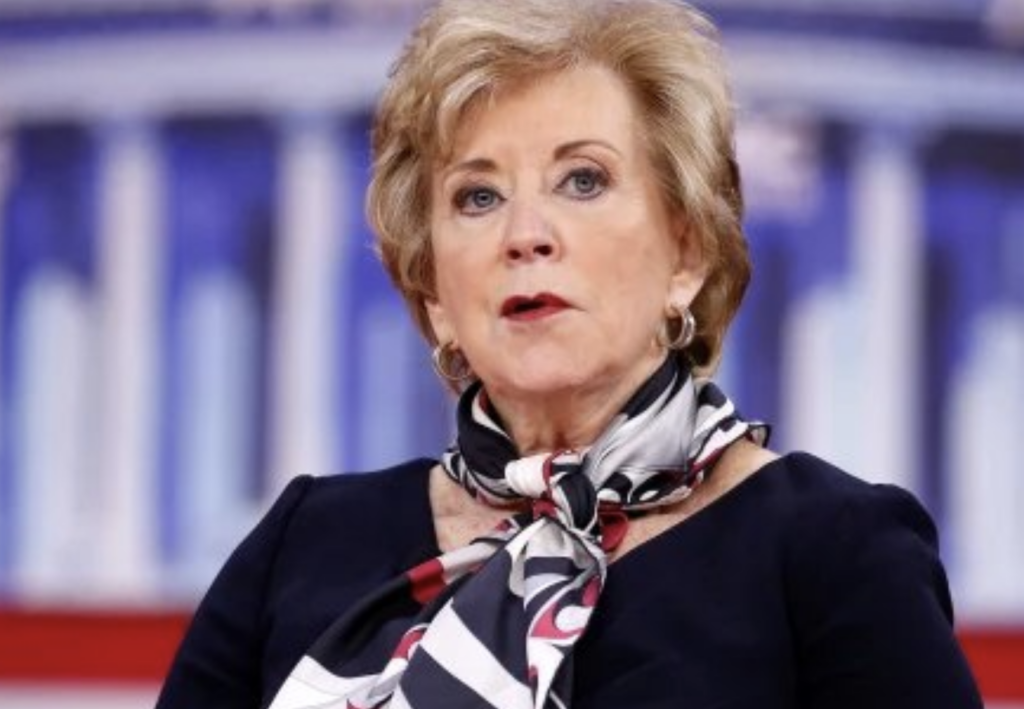
To dismiss Linda McMahon’s qualifications for education secretary is to betray a misunderstanding of what the role requires. The conventional wisdom assumes that a lifetime spent within academia is the only credible credential for managing America’s vast and complex education system. This assumption is not only flawed but demonstrably at odds with the qualities necessary for effective leadership. In McMahon, the country has an education nominee who combines executive experience, hands-on engagement in education policy and a visionary approach to reform—an approach that prioritizes student success over bureaucratic inertia.
Critics, including the National Education Association (NEA) and Senator Elizabeth Warren, label her as “unqualified,” but this claim is easily refuted. McMahon’s experience in both K-12 and higher education is substantive. She served on Connecticut’s Board of Education from 2009 to 2010, where she helped implement policies to improve schools, increase teacher incentives, and raise academic standards. The National Assessment of Educational Progress (NAEP) reported notable improvements in student performance during this period. Additionally, she has long been involved in higher education, serving on Sacred Heart University’s Board of Trustees and donating millions to support students.
The Department of Education is not a schoolhouse; it is a sprawling federal agency with a $79 billion budget, responsible for policy implementation, oversight and the strategic direction of education in America. It is, by its very nature, an administrative and managerial role, demanding the precise skills that McMahon honed over decades as a business leader and a government official. To argue that a career in education alone qualifies one to lead the department is akin to claiming that only a lifelong doctor can competently run the Department of Health and Human Services. Effective leadership is not about subject-matter expertise alone—it is about vision, execution and the ability to navigate a complex system toward meaningful outcomes.
McMahon’s tenure as co-founder and CEO of WWE demonstrated her ability to transform a niche entertainment company into a publicly traded, global enterprise. In doing so, she oversaw not only an intricate financial and operational structure but also developed programs specifically designed to educate and empower young people. Under her leadership, WWE launched initiatives such as the “Get R.E.A.L.” program, which partnered with schools to promote literacy and career readiness. Skeptics who dismiss her as merely a “wrestling executive” fail to recognize the scope of her leadership in creating programs that directly impacted students nationwide.
Her experience extends beyond business. McMahon has served in both federal and state-level education governance, equipping her with an intimate understanding of the policy landscape. Her appointment to Connecticut’s State Board of Education put her in direct deliberations over curriculum standards, school financing and teacher certification. She engaged with educators and policymakers alike, gaining first-hand insight into the complexities of public education. Those who worked with her on the board praised her preparedness and dedication, noting that she took her role seriously and contributed meaningfully to discussions on educational improvement.
At the federal level, McMahon’s leadership of the U.S. Small Business Administration provided another compelling case study in her ability to manage a government agency effectively. She inherited an organization that, like the Department of Education, faced institutional inefficiencies and the weight of outdated bureaucracies. Rather than succumb to stagnation, she streamlined processes, expanded outreach programs and made the SBA more accessible to small businesses across the country. Her tenure was widely lauded for its effectiveness, earning praise even from political opponents who acknowledged her competency and nonpartisan approach to administration.
The hypocrisy of Democrats opposing her nomination is striking. When McMahon was confirmed as head of the Small Business Administration in 2017, she received bipartisan support, including endorsements from Senators Chris Murphy and Richard Blumenthal. However, these same figures now oppose her nomination because she aligns with Trump’s policies, particularly on issues like removing radical gender ideology from schools and expanding school choice—positions widely supported by the American public. This opposition is not about qualifications; it is about partisan politics.
If education is to be a true engine of opportunity, it must embrace efficiency, accountability and innovation—principles that McMahon has championed throughout her career. Her role on Sacred Heart University’s Board of Trustees further illustrates her long-standing commitment to education. Over 16 years, she contributed to the university’s strategic planning, fundraising efforts and student development programs. The university, recognizing her contributions, named its student commons in her honor and invited her to deliver the 2018 commencement address. These are not ceremonial roles; they reflect a deep engagement with higher education and a recognition of her ability to drive institutional success.
Critics might contend that McMahon lacks the traditional academic background of past education secretaries, but history is replete with leaders who succeeded not because of their adherence to convention, but because they brought fresh perspectives and unassailable leadership skills. Margaret Spellings, a former Secretary of Education under President George W. Bush, has publicly stated that McMahon’s business acumen and federal agency experience prepare her well for the role. The Department of Education needs precisely this brand of executive management—a leader who is willing to challenge inefficiencies, demand accountability and introduce modernized solutions that empower students and educators alike.
The central question, then, is not whether McMahon fits the traditional mold of an Education Secretary, but whether she possesses the qualities necessary to make meaningful improvements in the education system. The answer is clear. She has led a billion-dollar organization, managed a federal agency, contributed to state education policy and dedicated decades to educational institutions. If we genuinely care about outcomes rather than optics, about results rather than resumes, Linda McMahon is not just qualified—she is the best candidate for the job.
Sponsored by the John Milton Freedom Foundation, a nonprofit dedicated to helping independent journalists overcome formidable challenges in today’s media landscape and bring crucial stories to you.
READ NEXT: How These Nuclear Orders Can CRUSH Sanctuary City Resistance




















Teaches the Truth for a limited time Dept Education
Although I think we should do away with the Department of Education I think it is good to have someone in the position that can bring a fresh perspective. Maybe she can make the Department relevant and if not shut it down. We need to improve the education that our children are receiving.
I believe President Trump is dismantling these unconstitutional groups from the inside with these appointments.
I believe we’ll get our wish.
The DOE has got to go.
Why are we looking at a head for an agency which should be dissolved?
So we can fix then desolve or reduce it in size and had it back to the states
To a lefty, the only qualification for government is government. And maybe the Teachers Union should see what The Rock is cooking. (Though I prefer New Japan.)
Sounds like a winner to me who might even bring the DOE under control. I miss the days of a real education where a student that graduated from even High School had the knowledge to go forth and be successful in this world.
The arguments set forth in this article saying a person cannot come in and do a good job managing, similar to a Doctor who has been in medicine all his life cannot run a health company or a hospital is down right insulting. You are right that a single person cannot do it all, but they are not asking for that, lame brain. What they want is a head that can run departments which will do the work as requested and required by law. What makes any politician, especially a Democratic poltician think they can do any job, much less this one, without dipping into this or that account for person use. The days of hiding and drawing a paycheck are over, the days of politicians taking money from tax payers forced to pay for nonsince is over as well.
DemocraCommies are threatened by intelligent, qualified white women.