

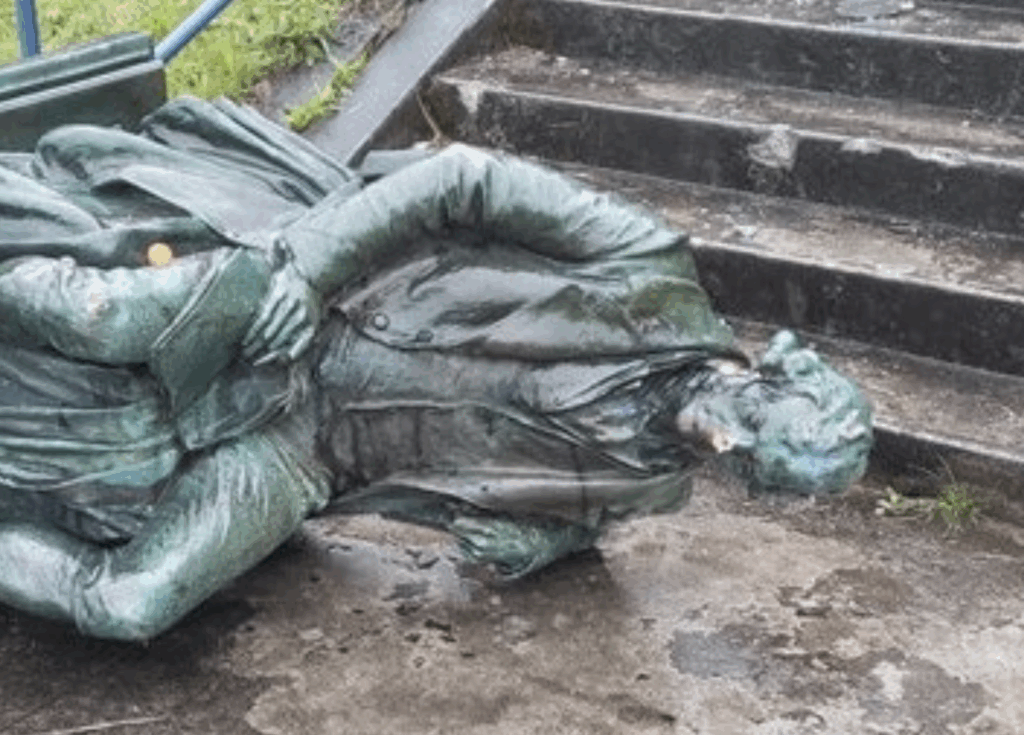
America is in the middle of a memory crisis, and the crisis begins in school. When citizens do not learn what actually happened, they fill the gaps with slogans, then they vote and legislate on the basis of slogans. The recent attempts to remove Thomas Jefferson from civic life, whether by renaming a school or exiling a statue to a back room, illustrate the problem. The claim is simple, Jefferson was a slaveholder, therefore he is disqualified. The truth is more demanding, Jefferson, like many of his generation, was caught inside an institution he believed to be a moral evil, and he spent real political capital trying to constrain it. A serious nation teaches both facts at once, the sin and the struggle. A unserious nation erases the struggle, then judges the sinners as if history were easy.
Consider what almost no college student, and very few of their parents, have ever been shown. In his original draft of the Declaration of Independence in 1776, Jefferson included a 168 word passage that condemned the transatlantic slave trade and placed moral blame on the British crown. Here is the paragraph in full, without alteration, so that the reader can assess it directly.
— @amuse (@amuse) September 4, 2025
“He has waged cruel war against human nature itself, violating its most sacred rights of life and liberty in the persons of a distant people who never offended him, captivating & carrying them into slavery in another hemisphere, or to incur miserable death in their transportation thither. This piratical warfare, the opprobrium of infidel powers, is the warfare of the Christian king of Great Britain. Determined to keep open a market where MEN should be bought & sold, he has prostituted his negative for suppressing every legislative attempt to prohibit or to restrain this execrable commerce. And that this assemblage of horrors might want no fact of distinguished die, he is now exciting those very people to rise in arms among us, and to purchase that liberty of which he has deprived them, by murdering the people upon whom he also obtruded them: thus paying off former crimes committed against the liberties of one people, with crimes which he urges them to commit against the lives of another.”
That is not the language of a man at peace with slavery. Those words would have been part of the founding document had a 26 year old delegate from South Carolina, Edward Rutledge, and colleagues from Georgia not insisted on their removal. They did insist, and the clause was struck for the sake of unanimity.
A reader might now object that condemning the trade is not the same as condemning slavery itself. That is fair, and Jefferson knew it. It is why, in 1778, while serving in the Virginia legislature, he authored a law prohibiting the importation of enslaved Africans into Virginia. He saw choking off the supply as a first step toward extinction. He wrote openly about the need for gradual emancipation, an end state he judged just, and he wrestling with logistics that his era, especially in the South, would accept. A serious critic will challenge his attachment to colonization schemes and his failures of personal manumission. A serious historian will answer that Jefferson was operating inside a legal and economic framework that restricted individual manumission for much of his life, that bound debts to human chattel, and that often required freed persons to leave the state within a year. The moral burden remains, however the practical constraints were real. We can hold both thoughts at once.
Jefferson’s effort to restrict slavery did not stop at Virginia’s borders. In 1784 he drafted a plan for the western territories that would have prohibited slavery in new states formed after the year 1800. The motion failed by a single vote. He called that failure an awful moment because he believed it would have prevented slavery from spreading into the new country. Three years later the Northwest Ordinance did codify a ban on slavery in the territory north of the Ohio River. The wording, there shall neither be slavery nor involuntary servitude, echoes Jefferson’s earlier draft and later appears in the Thirteenth Amendment. Those who claim Jefferson was indifferent to slavery must explain why his legislative pen consistently pointed away from bondage and toward liberty.
As President, Jefferson signed the 1807 law that banned the importation of slaves to the United States, effective January 1, 1808, the earliest moment the Constitution permitted. That measure did not abolish slavery, and Jefferson knew that, but it closed the Atlantic pipeline and made the institution less dynamic. He had argued for this end for decades, as his correspondence makes clear. Again, the critic will say that real emancipation was not achieved in his lifetime. The reply is plain, the founding generation was building a union that could, in time, finish the work by law, first by restricting the spread of slavery, then by ending the trade, and finally by abolishing slavery itself. The sequence is not an excuse, it is a strategy, and it succeeded.
Look beyond Jefferson and the pattern holds. Washington came to abhor slavery and arranged in his will for the emancipation of the people he owned. Franklin ended his life as an abolition leader, petitioning Congress to act against slavery and organizing the Pennsylvania Society for Promoting the Abolition of Slavery. Adams refused to own slaves and advocated gradual abolition in public and private. Hamilton helped found the New York Manumission Society and supported state level emancipation. Madison called slavery oppressive and backed the end of the trade after twenty years. Mason denounced the slave trade as infernal traffic and warned that a nation tolerating slavery invited the judgment of Heaven. None of this erases the contradiction that several of these men owned slaves. Much of it demonstrates, however, that the American founding was saturated with anti slavery moral language and real policy that moved the country away from bondage.
At this point the puzzled reader might ask why, if the founders were so animated against slavery, the Constitution did not abolish it outright. The answer is unity. There would have been no United States if the Deep South had walked out of the Convention or refused to ratify a Constitution that disarmed their economy at a stroke. The framers chose a union with difficult compromises rather than no union at all. They carefully avoided the word slavery in the text, referred to enslaved persons as persons, stopped the trade after twenty years, and fenced off the Northwest from the institution’s spread. They built an amendment process that would later end slavery and protect the equal citizenship of the freed. They did not sanctify property in man, they left the door open for abolitionists to walk through. That is not wishful thinking, it is the reading of later statesmen who invoked the founding to justify emancipation.
Frederick Douglass is decisive here. He first thought the Constitution a pro slavery pact. Then he reread it with attention to its text and structure and concluded that it leaned to freedom. He called it a glorious liberty document and insisted that the founding principles condemned slavery when properly applied. Lincoln made the same argument. He said the founders placed slavery on the course of ultimate extinction, and he pointed to the territorial bans and the end of the trade as proof. When he rose at Gettysburg and spoke of a nation conceived in liberty and dedicated to equality, he reached back to 1776 and made the Declaration the moral center of the regime. The Civil War did not create the American creed, it vindicated it.
Now contrast this serious, complicated, and inspiring history with what our schools often teach. Students learn to see the founding as a mask for oppression, then they move quickly to erasure. In New York City in 2021, officials voted unanimously to remove the 1833 Jefferson statue from the City Hall council chamber and sent it to a museum. In South Orange Maplewood, a school board renamed Jefferson Elementary as Delia Bolden Elementary in 2022, an attempt to replace a founder with a worthy local first. In Portland, protesters toppled the Jefferson High School statue during the 2020 unrest and demanded a name change for the school. In Charlottesville in 2019, the city ended Jefferson’s birthday holiday and replaced it with Liberation and Freedom Day to mark the end of local slavery. At the University of Missouri, student activists demanded the removal of a Jefferson statue from the Francis Quadrangle. Administrators added plaques rather than pull it down. At Jefferson’s own University of Virginia, recent editorials argued that his name and likeness should be stripped from buildings and spaces. These actions share a premise, Jefferson’s slaveholding makes his public presence unfit for a modern democracy.
The premise is understandable, yet it is incomplete. It ignores the other side of the ledger, the one schools should teach. If students saw the 168 word paragraph that Jefferson wrote in 1776 and learned why it was removed, they would understand more than a grievance. They would see the machinery of compromise and the difficulty of coalition. They would consider the cost of a perfect moral statement that fails to become law, versus an imperfect document that binds thirteen fractious polities into a single republic capable of improvement. If students studied Jefferson’s 1784 plan for the territories, his 1778 Virginia statute against the importation of slaves, and his signature on the 1807 federal ban, they would see a consistent trajectory. They would also learn to handle tension, one can be a participant in evil and still take meaningful steps to curtail it. That is not a comfortable lesson, but it is a necessary one because human beings govern.
Some will reply that such teaching whitewashes suffering or excuses hypocrisy. The charge misfires. Teaching the whole record does not minimize the horror of slavery. The deleted paragraph calls the trade an assemblage of horrors and a cruel war against human nature. No one reading those words will miss the moral indictment. The point is not to rehabilitate reputations for the sake of gentility. The point is to equip citizens with the truth so that they can make informed judgments. If, after seeing the full record, a community still decides to rename a school, that decision will at least rest on knowledge rather than piety. But many communities might choose a different course. They might decide to keep Jefferson’s name as a constant reminder of the founding tension, and to pair it with curriculum that forces students to wrestle with that tension in detail. That approach respects both memory and progress.
It is worth pausing on the logical structure of the debate. Critics assume that the existence of a grave moral failure, slaveholding, entails unfitness for honor. That conclusion does not follow. The correct test asks whether the figure, taken as a whole, contributed materially to the moral and political architecture of the nation in a way that deserves public gratitude, even while acknowledging failure. Jefferson’s authorship of the Declaration, including the anti slavery draft, his legislative work against the trade, his territorial vision that seeded later abolition, and his presidential action against importation, meet that test. The Founders, taken together, embedded a regime of liberty that provided the means and the motive for later generations to end slavery. That is the architecture we still inhabit. The question for schools is simple, will you teach the architecture or only the rot in the beams.
Education policy is not neutral here. Curriculum committees control which primary documents appear in textbooks, which speeches are discussed, and which legislative acts get assigned. If the deleted paragraph is never printed, if the Northwest Ordinance is never read, and if the 1807 act is never explained, students cannot form the right picture. They will look at a statue and see only an owner of slaves, then, trained by a simplified moral logic, they will vote to pull it down. If, instead, schools stage the debate honestly, students will weigh the fact that a young South Carolinian, Edward Rutledge, demanded the strike, that Georgia delegates agreed, that some Northern merchants were tender about the trade because they profited from it, and that the Congress chose unanimous independence over maximal moral clarity in a single clause. Students will see politics as the art of the possible and will recognize that a constitution that refuses to say slave, that bans the trade at the first legal moment, and that blocks slavery’s spread in the Northwest, is not a pro slavery charter but a compromise constitution designed to outlast the institution and eventually defeat it.
There is a further practical reason to teach the whole truth. Our public square is riven by performative moralism that mistakes erasure for virtue. When you tear down a statue you do not add a single page to a textbook. When you rename a school you do not add an hour to the unit on the founding. The measurable effect is memory loss. The constructive alternative is instruction. Erect more statues where they make pedagogical sense. Name classrooms after both the heroes and the reformers. Put Jefferson beside Frederick Douglass and Abraham Lincoln in a trio that shows ideas in action. Build assignments that require students to trace the legal language from Jefferson’s 1784 clause, to the 1787 Ordinance, to the text of the Thirteenth Amendment. Ask them to write about what the founders did and did not foresee, the cotton gin, the Missouri crisis, the Civil War, then have them assess whether the founders set the stage for abolition as Lincoln claimed. The exercise will teach humility, which is the right stance toward the past, and confidence, which is the right stance toward the founding.
A free nation depends on civic literacy. It is not enough to recite that all men are created equal. We must know where that sentence came from, what else Jefferson wrote in the same document, who objected, and why. We must know what the Constitution says and does not say about slavery, and we must know how the early republic moved against it. We must teach students to read primary sources in full, not excerpts designed to flatter a present mood. When we do that, the urge to erase will be replaced by a desire to understand, and understanding will foster gratitude without illusions. Jefferson deserves that kind of education. The founders deserve it too. So do our children.
If you enjoy my work, please subscribe: https://x.com/amuse.
Sponsored by the John Milton Freedom Foundation, a nonprofit dedicated to helping independent journalists overcome formidable challenges in today’s media landscape and bring crucial stories to you.
READ NEXT: Congresswoman To Retire Following Major Deal

















Tear down any future statues of SloJoe, who revived slavery. And racists such as Presidents Wilson, Johnson, nixon, and Obama.