





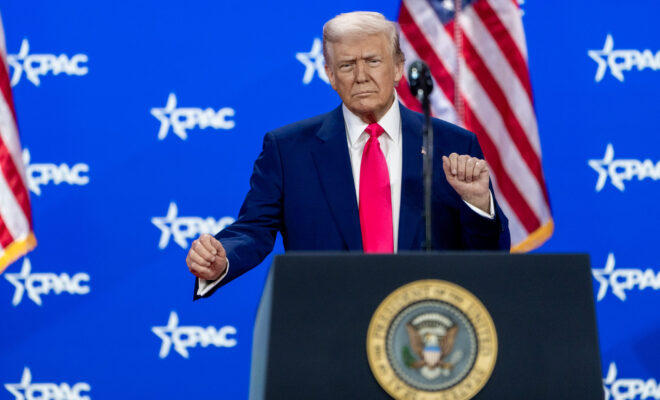
The conviction of President Donald J. Trump in New York is not merely a legal misstep; it is a constitutional disaster. The case was prosecuted under a theory so convoluted, so bereft of statutory grounding, that it cannot stand under even minimal judicial scrutiny. What began as a set of time-barred misdemeanors was alchemized into 34 felonies by a prosecutor determined to criminalize politics. The appeal now before the Appellate Division of the New York Supreme Court represents not only President Trump’s chance at vindication but the judiciary’s opportunity to reaffirm the rule of law and prevent partisan lawfare from becoming the new normal in American justice.
FIRST ON FOX: President Trump’s legal team filed a "powerhouse" appeal in Manhattan DA Alvin Bragg’s case against him, demanding the verdict be thrown out and that the "most politically charged prosecution in our Nation’s history" be dismissed altogether.https://t.co/NsGl1NCw3d
— Brooke Singman (@BrookeSingman) October 28, 2025
The first and most glaring flaw lies in the case’s foundation. Manhattan District Attorney Alvin Bragg’s legal theory hinged on the idea that New York Penal Law §175.10 (falsifying business records) could be elevated to a felony if those records were allegedly falsified to conceal another crime. That “other crime” was, according to the prosecution, a supposed conspiracy to influence the 2016 federal election through “unlawful means.” But those means, as the trial revealed, were drawn directly from the Federal Election Campaign Act (FECA), a law Congress expressly reserved for federal enforcement. Section 30143(a) of FECA could not be clearer: federal campaign law “supersedes and preempts any provision of state law with respect to election to Federal office.” In plain terms, state prosecutors may not enforce federal election law, nor may they use it as a predicate to create a state felony. When New York’s prosecutor built his case atop FECA violations, he trespassed into territory Congress had explicitly walled off.
Even worse, the trial court permitted the jury to convict without unanimous agreement on the supposed “unlawful means.” Some jurors may have believed Trump conspired to violate federal campaign law, others may have thought he aided a tax violation, and still others may have relied on vague notions of concealment. Such fractured reasoning is the antithesis of due process. The Constitution and New York law both demand unanimity on the essential elements of a crime. A verdict based on a patchwork of incompatible theories is no verdict at all.
Layered on top of these foundational errors was the trial court’s unprecedented disregard for presidential immunity. The Supreme Court’s decision in Trump v. United States (2024) established unequivocally that a president’s official acts cannot be used as evidence against him in any criminal proceeding. Yet jurors in this case were shown communications between President Trump and his White House staff, tweets issued from official accounts, and even discussions with the attorney general, each squarely within the domain of official presidential conduct. Such evidence was not only irrelevant to the alleged bookkeeping offenses; it violated constitutional safeguards meant to protect the independence of the executive branch. When prosecutors invite jurors to judge a president’s official actions through a partisan lens, the separation of powers collapses.
Compounding these errors was the appearance, indeed, the stench, of judicial bias. Justice Juan Merchan, who presided over the trial, had donated to President Biden’s campaign and to a group called “Stop Republicans PAC.” His daughter was a senior executive at a Democratic political firm that profited directly from anti-Trump advertising campaigns citing her father’s courtroom proceedings. Under New York’s own judicial ethics rules, a judge must recuse himself whenever his impartiality “might reasonably be questioned.” It is hard to imagine a clearer conflict. The failure to recuse was not just an ethical lapse, it was a structural defect that tainted every subsequent ruling, motion, and instruction in the case.
The appeal now pending in the Appellate Division details these errors exhaustively. It demonstrates that FECA preemption alone requires reversal. It further shows that the admission of presidential acts evidence violated Supreme Court precedent and that the jury instructions denied Trump the unanimity required by both state and federal law. Even the “intent to defraud” element was improperly expanded beyond its traditional meaning. Historically, intent to defraud required proof of an intent to cheat someone out of money or property. But here, prosecutors redefined it as intent to “deceive the voting public.” That novel, amorphous standard transforms political spin into felony fraud. If allowed to stand, it would criminalize campaign strategy itself.
This was not a fair trial by any measure. It was an exercise in political theater disguised as law enforcement. The DA’s office, frustrated after years of fruitless investigation, stitched together a Frankenstein’s monster of preempted statutes, speculative motives, and inadmissible evidence. The trial judge allowed it to proceed under the glare of an election year spotlight, gagging the defendant even as hostile witnesses and media figures launched daily attacks. The result was a verdict that reflected the passions of the moment rather than the requirements of justice.
The role of an appellate court in such circumstances is not to ratify the politics of the day but to restore constitutional order. The New York Appellate Division must recognize that this case violates every principle of fair trial jurisprudence. It must declare that federal election law belongs to federal authorities alone. It must reaffirm that a president’s official acts are immune from prosecutorial exploitation. It must hold that due process demands jury unanimity on the actual crime charged. And it must insist that judges adhere to the appearance of impartiality, especially when political power and personal interest intersect.
If the appellate court upholds this conviction, it will not merely wound one man, it will erode the boundaries that protect every American from politically motivated prosecution. The decision will signal to partisan prosecutors nationwide that they may weaponize obscure state statutes to criminalize federal conduct. It will tell future judges that personal bias is permissible so long as it aligns with elite sentiment. It will announce to the public that the rule of law has been replaced by the rule of politics. Such a precedent would be catastrophic for the Republic.
The better path, the only lawful path, is reversal. The appellate court should vacate the conviction, dismiss the indictment, and issue an opinion reaffirming the supremacy of federal law and the constitutional limits of state power. It should use this case to establish enduring precedent against the misuse of state courts for partisan ends. In doing so, it will not merely correct an injustice; it will strengthen the very foundations of our legal order.
America’s judicial system stands at an inflection point. If lawfare is permitted to masquerade as justice, no future president, or citizen, will be safe from the machinery of political revenge. The New York Supreme Court now has a chance to halt that descent, to redeem itself, and to restore the integrity of American law.
If you enjoy my work, please share my work and subscribe: https://x.com/amuse.
Sponsored by the John Milton Freedom Foundation, a nonprofit dedicated to helping independent journalists overcome formidable challenges in today’s media landscape and bring crucial stories to you.
READ NEXT: Controversy Deepens Around Questionable Nobel Prize















All the cases against President Trump including the alleged rape case where the woman couldn’t remember any of the details and All other fraudulent cases brought by democrats should be null and void. They where all political lawfare to stop President Trumps re-election because the democrats can’t win legitimately at the ballot box.