

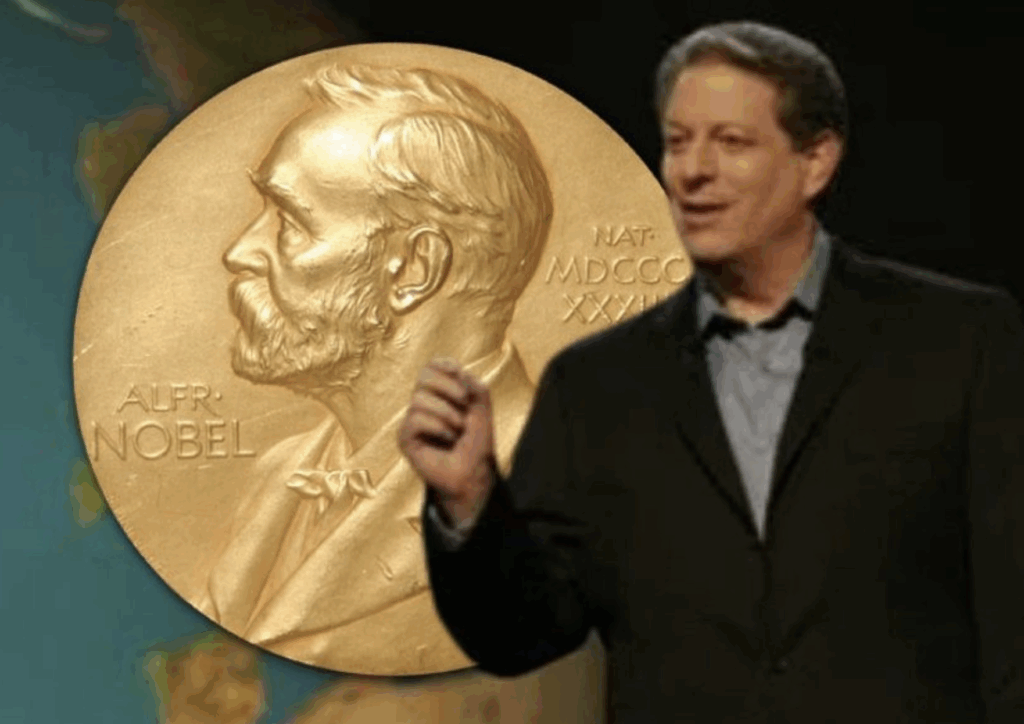
Al Gore’s celebrated documentary, “An Inconvenient Truth” (2006), was hailed as a watershed moment in environmental awareness. It won two Academy Awards, earned Gore a Nobel Peace Prize, and launched him into a moral pantheon as the conscience of a planet in peril. But beneath its sanctimony lay a problem: much of it was false. Nearly two decades later, the film’s signature claims have collapsed under scrutiny. What remains is not a triumph of science but a masterclass in propaganda. The honors Gore received, from the Nobel Committee to Hollywood’s Academy, were built upon exaggerations, misrepresentations, and outright scientific errors and lies. Those accolades should be returned, not out of spite, but out of respect for truth.
Consider Gore’s most iconic claim: that melting ice sheets would cause sea levels to rise twenty feet “in the near future.” The image of cities drowning under water seared itself into public imagination. Yet scientists at the time already knew that such a rise would take millennia, not decades. A British High Court judge reviewing the film found this scenario “distinctly alarmist,” ruling that the film’s educational use required a disclaimer. Actual sea‑level rise since then has been measured in inches, not feet. Even the U.N.’s most extreme projections foresee two to three feet of rise by 2100. Gore’s image of coastal apocalypse was designed to terrify, not to inform.
The same alarmist pattern repeated with his claims about the Pacific atolls supposedly “being inundated” and forcing mass evacuations. The facts say otherwise. No island nation has vanished beneath the waves. On the contrary, studies have shown that most atolls have remained stable or even grown in landmass, as natural sediment deposition and coral growth keep pace with sea‑level change. The supposed “first climate refugees” never materialized because the crisis was largely imagined.
Equally speculative was Gore’s warning that global warming might “shut down the ocean conveyor belt,” plunging Europe into a deep freeze. This was pure science fiction. The Atlantic Meridional Overturning Circulation, which drives the Gulf Stream, has indeed shown some slowing, but every major climate body, including the IPCC, considers a near‑term shutdown “very unlikely.” Europe remains temperate; no new ice age has come. Yet this scenario, presented as plausible, was crucial to the film’s apocalyptic tone.
Gore’s manipulation of paleoclimate data was another sleight of hand. He displayed ice‑core graphs showing a tight correlation between CO₂ levels and global temperature over hundreds of thousands of years, implying a simple causal chain: more CO₂, higher temperature. What he failed to mention is that temperature increases preceded CO₂ rises by roughly a thousand years. The warming came first, driven by solar cycles; then CO₂ amplified it. This distinction matters because it undercuts the film’s central message, that human‑emitted CO₂ alone drives climate catastrophe. Gore’s graph was visually compelling but scientifically misleading.
Some of Gore’s examples were simply false. Mount Kilimanjaro’s melting snowcaps, he claimed, were proof of global warming. Yet studies by climatologists Philip Mote and Georg Kaser found no significant warming at the summit; the retreat resulted from local conditions, less snowfall, dry air, and sublimation, not from rising global temperatures. Most of the glacier loss occurred before 1950, long before the modern spike in CO₂. Kilimanjaro’s snows were a casualty of regional weather, not planetary warming.
The drying of Lake Chad offered another convenient symbol, which Gore attributed to global warming. But hydrologists have long known that human water use, population growth, and over‑irrigation were the main culprits. The British High Court again noted the film’s “alarmism,” citing population pressure and over‑grazing as the true causes. Gore transformed a complex ecological and human problem into a simplistic morality tale.
Then came Hurricane Katrina. Gore suggested it was a product of climate change, an emotional manipulation that exploited tragedy. Yet attribution studies at the time and since have found no definitive link between global warming and single hurricanes. In fact, after 2005, the U.S. entered a twelve‑year stretch without a single major hurricane landfall. Gore’s implication that such storms were becoming more frequent or more intense was premature at best, deceptive at worst.
His use of polar bears as icons of doom was equally dishonest. The “drowning polar bear” image came from a study that found four bears dead after a storm, not a population collapse. Since the film’s release, polar bear numbers have risen from roughly 22,500 to about 30,000. That increase coincided with Arctic sea‑ice fluctuations, suggesting the species is resilient, not vanishing. Gore’s portrayal of dying bears floating on melting ice floes was an act of emotional theater, not empirical reporting.
Even coral reefs, depicted as dying en masse, tell a more complicated story. While heat‑induced bleaching events have occurred, subsequent research shows that reefs can and do recover. Some regions, including large portions of the Great Barrier Reef, have recently recorded their highest coral cover in decades. Gore’s film offered no such nuance. It was a sermon, not a study.
When a 2007 British court reviewed nine key inaccuracies in “An Inconvenient Truth,” it ruled that the film contained “errors of fact” and could be shown in schools only with guidance notes correcting its falsehoods. Yet instead of damaging Gore’s reputation, the ruling elevated him further, turning criticism into proof of martyrdom. The irony is stark: the man who preached about the moral costs of misinformation became one of its great practitioners.
The financial rewards were considerable. Gore parlayed his fame into a fortune, investing heavily in green‑energy funds that benefited directly from the very panic he helped incite. He became a partner at Generation Investment Management, whose holdings surged as governments subsidized renewable ventures. In effect, Gore monetized fear. He branded himself the planet’s savior while building a private empire on carbon guilt.
Some defenders argue that Gore’s exaggerations were merely rhetorical devices to spur awareness. But this utilitarian defense collapses on ethical grounds. A falsehood told for a good cause is still a falsehood. Democratic societies depend on public trust in evidence. Once leaders begin manipulating facts “for the greater good,” they erode the foundation of honest debate. If Gore believed the ends justified the means, he betrayed the very scientific integrity he claimed to champion.
The damage extends beyond Gore’s personal credibility. His brand of climate alarmism distorted public policy and poisoned discourse. It turned a legitimate discussion about stewardship into a moral panic. Those who questioned his claims were vilified as “deniers,” a term chosen to echo Holocaust denial. That rhetorical move silenced nuance and cast dissenters as villains. The result was a decade of polarization, in which skepticism became heresy and science became ideology.
The broader cultural impact was profound. Hollywood, academia, and media institutions used “An Inconvenient Truth” as moral validation for an entire political agenda. Governments worldwide poured trillions into green subsidies, many of which failed or fueled corruption. Meanwhile, genuine environmental issues, like deforestation, overfishing, and pollution, were overshadowed by speculative climate models that failed to predict real‑world outcomes. By elevating Gore as prophet, the establishment mistook narrative for knowledge.
It is time to confront that mistake. Awards like the Nobel Peace Prize, the Prince of Asturias Award, and the Oscars for “An Inconvenient Truth” were not just premature, they were undeserved. They enshrined deception. If these institutions care about credibility, they should reclaim their honors. Doing so would send a message that truth matters more than politics. Gore’s intentions, whatever their sincerity, do not excuse the consequences of misleading billions.
The moral of this story is simple. Science must remain grounded in evidence, not animated by ideology or profit. The world does face environmental challenges, but exaggeration is not enlightenment. Al Gore’s legacy is not the salvation of the planet but the corruption of its discourse. His laurels, won through distortion, belong not on the mantle of heroes but in the museum of propaganda.
If you enjoy my work, please share my work and subscribe: https://x.com/amuse.
READ NEXT: Major Shift In Russia’s Eastern Ukraine Campaign Reported
Sponsored
We’ve secured major victories for America’s future. PLEASE help us secure one more! Congressman Jeff Crank needs YOUR Help to defeat the woke Left. Your voice powers our movement. Complete the Survey TONIGHT!

















So, why a Novel Peace Prize? It should have been a prize in Science but it was already known it would not withstand the test of truth and scrutiny. There are so many Inconvenient Facts. If Obama believed Gore, he must really dislike his children. Otherwise why would be buy not one, but two, multimillion dollar oceanfront properties, soon to be worthless?
Al Gore: just another Democommie liar, but on a global scale.
I always knew it was nothing but leftist lies.
The carbon tax was going to be a HUGE moneymaker for the companies that were going to sell them. Look up Chicago Climate Exchange (CCX) and who was involved. See https://welovetrump.com/2020/09/27/blood-and-gore-the-untold-story-behind-al-gores-carbon-tax-company/
Huge eye opener!
Crusade built on lies?
Well, he is a democrat, what do you expect?
Gore! Another schiff eater!
Gore is FULL of SCHIFF!