

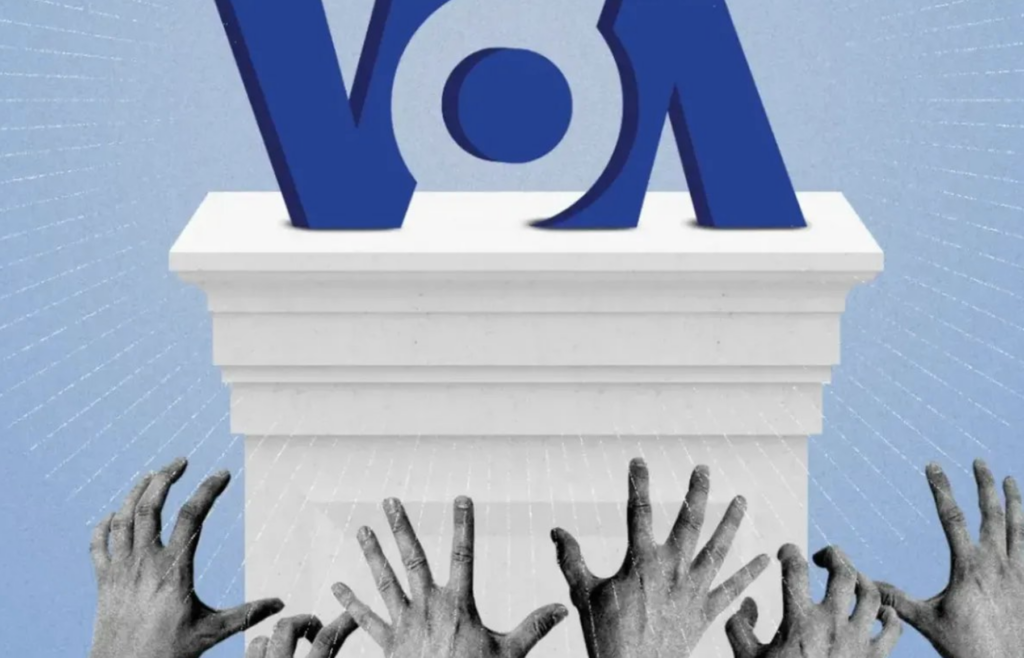
A functioning government agency is not necessarily a good one. Indeed, when institutions calcify around missions they no longer serve, or worse, when they evolve into ideological instruments alien to the values of the republic that funds them, the most prudent course of action may be not reform but suspension. Such is the case with the Voice of America.
For decades, VOA was cast as America’s voice abroad, a beacon of truth in dark corners of censorship and authoritarian propaganda. But institutions, like people, can forget who they are. The VOA of today no longer bears faithful resemblance to the anti-totalitarian spirit of its founding. Instead, it has become, in both tone and practice, an organ of progressive sentiment, projecting far-left values to audiences across the globe. The irony is staggering. At a time when America must recover its sense of national identity and confidence, it is paying to export the very ideology undermining it from within.
In this context, the Trump administration’s decision to shutter VOA through executive action was not rash but rational. It was a clarifying act, and possibly a liberating one. A recent MSNBC report, meant to cast the closure in apocalyptic terms, inadvertently proves the point. It chronicles how quickly the agency unraveled: leases terminated, funding frozen, employees in limbo, wire services lost and broadcast channels gone dark. The agency’s sudden operational collapse reveals how hollow it had become. A single order, followed by a tangle of litigation, was enough to topple it.
This, we are told, is a tragedy. But it is no tragedy. It is a structural correction. The very fragility of VOA suggests its institutional weight rested not on enduring public service but on bureaucratic momentum, inertia, and ideological subsidy.
Critics cite the damage done as if it were irreversible, as if the act of unspooling an agency were akin to burning the Library of Congress. Yet their own admissions undercut this narrative. Steve Herman, VOA’s chief correspondent, admits that many employees took the government’s offer to resign. The wires were cut. The leases were ended. The proverbial eggshell is already shattered. What remains is the opportunity to decide what kind of bird ought to be born from it.
It is often claimed that if the courts ultimately block this executive action, the agency will simply restart, pick up where it left off and resume business as usual. That is unlikely. Bureaucracies do not bounce. Once disbanded, they reconstitute only by design, not default. Should the courts eventually declare the shutdown impermissible, the president will retain the prerogative to rebuild the agency within the boundaries set by law. But reconstruction allows redefinition. The America that reboots VOA is not compelled to clone its prior form.
This is the strategic insight: if litigation fails, it still leaves the administration with a rare advantage. In that interregnum between judicial injunction and legislative fiat, the president may reimagine the agency’s mission, leadership and standards. He may replace it not with a carbon copy, but with a new entity compatible with the nation’s interest and values. The hiatus imposed by litigation does not entomb reform, it prepares its ground.
But why, some ask, shutter VOA so abruptly, with such apparent disregard for its global reach and humanitarian messaging? Because what VOA broadcasts is no longer neutral. It is not, as it once was, an American-led defense of freedom and democratic ideals. Increasingly, it is a megaphone for progressive doctrines, promoting social agendas that most Americans never voted for and many actively oppose. The left understood long ago that control of narrative is control of power. To project American greatness, one must first believe in it. VOA no longer does.
Judge Royce Lamberth, presiding in the federal district court, criticized the administration for overstepping its authority. He framed the matter as one of separation of powers, arguing that Congress, not the president, determines the funding and structure of agencies. But this rests on a narrow conception of executive authority. It is true that Congress appropriates funds. It is also true that the president, as chief executive, has the constitutional obligation to ensure that the laws be faithfully executed. When an agency drifts from its mandate or abuses its appropriations to advance ideological projects antithetical to American values, the president is not only permitted but obligated to act.
In this case, the Department of Government Efficiency (DOGE), led by Elon Musk, identified significant evidence of waste, ideological capture and structural redundancy within the U.S. Agency for Global Media, of which VOA is a part. The executive order to pause operations was part of a broader campaign to restore fiscal sanity and institutional accountability across government. The left calls it lawfare when their judicial allies intervene, but they bristle when the executive uses his constitutional tools in return.
Some observers fret that without VOA, authoritarian regimes will rush to fill the void. That is possible. But it is equally possible, and more pressing, that with VOA intact in its current form, we are already funding the ideological equivalent of enemy propaganda. A propaganda war is not won by broadcasting slogans the audience can already hear on TikTok. It is won by speaking uncomfortable truths with clarity, pride and national purpose. If VOA cannot or will not do that, then silence is preferable. The old idea that something must always fill the ether misses the point. Not all speech is edifying. Not all broadcast is light.
In its heyday, VOA championed American resolve during the Cold War, outshouting Soviet lies with the crisp voice of liberty. It told the world what America stood for, because America then knew what it stood for. But in recent years, VOA has become an echo chamber of fashionable nihilism, a translator of woke catechisms into every language on Earth. Better to speak nothing than to speak self-loathing.
Is all lost? Of course not. If this period of suspension is used wisely, if the president ultimately reconstructs the agency with a clearer mission, restored editorial integrity and leadership rooted in patriotic service, then VOA can be reborn. The current chaos is not a grave, it is a clearing. The dissolution of a compromised institution is not the death of diplomacy, it is its potential renewal.
Let those who grieve the shutdown remember this: sometimes things must be torn down so they can no longer be rebuilt in their corrupted form. By rendering VOA structurally unrecoverable, the Trump administration has not ended its mission, it has purified the possibility of its redemption.
And that, at bottom, is what this moment requires. Not lamentation over an interrupted broadcast, but the courage to imagine a new transmission, one worthy of the nation it represents.
Sponsored by the John Milton Freedom Foundation, a nonprofit dedicated to helping independent journalists overcome formidable challenges in today’s media landscape and bring crucial stories to you.
READ NEXT: Disconnect Between Mass Shooting Stats & Reality Revealed


















Lets shutdown More