










President Donald J. Trump’s foreign policy instinct has long been derided by Beltway mandarins as unserious or improvisational. Yet time and again, he has demonstrated a knack for intuitive statecraft that outpaces their sterile diplomacy. His recent flirtation with renaming the Persian Gulf the “Arabian Gulf” was no gaffe. It was, rather, a calculated diplomatic maneuver that fits squarely within the Trumpian method of negotiation: create leverage from low-cost controversy, provoke response, and trade it away for something substantial. That is, in fact, the essence of the Art of the Deal.
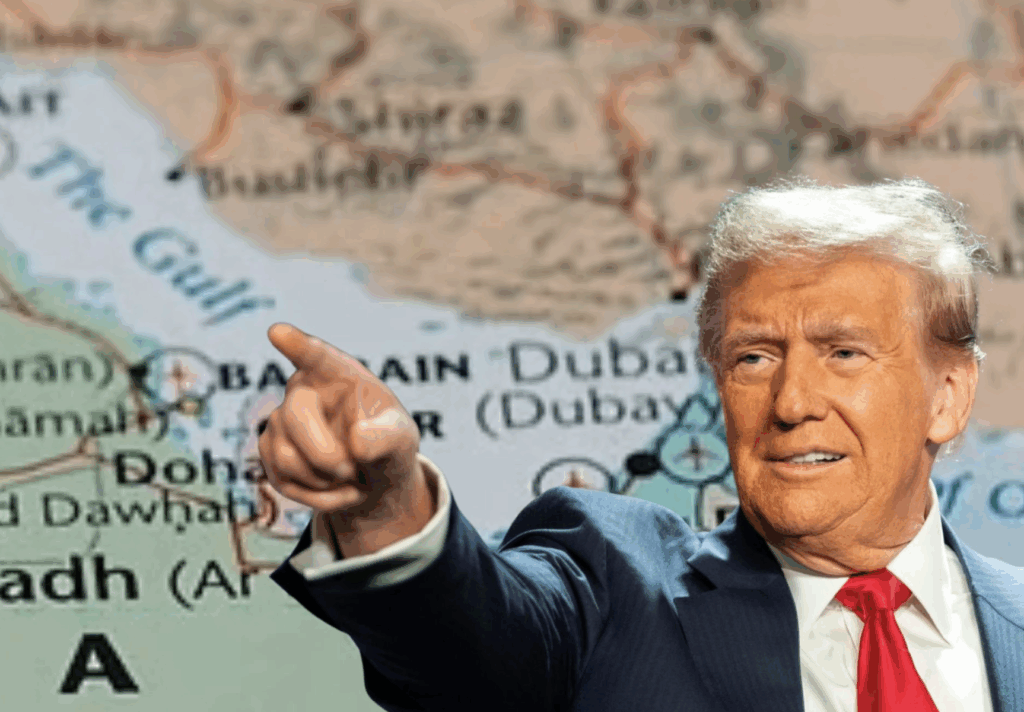
During his May 2025 trip to the Middle East, Trump weighed a symbolic but potent gesture: announcing that the US would henceforth refer to the Persian Gulf as the Arabian Gulf. This would have aligned with the naming conventions of America’s Gulf Arab allies, such as Saudi Arabia, the UAE, and Bahrain, who have for decades referred to the waterway as Al-Khalīj al-ʿArabī. The gesture, while semantically superficial for most Americans, would have carried outsized weight in Arab capitals. It would have signaled alignment with Arab narratives of regional primacy and further isolated Iran at a moment of strategic recalibration.
Iran, however, was quick to object. Tehran considers the term “Persian Gulf” not merely a geographical label but a symbol of national identity and civilizational pride. Iranian officials have gone so far as to call alternative names “illegitimate and void,” and have launched international protests over perceived slights, as in the infamous 2010 cancellation of the Islamic Solidarity Games. By signaling willingness to side with Arab nomenclature, Trump put Iran on the defensive, creating precisely the sort of diplomatic dilemma he could later exploit.
Today I introduced the Persian Gulf Act to stop Donald Trump's ridiculous political stunts and attempts to change this historic name. pic.twitter.com/h23fhtFUUz
— Congresswoman Yassamin Ansari (@RepYassAnsari) May 14, 2025
And exploit it he did. When Iranian officials, including a key figure from the Supreme Leader’s inner circle, threatened to walk away from nuclear negotiations over the naming issue, Trump agreed to drop the renaming proposal. But not without cost to Tehran. In exchange, Iran made a public and unprecedented concession: it would forgo its stockpile of highly enriched uranium. This statement, made by a senior Iranian official, was the clearest signal yet that Iran was prepared to reach a deal with the Trump administration. Trump had taken a symbolic gesture of virtually no cost to the US and leveraged it into a concrete step toward nuclear de-escalation. That is textbook realpolitik.
Critics will claim this episode demonstrates the transactional superficiality of Trump’s diplomacy. But such criticism misses the mark. What matters in foreign policy is not how ornate the gesture, but how effective the outcome. The Persian Gulf renaming proposal served as a deliberate feint. Trump used it to measure Iran’s red lines, provoke a reaction, and then retreat in exchange for substantive gain. It was not a misstep, but a masterstroke.
This brings us to the broader historical context, which undermines the notion that the name “Persian Gulf” is some immutable truth carved into the stone tablets of history. The body of water in question has worn many names across civilizations. The earliest known term, from the Sumerians, was A-ab-ba, or “Great Water.” Assyrians called it the “Bitter Sea.” The Achaemenid Empire referred to it as the Pars Sea. Arab geographers in the 10th to 14th centuries CE used terms like Khalij Fars and Bahr Fars. That is, the name has evolved, shifted, and adapted depending on who wielded power.
If anything, the insistence on “Persian Gulf” as the only legitimate name is a relatively modern phenomenon, hardened in part by Iran’s need to assert its geopolitical stature against rising Arab nationalism. Ironically, even post-revolutionary Iran toyed with abandoning the Persian nomenclature. Following the 1979 Islamic Revolution, Iranian officials floated the term “Islamic Gulf” as a neutral alternative that could signal pan-Islamic unity and diminish nationalist associations. In 1987, the proposal resurfaced, with then-Foreign Minister Ali Akbar Velayati suggesting the “Islamic Gulf” as a conciliatory gesture amid the brutal war with Iraq. Even Ayatollah Khomeini, when asked about the dispute, said, “You could call it the Islamic Gulf.”
The Arab preference for “Arabian Gulf” is equally entrenched, though from the opposite direction. Since the 1960s and the rise of Nasserism, the Arab world has made “Arabian Gulf” a marker of resistance to Persian hegemony. The six monarchies of the Gulf Cooperation Council consistently use it. Textbooks, state media, and even museum exhibits in these nations reflect the term’s normalization. Iraq too, especially during Saddam Hussein’s reign, embraced “Arabian Gulf” as a propaganda tool to galvanize Arab solidarity against Iran during the 1980–1988 war. In 2023, Iraq hosted the “Arabian Gulf Cup,” reigniting tensions and underscoring that the name remains a live wire in Middle Eastern geopolitics.
For Arab states, the nomenclature is no trivial matter. It represents a claim to regional authorship and cultural ownership. When maps say “Persian Gulf,” they see an endorsement of Iranian historical primacy. When “Arabian Gulf” is used, they see validation of their modern political reality. Trump, ever the negotiator, understood this perfectly. By simply entertaining a change in terminology, he positioned himself as a friend to the Arab world. Then, by reversing course in response to Iranian objections, he gained diplomatic currency that could be spent on nuclear de-escalation.
The symbolism also reflects the larger pattern of Trump’s foreign policy approach. He speaks the language of transactionalism not because he is naïve, but because he understands that foreign leaders respond more predictably to deals than to sermons. Unlike the Obama administration’s often ponderous moralizing, Trump’s diplomacy deals in pressure, leverage, and conditionality. The naming episode is a microcosm of this philosophy. It was never about semantics. It was about creating a chip that could be traded.
Moreover, the incident offers a lesson in the power of controlled controversy. In the modern media environment, especially amid global elites who over-index on symbology, the creation of a naming scandal was almost guaranteed to provoke hysterical headlines and sharp diplomatic responses. This was precisely the point. Trump didn’t bungle the issue, he stage-managed it. Then, when the moment was ripe, he sacrificed the trivial in exchange for the strategic.
Indeed, it is telling that the final outcome of this drama was not a new name on American maps but a new chapter in US-Iran relations. Tehran, boxed in by its own nationalist bluster, was forced to make a choice: walk away from negotiations over a name, or accept a symbolic victory and yield real ground on uranium. They chose the latter. And Trump, having spent nothing, gained much.
If our foreign policy establishment had an ounce of such flexibility and creativity, perhaps the last several decades of Middle East entanglements might look different. But then again, that is why Trump, not Foggy Bottom, brokered this understanding.
If you enjoy my work, please consider subscribing: https://x.com/amuse.
Sponsored by the John Milton Freedom Foundation, a nonprofit dedicated to helping independent journalists overcome formidable challenges in today’s media landscape and bring crucial stories to you.
READ NEXT: Rising Overseas Tensions Prompt Swift Allied Military Moves












GREAT DIPLOMACISE