


“If he approves, he shall sign it.”
These words, found in Article I, Section 7 of the Constitution, frame the president’s role in the legislative process with elegant precision. The Founders assumed the phrase needed no interpretation. A bill passes Congress, it arrives at the president’s desk, and if he approves, he signs it. That act of signature is the hinge upon which the legislative process swings from deliberation to law.
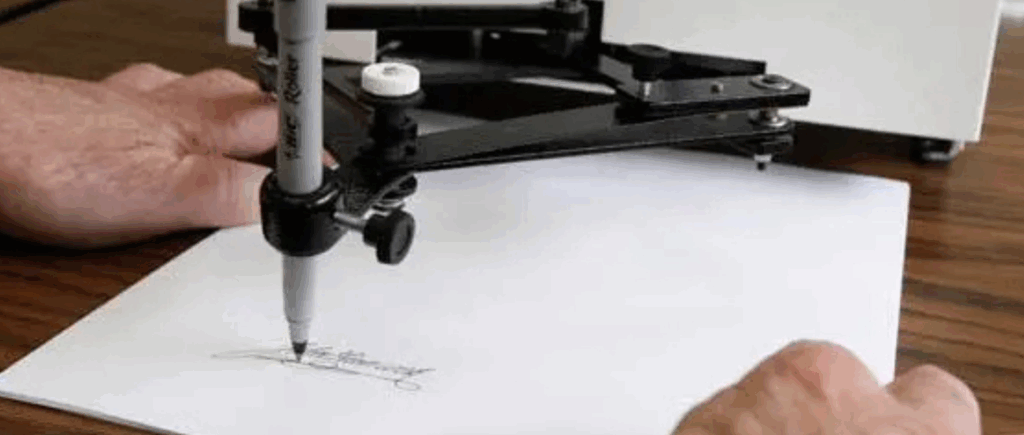
Yet during President Biden’s rein, this clarity has been obscured by a machine. The autopen, a mechanical device that replicates a person’s signature, has emerged from bureaucratic obscurity to constitutional controversy. It is no longer a mere curiosity. It is now central to a troubling question: Did Joe Biden, in the final years of his presidency, remain capable of approving what was signed in his name?
The evidence suggests he did not. By late 2023, Biden’s cognitive decline was no longer a matter of partisan conjecture but a fact witnessed even by sympathetic drive-by media outlets. During key public appearances, he was completely disoriented, struggled to answer simple questions, and relied heavily on aides. This alone might not render a president incapable. But when paired with a startling increase in the use of the autopen, it begins to raise a deeper constitutional concern. Who, exactly, was exercising the powers of the presidency?
According to congressional investigations, including findings from the Congressional Oversight Project, nearly every executive order and legislative signature in Biden’s final year was executed not by the man himself but by a machine. The implications are staggering. Staffers, whose names the public never voted for, authorized the use of this device to enact laws and grant pardons. Representative James Comer, who chairs the House Oversight Committee, has identified several of these staffers. They are now subject to subpoenas and depositions. But one question remains unanswered: Who decided what would be signed?
That question is not rhetorical. The Constitution does not vest executive power in a group or a machine. It vests it in a president. The autopen is not inherently unconstitutional, but its legitimacy hinges entirely on a prior act of presidential will. If Biden directed its use for a particular bill, knowing its contents and approving its passage, the constitutional bar may be met. But if he did not, if he was unaware or incapable, then no such delegation can be presumed. The act becomes not one of presidential approval, but of bureaucratic substitution.
Some will object: Isn’t this much ado about nothing? The autopen was used under George W. Bush and Barack Obama. Indeed, the Office of Legal Counsel opined in 2005 that its use was valid, provided the president authorized it. But here is where Biden’s case sharply diverges. Bush used it only in emergencies, and even then sparingly. He returned to Washington to sign major bills personally. By contrast, Biden’s autopen was deployed while he vacationed, while he campaigned, while he rested, and, as evidence increasingly suggests, while he was incapacitated.
Consider the most damning example: In May 2024, Biden was in San Francisco. During his visit, the autopen signed an FAA funding extension. The White House acknowledged the signature but failed to produce any documentation proving Biden had read the bill or authorized the autopen that day. What was his state of mind? Was he briefed? Could he comprehend the legislation at all? These questions are not peripheral. They are the very heart of constitutional legitimacy.
Moreover, the pattern reveals more than isolated oversight. Biden’s personal signature became increasingly rare throughout 2024. In fact, the last known instance of his actual signature appears to have been his letter of withdrawal from the 2024 presidential race. It is a bitter irony that the clearest proof of his direct authorship was the moment he finally conceded he could no longer serve. That should have been a turning point. Instead, the autopen took over. Executive orders continued. Pardons were granted. Laws were signed. But the man constitutionally required to approve them was not, in any meaningful sense, present.
One might defend this mechanization of the presidency as a modern necessity. Delegation is the lifeblood of any complex institution. But delegation requires judgment. It presupposes the capacity to authorize. When a machine becomes the stand-in for a president whose mental faculties are declining, we are no longer discussing delegation. We are discussing a substitution.
Imagine a judge who, after losing the ability to reason, leaves a mechanical device to render verdicts in her name. No one would defend this as justice. Nor should we accept such automation in the Oval Office. A president’s signature is not just a flourish of ink. It is a constitutional act, the apex of a deliberative process, a final assurance that the executive has personally reviewed and approved the law.
To say otherwise is to risk transforming our republic into a machine-run bureaucracy, where the real power lies not with elected leaders but with the unnamed and unelected staffers who decide when to deploy the autopen.
This is not hypothetical. The Oversight Committee’s investigation reveals that many executive actions over the past year were never discussed with Biden, never authorized in real time, and perhaps never even known to him. Pardons involving close political allies and family members were reportedly processed through the autopen while Biden struggled to form coherent sentences in public appearances. Some staffers, when questioned, could not definitively state that the president had even seen the documents they ordered signed.

President Trump, now serving his second term, has sharply criticized this practice. In recent remarks, he noted that “no one knows who was really calling the shots” during Biden’s final year. Trump has called for full transparency and accountability. His administration has pledged to review every autopen-signed document from the prior presidency for legitimacy. Critics may call this political theater. But it is, in fact, a necessary restoration of executive integrity.
The stakes are immense. The Constitution does not permit a vacancy in the executive disguised as continuity. If the President was unable to act, then the 25th Amendment should have been triggered. The refusal to do so is not just political cowardice. It is a constitutional breach. Biden’s inner circle may have hoped to preserve the appearance of stability. But appearances are not governance. And government by appearance is, by definition, fraud.
A broader philosophical concern also emerges. If the autopen becomes a normalized tool of governance, detached from real-time presidential approval, then the meaning of “executive power” collapses. If “signing” can be delegated to a device, detached from intent, then why not “commanding” the military? Why not “negotiating” treaties? Why not voting itself? Each erosion of responsibility, each step away from personal accountability, dissolves the very logic of constitutional rule.
This is not a question of left versus right. It is a question of whether we still believe in the constitutional framework our republic is built upon. A president must be present, in mind and in will. A machine cannot fulfill the oath of office. Nor can staffers acting without direction.
What must be done? Congress must complete its investigation. Those who deployed the autopen without clear presidential approval must testify under oath. Every executive order, every pardon, every law signed by the autopen must be reviewed. If Biden did not personally approve them, they are invalid. And if the public was misled, accountability must follow.
The Founders could not have foreseen an autopen. But they did foresee the need for active, accountable leadership. They gave us tools to respond: oversight, impeachment, and, in cases of incapacity, the 25th Amendment. We failed to use them. We must not fail to learn from that mistake.
If you enjoy my work, please consider subscribing: https://x.com/amuse.
Sponsored by the John Milton Freedom Foundation, a nonprofit dedicated to helping independent journalists overcome formidable challenges in today’s media landscape and bring crucial stories to you.
READ NEXT: Biden’s Exit: The Cancer Cover-Up Was Always The Plan

















WE also want to know just WHO INH was running this country
That was so dangerous
The DIMS’s corruption knows no debts or bounds
I believe that forgery, even if by a machine, would be considered fraud depending on the circumstances. It reeks of fakery, much like cut and paste or AI fakes. Its use should be VERY LIMITED and ONLY by presidential approval.
Communist China’s President Xi worked the auo-pen when Obama was busy elsewhere.
Congress should declare all autopen signatures in the past two years to be null and void.
What we got from Biden was four years of Weekend at Bernie’s and a government run by a committee of lefties.