

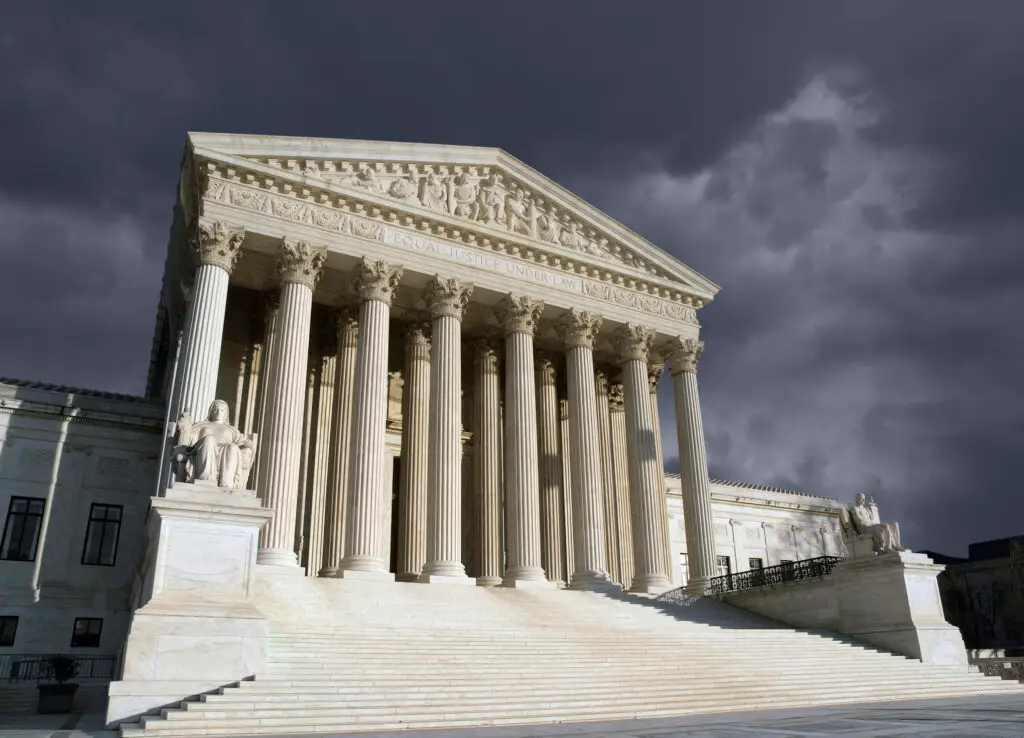
Both are being thoroughly abused by the left. The Supreme Court is currently hearing arguments by the Trump team against the right of children of illegal aliens born in the United States to gain automatic “birthright” citizenship under the 14th Amendment.
It is also hearing their arguments against the authority of individual federal judges to universally block presidential policies nationwide rather than apply them just to the people and organizations that sued.
Both of these issues are being thoroughly abused. The first is a magnet for illegal immigration that encourages pregnant women to cross the border illegally just to give birth and remain in the U.S., an act that has been called “birth tourism” or having an “anchor baby,” because the baby is then used to allow the parents to remain in the U.S.
The second, a judicial power, is being abused by Democrats and opponents of President Donald Trump by “judge shopping” across jurisdictions to get a friendly federal judge to then block presidential policies across the entire countries well outside his/her domain.
It’s time to put an end to them both as one causes harm to the very idea of citizenship and the other improperly undermines the power of the constitutionally elected president by allowing single individual judges anywhere in the country to block and obstruct his policies everywhere.
Referring to birthright citizenship for children of illegals, Trump said: “We have to end it. It’s ridiculous.”
Birthright citizenship did not become part of the Constitution until 1868, when the 14th Amendment was passed in the wake of the Civil War in order to settle the question of the citizenship of freed, American-born former slaves.
Previous Supreme Court cases, like Dred Scott v. Sandford in 1857, had determined that African Americans could never be U.S. citizens. The 14th Amendment, focused on this specific issue of freed slaves, overrode that.
The Citizenship Clause in that amendment states: “All persons born or naturalized in the United States, and subject to the jurisdiction thereof, are citizens of the United States and of the State wherein they reside.”
In 1898, the Supreme Court took that earlier ruling further when it decided that birthright citizenship applies to the children of immigrants in the case of U.S. v. Wong Kim Ark.
Wong was a 24-year-old child of legal Chinese immigrants who was born in the U.S. but denied reentry when he returned from a visit to China. Wong successfully argued that because he was born in the U.S., his parents’ immigration status did not affect the application of the 14th Amendment.
However, in his dissent, Chief Justice Melville Fuller wrote at the time that Wong could not be a citizen because his parents, though here legally, still owed their allegiance to the Chinese emperor and could not be fully “subject to the jurisdiction” of the United States as required by the 14th Amendment.
Justice John Marshall Harlan joined the dissent.
Still, this case did not really address whether having parents with no immigration status, (i.e.; being here illegally) should also confer automatic citizenship to the American-born child.
Trump’s team argues that ‘children born in the United States of illegal aliens or temporary visitors’ are not “subject to the jurisdiction thereof” and therefore cannot be considered birthright citizens.
And the Trump administration’s arguments rest on that same language in that clause, arguing that this language excludes children of noncitizens who are in the U.S. unlawfully. This is also the basis of Trump executive order barring birthright citizenship for children born in the U.S. to someone in the country illegally.
Meanwhile, a number of U.S. allies in Europe agree with Trump as they also do not offer birthright citizenship. Among the 32 countries in NATO, the U.S. and Canada are the only two that have unrestricted birthright citizenship.
Other common law-based countries, like the U.K. and Australia, allow for a modified version where citizenship is automatically granted if one parent is a citizen or permanent resident. And I agree with them.
As to universal injunctions, they must end as well.
That is why the citizenship case now before the justices is also a referendum on the use of nationwide injunctions that have frustrated many of Trump’s efforts to shrink the size of the government, halt federal spending and end DEI.
But it’s not just Trump. Presidents from both parties, members of Congress and several Supreme Court justices have raised concerns about the power of a single judge to temporarily block a president’s agenda nationwide.
In one recent case where the judge blocked Trump’s citizenship order, she justified her decision by saying that one of the groups that sued has more than 680,000 members.
“Because ASAP’s members reside in every state and hundreds of them expect to give birth soon, a nationwide injunction is the only way ‘to provide complete relief’ to them,” she wrote. “It also is necessary because the policy concerns citizenship—a national concern that demands a uniform policy.”
However, in New Hampshire, the U.S. district judge took a more correct, measured, and restrictive approach and blocked the Trump citizenship order only in the state.
Before reaching the Supreme Court, a three-judge panel in the 4th U.S. Circuit Court of Appeals split 2-1 to deny the administration’s emergency appeal, focused on nationwide, or universal, injunctions.
In sole dissent, Judge Paul Niemeyer wrote that the administration “only seeks to stay the effort by the district court to impose its injunction nationwide to afford relief to persons beyond the District of Maryland.”
The legality of the Trump order was not before the court, Niemeyer wrote. “Rather, it is whether the court was entitled, in the circumstances of this case, to extend its injunction to apply ‘throughout these United States’ — to persons not before the court nor identified by the court. I would grant the government’s modest motion, which seeks only to cabin the order’s inappropriate reach,” he wrote.
And that is what the Trump administration has asked the justices to do — to scale back nationwide injunctions to apply only to the pregnant women, immigrant advocacy groups, or states that challenged the ban.
Let’s pray the Supreme Court rules correctly and ends birthright citizenship for children of illegals and universal injunction, so that Trump can keep the campaign promises he was elected by the American people to fulfill.
The opinions expressed in this article are those of the author and do not necessarily reflect the positions of American Liberty News.
READ NEXT: Did Comey’s Instagram Post Cross The Line? Secret Service Responds


















Absolutely time to end both since both were legislated from the bench!!!
Children born to foreign diplomats serving in the US are not US citizens at birth. Native American children born in the US after the 14th Amendment was in place were not US citizens at birth. The Indian Citizenship Act of 1924 granted citizenship at birth to Native Americans over fifty years later. If the 14th Amendment, as presently interpreted, gave birthright citizenship to all those born in the US, why did the US Congress find it necessary to pass The Indian Citizenship Act of 1924? It is obvious the words “and subject to the jurisdiction thereof” have an ignored and overlooked meaning.
What part of ILLEGAL do I not understand??????????????????????????????????????????????????????????????